
Last April, a homeowner in Ooltewah discovered two inches of standing water in their finished basement after a standard three hour rainfall. They had a drain installed back in 2018, but the pipes lacked any way to clear out the inevitable silt and debris. It’s exhausting to watch the weather radar with a sense of dread. You shouldn’t have to worry about foundation cracks or the high cost of re-excavating a buried pipe that stopped working because it couldn’t be maintained. Most homeowners believe a drain is a permanent fix, but without a way to service it, even the best systems can fail under the pressure of Chattanooga’s heavy red clay.
Investing in a professional basement french drain system with cleanout wash out ensures that your home stays dry for the long haul. You’ll learn how these specialized access ports protect your foundation from hydrostatic pressure and prevent the nightmare of long-term sediment failure. We’ll break down the mechanics of the cleanout design and explain why this maintenance-friendly approach is the only way to secure your property value against the unique soil conditions found in East Brainerd, Apison, and the surrounding areas.
Key Takeaways
- Understand how heavy Tennessee Valley rainfall creates hydrostatic pressure that forces groundwater through your basement floor and walls.
- Learn why a high-performance basement french drain system with cleanout wash out is essential for maintaining long-term drainage efficiency and preventing sediment failure.
- Discover the critical role of non-woven geotextile fabric in filtering out Chattanooga’s dense clay soil before it can clog your drainage pipes.
- Identify the professional installation standards for Ooltewah homes, from precision floor cutting to achieving the perfect trench pitch for gravity-fed flow.
Understanding Hydrostatic Pressure in Chattanooga Basements
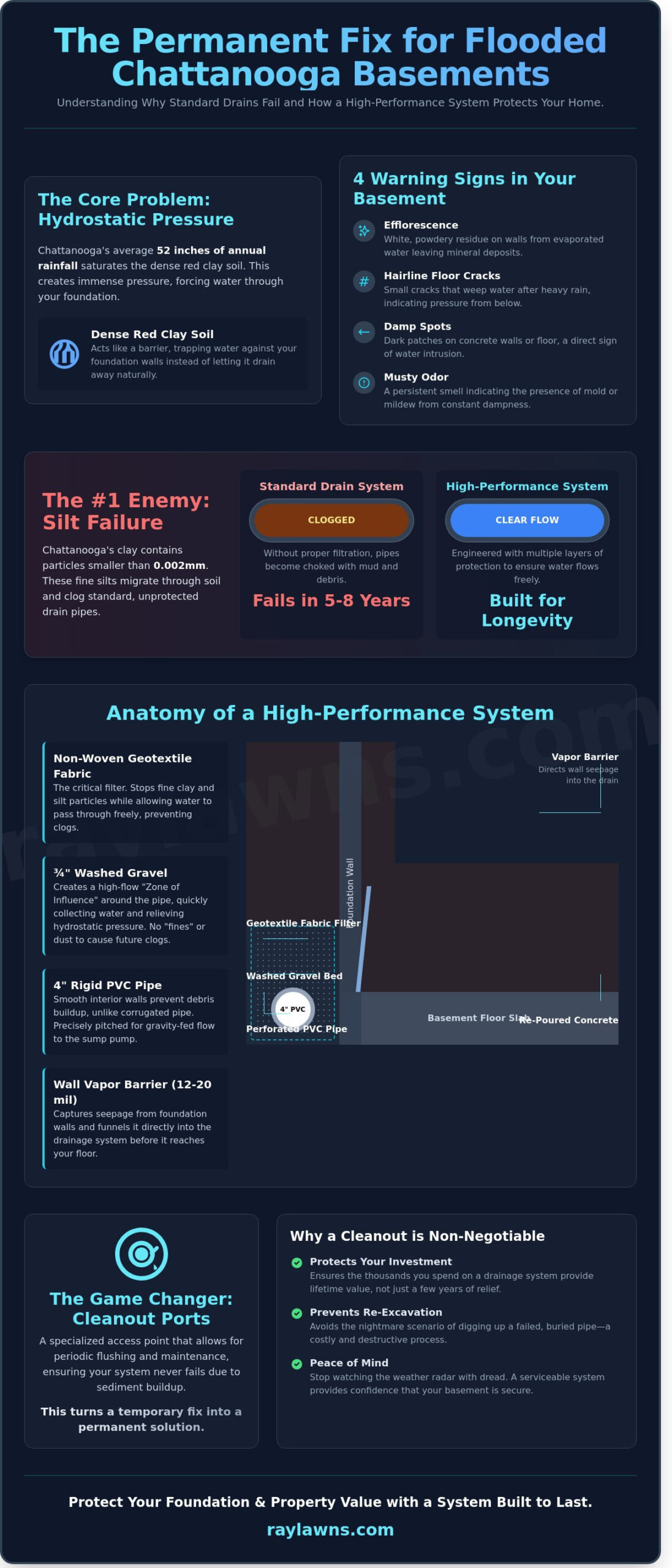
Hydrostatic pressure is the primary force behind basement flooding in Ooltewah. When the Tennessee Valley receives its average 52 inches of annual rainfall, the soil surrounding your foundation becomes saturated. This standing water creates immense pressure. It forces groundwater through microscopic pores in concrete and the cove joint where the wall meets the floor. A standard French drain is designed to alleviate this, but local conditions require a more robust approach to handle the volume.
In Hamilton County, the soil isn’t just dirt; it’s dense, expansive red clay. This clay acts as a barrier that prevents water from draining away naturally. Instead, it traps moisture against your basement walls. You’ll notice signs of sub-slab accumulation such as:
- White, powdery residue known as efflorescence on the walls.
- Damp spots appearing on the concrete slab after a heavy storm.
- Small hairline cracks in the floor that weep water.
- A consistent musty odor that persists despite using dehumidifiers.
The Impact of Hamilton County Soil on Drainage
The red clay in Chattanooga contains particles smaller than 0.002 millimeters. These tiny particles easily migrate into standard drainage pipes. Without a proper filter and a basement french drain system with cleanout wash out, most systems will clog within 5 to 8 years. Ooltewah’s hilly terrain worsens this. Homes built on slopes face increased pressure on the uphill foundation walls, where water pools and searches for any path of least resistance into your living space.
Interior vs. Exterior French Drains
For established homes in East Brainerd or Collegedale, an interior system is often the most practical solution. Exterior drains require massive excavation that can destroy landscaping and decks. An interior basement french drain system with cleanout wash out captures water exactly where it enters the home. It intercepts the water before it ever reaches the middle of your basement floor. While exterior systems are great during new construction, interior systems offer better longevity in our humid climate because they aren’t subject to the same root intrusion or soil shifting that occurs outside.
Anatomy of a High-Performance Basement French Drain System
A high-performance basement french drain system with cleanout wash out is an engineered solution designed to manage the heavy groundwater common in Ooltewah. It isn’t just a pipe in a hole. It’s a multi-layered defense. The system starts with a perforated pipe, surrounded by clean aggregate and wrapped in a filtration layer. In the Chattanooga area, our heavy red clay is the biggest enemy of drainage. This is why we use non-woven geotextile fabric. Unlike woven fabrics that clog like a plastic sheet, non-woven fabric allows water to pass while stopping fine clay particles. This ensures the system remains clear for decades. A high-capacity sump pump basin serves as the collection point, often handling 3,000 gallons of water per hour during peak rainfall. Integrating these components with a strategic plan from an experienced French drain company ensures the water actually reaches the discharge point instead of sitting stagnant under your floor.
The Pipe and Stone Foundation
We prefer 4-inch PVC pipe for basement applications because its smooth interior walls prevent debris buildup. While some use flexible corrugated pipe, PVC is much easier to maintain when using a basement french drain system with cleanout wash out. The pipe sits in a bed of 3/4-inch washed stone. We never use “crusher run” or stone with “fines,” as the dust will eventually settle and choke the pipe. This stone creates the “Zone of Influence.” This is the area around the pipe where hydrostatic pressure is neutralized. A 12-inch wide trench provides a much larger relief zone than a narrow 6-inch cut, allowing the system to pull water from further beneath the slab.
The Role of the Vapor Barrier
Water doesn’t just come from under the floor; it often seeps through the foundation walls. We install 12-mil or 20-mil wall-mounted vapor barriers that tuck directly into the drain system. This setup directs wall seepage down into the aggregate and pipe before it ever touches your basement floor or framing. Addressing Moisture in basements: causes and solutions requires this vertical protection to prevent humidity spikes and mold growth. By sealing the system at the floor-wall joint, we also help maintain indoor air quality by reducing the entry of soil gases. If your walls feel damp after a storm, it’s time to talk to a specialist about a professional drainage upgrade.
Why a Cleanout Washout is Essential for Long-Term Success
A cleanout is a vertical access pipe that connects directly to your underground drainage line. It acts as a gateway for inspection and maintenance. Without this port, your drainage system is a sealed box. Once sediment enters, it has nowhere to go. Installing a basement french drain system with cleanout wash out capability ensures you aren’t just burying a pipe and hoping for the best. It’s a proactive tool that protects your foundation for decades.
Tennessee clay is notorious for its fine particles. In areas like Ooltewah and Collegedale, this silt eventually works its way through filter fabric and gravel. This leads to “Silt-Lock,” a condition where heavy sediment settles at the bottom of the pipe. Over time, this buildup can reduce your system’s water capacity by 40% or more. A high-pressure washout forces this debris out of the pipe and into the sump pit or discharge area. This simple maintenance task prevents the entire system from becoming a solid, clogged mess. It is much more cost-effective to include these ports now than to excavate a failed system later.
For more technical details on component placement, this French drain installation guide offers a look at how professional-grade systems are structured. Many french drain companies skip this step to save on labor, but we view it as a non-negotiable part of a quality build.
Maintenance Access Points
We strategically place cleanouts at every 90-degree corner and along long stretches of pipe. Corners are high-friction areas where sediment is most likely to settle. If a blockage is suspected, these ports allow a technician to feed a waterproof camera into the line. This pinpoint accuracy saves you from unnecessary digging. In finished basements, we use recessed brass or plastic covers. These sit flush with your floor, staying out of sight until they are needed for service.
The Washout Process Explained
The washout process is a routine part of home ownership in Chattanooga. To perform a flush, the cap is removed and a high-pressure hose is inserted into the line. You run the water until the discharge coming into your sump basin is clear of mud and grit. Follow this step-by-step approach:
- Remove the threaded cleanout cap with a pipe wrench.
- Insert a garden hose or a specialized jetting nozzle.
- Flush the line for 10 to 15 minutes per section.
- Verify that the sump pump is discharging the water effectively.
For most homes in the Tennessee Valley, we recommend a washout every 2 to 3 years. Early warning signs that you need a flush include a musty basement smell or a sump pump that runs longer than usual after a storm. Taking 30 minutes to maintain your basement french drain system with cleanout wash out ports can prevent thousands of dollars in water damage.
The Professional Installation Process in Ooltewah and Chattanooga
The installation of a basement french drain system with cleanout wash out requires more than just a shovel and some pipe. It’s a surgical process that protects the structural integrity of your home. We start by marking the perimeter, usually 12 inches from the foundation wall. Precision floor cutting with industrial diamond blades ensures we don’t cause spiderweb cracks across your entire slab. We use HEPA-filtered vacuums to trap 99% of concrete dust at the source. This keeps your Ooltewah home clean while we perform the heavy work.
Trenching and Pit Preparation
Excavation goes deep enough to sit below the footer level, typically 10 to 12 inches into the soil. We maintain a strict pitch of 1/8 inch per foot. Gravity doesn’t take days off, so the slope must be perfect to move water toward the sump pit. In the heavy red clay soils of Chattanooga, we often reinforce the trench walls. This prevents soil from slumping before the pipe is set. We then install the sump basin in a bed of clean 57 stone to prevent shifting over time.
Pipe Placement and Cleanout Integration
We wrap the perforated pipe in a heavy-duty filter fabric to prevent fine silt from clogging the holes. The cleanout risers are the most critical part of this stage. We install these vertical ports at key corners. They allow for a basement french drain system with cleanout wash out if sediment ever builds up years down the road. Before any concrete is poured, we run a flow test. We dump 5 gallons of water at the furthest point to confirm it reaches the sump basin in under 60 seconds.
Restoring the Basement Floor
The exterior discharge needs to be handled carefully so it doesn’t wash out your yard or flood your neighbor’s property. We often coordinate this with landscaping Chattanooga experts to ensure the water exits through a pop-up emitter or a dry well. Back inside, we use 4,000 PSI high-strength concrete to patch the floor. We trowel it to a smooth finish that sits flush with the existing slab. You won’t even feel the seam under your new carpet or vinyl plank flooring. Once the concrete cures, we commission the pump and test the check valves for quiet operation.
If you’re ready to dry out your home for good, request a professional drainage evaluation from our team today.
Choosing a Local Drainage Expert for Your Hamilton County Home
Managing water in Ooltewah requires more than just a shovel and a bag of gravel. The Tennessee Valley features heavy red clay that traps moisture and exerts over 1,200 pounds of pressure per square foot against foundation walls. A contractor from outside the area might apply a generic solution that fails during our 51-inch annual rainfall cycle. You need a specialist who understands local topography and soil density. A professional site evaluation must include a laser level survey to confirm the 2% minimum slope required for effective gravity flow. Without this precision, water sits stagnant in the pipes, leading to premature system failure.
Your property functions as a single ecosystem. Fixing a basement leak often requires looking at the entire yard. Integrating your interior protection with professional Chattanooga lawn care ensures that surface runoff doesn’t overwhelm your sub-surface pipes. We look for the root cause, whether it is a grading issue in the backyard or a gutter downspout dumping 600 gallons of water directly against your foundation during a standard afternoon storm.
Questions to Ask Your Contractor
Don’t hire a crew based on a verbal estimate alone. Ask specific questions about their technical process. Start with: “How do you handle clay filtration in your French drain designs?” Standard perforated pipes often clog within 48 months if they aren’t protected by non-woven geotextile fabric. Follow up by asking: “Where will the water be discharged once it leaves the basement?” It should never dump within 10 feet of the foundation. Finally, confirm the maintenance plan. “Do you include cleanouts as a standard feature?” A high-quality basement french drain system with cleanout wash out ports allows you to flush the line every 12 months to prevent silt and sediment buildup.
The Ray Lawns Approach to Drainage
We’ve spent over 20 years solving Ooltewah’s unique drainage challenges. Our philosophy centers on over-engineering every project for permanent results. While local codes might allow for thinner materials, we prefer 4-inch Schedule 40 PVC because it resists the crushing weight of shifting Tennessee clay better than flexible corrugated pipe. We take pride in a meticulous jobsite. Our crews remove 100% of excess soil and debris daily, ensuring your property looks better when we leave than when we arrived. We don’t just patch a leak; we install a basement french drain system with cleanout wash out capability that protects your home’s structural integrity for the next 30 years.
Secure Your Foundation Against Tennessee Groundwater
Tennessee Valley clay holds water like a heavy sponge. This creates thousands of pounds of pressure against your basement walls every time a storm rolls through Ooltewah. You can’t stop the rain, but you can control where it goes. A high-performance basement french drain system with cleanout wash out ensures that silt and sediment don’t clog your pipes over the next 20 years. We’ve been solving these specific drainage challenges in Hamilton County since 2002. Our team focuses on meticulous cleanup and protecting your home’s structural integrity throughout the entire installation process.
Don’t let a wet basement turn into a costly foundation failure. A proactive approach saves your property and your peace of mind. Our family-owned crew understands the local terrain and the unique demands of Chattanooga soil. We’ll make sure your home stays dry and your yard looks better than when we arrived. It’s time to stop worrying about the forecast and start enjoying a dry, stable home. Reach out today to get a clear, professional plan for your property.
Request a Professional Drainage Evaluation from Ray Lawns
Your home deserves a drainage solution that’s built to last a lifetime.
Frequently Asked Questions
What is the difference between a French drain and a cleanout washout?
A French drain is the perforated pipe buried in a gravel bed that collects groundwater, while a cleanout washout is a vertical access pipe used for maintenance. You need the cleanout to clear out silt and sediment that naturally builds up in Ooltewah’s heavy clay soil. Without a basement french drain system with cleanout wash out, you’d have to tear up your concrete floor if the line ever became restricted by debris.
How often should I flush my basement French drain system?
You should flush your system every 12 to 24 months to ensure peak performance. In areas like East Brainerd where the soil has high iron ochre content, yearly flushing prevents orange sludge from hardening inside the pipe. Use a standard garden hose to run water through the cleanout ports for 10 minutes or until the discharge at the sump pump runs clear.
Will a basement French drain help with mold and mildew smells?
Yes, an interior drain system reduces mold and mildew by eliminating the standing water and seepage that fuels fungal growth. Most homeowners see a 30 percent drop in basement humidity levels within 48 hours of installation. By keeping the floor-to-wall joint dry, you stop the damp conditions that allow mold spores to colonize on organic materials like drywall and wood studs.
Can I install a basement French drain myself or do I need a pro?
You should hire a professional because basement drainage involves structural risks and specialized heavy equipment. Digging a trench requires jackhammering through 4 inches of reinforced concrete and hauling away 2 to 3 tons of debris by hand. A mistake in the pitch of the pipe or a nick in the footer can cause 10,000 dollars in structural damage or lead to a total system failure.
How much does a basement French drain with cleanouts cost in Chattanooga?
A professional basement drainage installation in the Chattanooga area typically costs between 80 and 160 dollars per linear foot. For a standard 1,000 square foot basement, homeowners often invest 8,000 to 14,000 dollars for a complete perimeter system. These prices vary based on the thickness of your concrete slab and the number of sump pumps required to move the water effectively.
Does a French drain discharge water into the sewer or the yard?
A French drain must discharge into your yard, a dedicated drainage ditch, or a dry well. It’s illegal in Hamilton County to connect a sump pump or French drain to the sanitary sewer system. Most professional installers run the discharge pipe 15 to 20 feet away from the foundation to ensure the water doesn’t cycle back into the basement through the soil.
Will installing an interior drain affect my home’s foundation?
Installing an interior drain won’t hurt your foundation; it actually extends its lifespan by relieving hydrostatic pressure. When groundwater builds up against your walls, it exerts 500 pounds of pressure per square foot. The drain gives that water an escape route, which prevents the basement walls from bowing or cracking over the next 20 years.
Can I finish my basement over a French drain system?
You can absolutely finish your basement after the drain is installed. Just make sure the contractor installs a dimpled plastic vapor barrier that extends from the floor up the wall behind the studs. When you frame your walls, leave 12 inch access panels over the cleanout locations so you can still maintain the system without cutting into your new drywall later.
get a quote today!
"*" indicates required fields

We take lawn care so seriously that we consider it an art. Our basic service is lawn maintenance, which includes lawn mowing, trimming, edging, and blowing off clippings.

Our landscaping services include most types of yard work. We are excellent at trimming hedges, installing mulch, and creating flowerbeds.

This is our rescue effort for yards that have become entirely overgrown. Includes multiple passes with the lawn mower to tame even the most unruly yards.