
Buying a bag of grass seed labeled “shade-tolerant” is often the fastest way to waste $150 on a lawn that won’t survive a single Chattanooga July. If you’ve spent the last 3 seasons watching your fescue thin out and turn into a muddy slope in East Brainerd, you aren’t alone. It’s a frustrating cycle that many homeowners in the Tennessee Valley face when their backyard canopy blocks the sun. You deserve a yard that stays green without the constant reseeding and erosion issues that plague our local red clay soil.
Finding the best sod for Tennessee shade requires moving past generic marketing and looking at specific cultivars tested for our unique humidity. In this guide, you’ll discover which turf varieties actually thrive under a heavy canopy and how to prep your ground for long-term success. We will examine the maintenance trade-offs between Zoysia and Fescue so you can finally stop the mud from washing onto your patio every time it rains in Ooltewah or Apison.
Key Takeaways
- Learn how the “Four Hour Rule” determines your lawn’s success in the unique Transition Zone climate of the Tennessee Valley.
- Understand why Tall Fescue remains a dependable choice for shady yards due to its deep root system and cool-season resilience.
- Discover why Zeon Zoysia is considered the best sod for Tennessee shade for homeowners seeking a premium, warm-season alternative.
- Identify why professional soil preparation and site grading are essential for preventing sod rot in Chattanooga’s heavy clay soil.
- Use a professional decision matrix to choose the right grass cultivar based on your specific maintenance budget and sunlight levels.
The Tennessee Shade Challenge: Why Most Lawns Fail in Chattanooga
Hamilton County sits directly in the “Transition Zone,” a geographic strip where the climate is too hot for cool-season grasses and often too cold for certain warm-season varieties. This makes selecting the best sod for Tennessee shade a complex task for any homeowner. In Chattanooga, we deal with extreme temperature swings that put immense stress on turf. If your lawn isn’t getting the right balance of light and drainage, it won’t survive a single season.
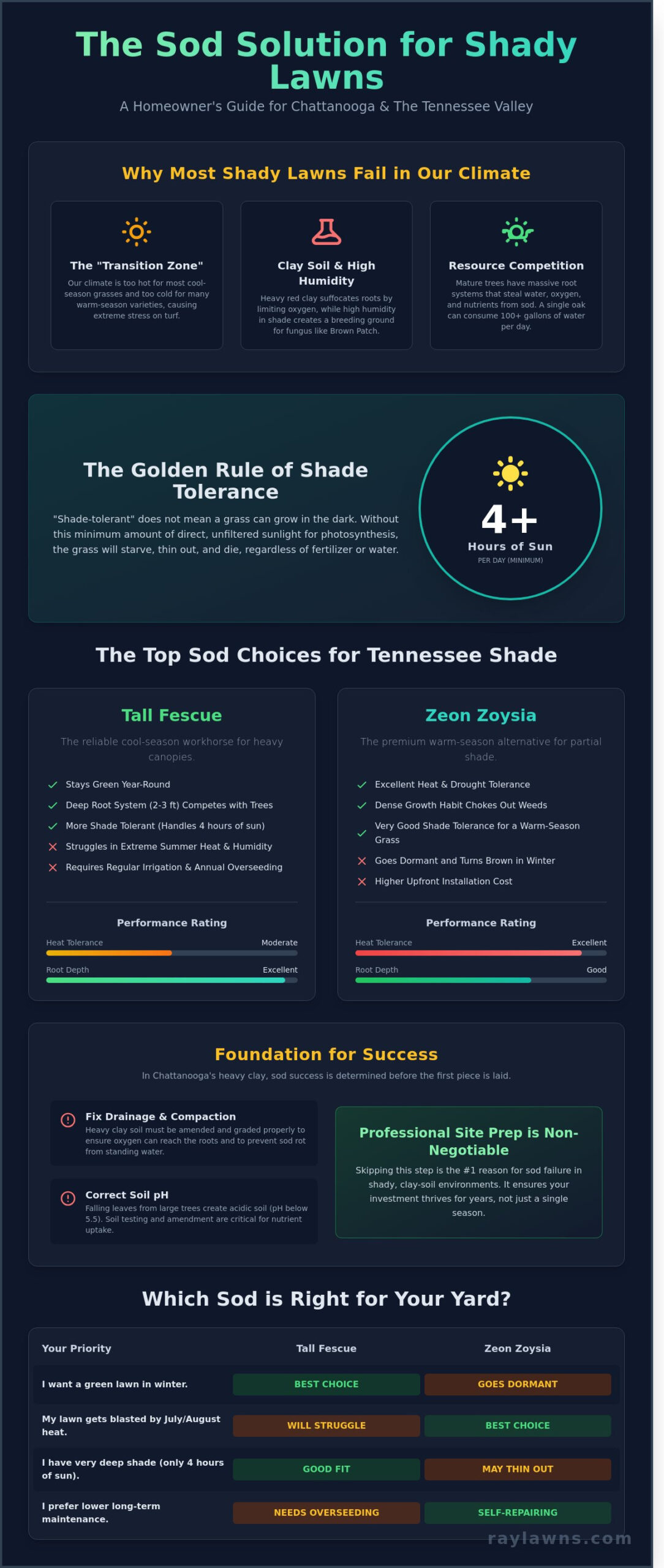
The “Four Hour Rule” is the baseline for success. Many homeowners assume that “shade-tolerant” means a grass can grow in the dark. It can’t. Every species of sod requires at least 4 hours of direct, unfiltered sunlight to perform photosynthesis. Without this energy, the grass plant starves, thins out, and eventually dies. If your backyard in Ooltewah is covered by a dense canopy that blocks the sun from 8:00 AM to 5:00 PM, no amount of fertilizer will save the lawn.
The Tennessee Valley humidity creates a secondary crisis. Shady areas often have poor airflow, meaning dew stays on the grass blades for 10 to 12 hours at a time. This constant moisture is a breeding ground for Rhizoctonia, or Brown Patch fungus. Combined with Chattanooga’s heavy red clay soil, you get a “suffocation” effect. Clay lacks the necessary pore space for oxygen. Under a tree, the tree’s massive root system and your new sod installations in Chattanooga compete for that limited oxygen and water. Most of the time, the tree wins.
The Problem with “Standard” Grass Blends
Generic “shade mix” seeds found at big-box stores are usually Fescue blends grown in cooler climates like Oregon. They look lush in April, but they can’t handle a 95-degree July day in East Brainerd. It’s a common mistake to think grass “loves” shade; it only tolerates it. You can tell your lawn is suffering from light deprivation if the blades become narrow and pale or if the turf pulls up easily in clumps, indicating a shallow, weak root system.
Micro-Climates in Ooltewah and East Brainerd
Large hardwoods like White Oaks and Maples dominate many local properties. A single mature Oak can pull 100 gallons of water from the soil every day, leaving your sod parched even after a heavy rain. These trees also drop organic matter that can push soil pH levels below 5.5, which is far too acidic for healthy turf. We find that “dappled light,” where sun filters through a high, thinned-out canopy, is the gold standard for shady lawn success. Afternoon shade is generally more beneficial than morning shade because it protects the grass from the intense 3:00 PM heat spikes common in the Tennessee Valley.
Tall Fescue: The Traditional Cool-Season Choice for Shady Yards
Tall Fescue remains the most reliable option for homeowners dealing with heavy tree canopies. In the wooded lots of Ooltewah and East Brainerd, it’s widely considered the best sod for Tennessee shade. While warm-season grasses like Bermuda require at least six hours of direct sunlight to thrive, fescue can often survive on four. Its ability to stay green during the winter provides an aesthetic edge that most southern lawns lack.
The secret to its resilience lies underground. Fescue develops a deep root system that can reach depths of 2 to 3 feet in well-prepared soil. This is a critical advantage when competing with the aggressive, shallow roots of established oaks and maples. These trees often suck the top layer of soil dry. Fescue’s ability to tap into deeper moisture reserves helps it survive the late-summer stretches that kill off weaker varieties. It’s a durable choice that stands up to the reality of a Tennessee backyard.
Quality matters when selecting your turf. You should always look for a certified Turf-Type Tall Fescue (TTTF) blend. Avoid “contractor grade” bags or Kentucky 31. These cheaper options often contain weed seeds or coarse, forage-style grasses that look like pasture. A high-quality TTTF blend offers a finer leaf texture and better resistance to the fungal pressures common in our region. Investing in a premium blend prevents the frustration of a patchy, uneven lawn three months after installation.
Pros and Cons of Fescue in the Tennessee Valley
The biggest draw for Chattanooga residents is the year-round color. Your lawn will stay a deep, rich green while your neighbors’ lawns turn brown in November. It’s an immediate boost to curb appeal during the dreary winter months. However, the trade-off is heat sensitivity. When the humidity spikes in Ringgold and Apison during July and August, fescue struggles. It’s a cool-season grass living in a transition zone. Without a dedicated irrigation plan, you can lose 25 percent of your stand during a single drought. Maintenance is also non-negotiable. Because fescue is a bunch-forming grass, it doesn’t spread or “heal” itself. You must commit to professional aeration and overseeding every September to fill in thin spots and keep the lawn dense.
Best Practices for Fescue Success
- Mowing Height: Keep your mower deck high. We recommend a height of 3.5 to 4 inches. Taller grass blades create more shade for the soil, which keeps root temperatures lower and prevents weed seeds from germinating.
- Watering Schedule: Never water in the evening. Moisture sitting on the grass overnight is an invitation for brown patch fungus. Set your timers for 5:00 AM to ensure the blades dry quickly once the sun rises.
- Soil Health: Our local clay soil compacts easily. Annual core aeration is the only way to ensure oxygen and nutrients reach the root zone.
Maintaining a lush, shady lawn requires a consistent schedule and a bit of local expertise. If you need help managing these seasonal tasks, you can learn more about our specialized Chattanooga lawn care programs to keep your best sod for Tennessee shade thriving year-round.
Zoysia Grass: The Premium Warm-Season Alternative for Partial Shade
Many homeowners believe Fescue is the only option for yards with trees and shadows. That is a common misconception. While Fescue handles deep shade better, certain Zoysia cultivars are often the best sod for Tennessee shade when your property receives at least 4 hours of dappled sunlight. In the heavy clay soils of Apison and Collegedale, Fescue often struggles with root rot during wet springs and heat stress in August. Zoysia handles these transitions with much more resilience.
The “Carpet Effect” is Zoysia’s greatest advantage. It creates a thick, woven mat of stolons and rhizomes that acts as a natural barrier. This density prevents weed encroachment in areas where other grasses usually thin out. You won’t see the typical bare patches under a high-canopy oak tree that you see with Fescue. Zoysia is a “buy once, cry once” investment. It requires about 1 inch of water per week, which is 30% less than what a thirsty Fescue lawn demands during a Chattanooga summer. You also save on chemicals. Zoysia only needs 2 to 3 pounds of nitrogen per 1,000 square feet annually, whereas Fescue requires constant feeding to stay green.
Zeon vs. Emerald Zoysia: What Works Best Here?
Zeon Zoysia is the gold standard for Hamilton County yards. It thrives on just 4 to 5 hours of direct sunlight and maintains a lush, barefoot-soft texture. Emerald Zoysia is another beautiful, fine-bladed option, but it presents a challenge with our local recovery times. If a late frost hits in April, Emerald takes weeks longer to green up than Zeon.
- Zeon Zoysia: High shade tolerance, fast recovery from winter, and excellent traffic durability.
- Emerald Zoysia: Dense and beautiful, but slower to grow and more susceptible to thatch buildup.
The cost-benefit analysis favors Zoysia over the long term. A Zeon installation costs roughly 20% to 30% more upfront than Fescue. However, you recoup that money within three years. You eliminate the $500 to $800 annual cost of professional aeration and overseeding that Fescue requires to stay thick.
Winter Dormancy and Aesthetics
Homeowners must prepare for the “Brown Phase.” From early November through mid-April, Zoysia goes dormant. It will look like a golden-tan rug while Fescue yards stay green. This is a trade-off for summer durability. Zoysia is much more resilient against “solar-powered” weeds that pop up in early March. Because the root system is so tight, those early weeds cannot find a place to germinate.
This dormancy period also protects your soil. The thick dormant grass prevents erosion during our heavy Tennessee winter rains. For homeowners who want to transform a muddy, shaded backyard into a clean outdoor living space, sod installations Chattanooga provide the instant results needed to reclaim your property. You get a weed-resistant, drought-tolerant lawn that actually thrives in the heat of the Tennessee Valley.
Preparation is Everything: Solving Soil and Drainage Issues
Laying the best sod for Tennessee shade on unprepared Chattanooga clay is a recipe for failure. Most local yards in areas like Ooltewah and Apison contain a 40% clay content. This soil acts like a brick when dry and a sponge when wet. If you don’t break this surface, new roots can’t penetrate. We often see homeowners struggle because heavy construction equipment compacted their soil to a density of 1.8 grams per cubic centimeter. That’s essentially concrete. Mature oak and pine trees exacerbate the problem. They suck out moisture and leave behind acidic litter. You need a soil test before you spend a dime on sod. Pine needles can drop pH levels below 5.0, which stunts growth before the grass even takes hold. We aim for a pH between 6.0 and 7.0 to ensure nutrient uptake.
Managing Moisture in the Shade
Shady zones stay wet 3 times longer than sunny spots. This standing water creates a breeding ground for Pythium blight and root rot. If your backyard in Collegedale has boggy patches, you might need a French drain company to redirect subsurface flow. We also use landscaping Chattanooga techniques like selective canopy thinning. This increases airflow by 25%, allowing the ground to breathe and preventing fungal outbreaks.
The Ray Lawns Professional Prep Process
We start by tilling the top 6 inches of soil to incorporate organic amendments. This breaks the clay bond and allows for deep rooting. Grading is the next critical step. We ensure a 2% slope away from the house to prevent the “bowl effect” where water pools in shady corners. Our team applies a high-phosphorus starter fertilizer to encourage immediate root development. This gives the best sod for Tennessee shade the foundation it needs to survive the first winter.
A professional installation depends on these invisible steps. Skipping the prep work means your new lawn will likely fail within 12 months. We focus on the soil chemistry and the physical structure of the ground to ensure your investment lasts for years. Proper tilling and grading transform a difficult, shaded lot into a sustainable green space. Get a professional sod installation quote to start your project the right way.
Choosing Your Best Sod: Making the Final Call for Your Yard
Selecting the best sod for Tennessee shade requires a balance between your backyard’s reality and your personal goals. We look at three main factors: daily sun hours, your maintenance budget, and how you plan to use the space. A yard in Ooltewah with heavy oak cover needs a different approach than a cleared lot in Collegedale. If your site receives less than four hours of filtered light, even the hardiest grass will struggle. In those cases, we often recommend alternative landscaping services like shade-tolerant ground covers or privacy tree installations to define the space without the frustration of thinning turf.
Professional installation beats DIY every time because of the prep work. We don’t just lay grass on top of hard Chattanooga clay. Our team focuses on grading, soil aeration, and removing air pockets that kill new roots. This meticulous process ensures your investment actually takes hold. You get a lawn that looks established in weeks, not months. We’ve seen 40% of DIY projects fail within the first year because of poor soil contact. Our professional approach eliminates that risk.
Final Cultivar Recommendations
- Best for deep shade: Turf-Type Tall Fescue blends are the standard for areas with 4 to 6 hours of sun. They stay green through the winter but require annual overseeding every September to maintain density.
- Best for partial shade and luxury feel: Zeon Zoysia offers a carpet-like texture and high shade tolerance. It’s a premium choice for homeowners who want a barefoot-soft yard with minimal mowing requirements.
- Best for high-traffic shady areas: TifGrand Bermuda is the most shade-tolerant Bermuda variety available. It handles dogs and foot traffic better than Fescue while surviving in 60% less light than standard Bermuda varieties.
Next Steps for a Lush Lawn
Make 2026 the year you stop fighting your yard and start enjoying it. Our family-owned team understands the specific challenges of Hamilton County soil and weather patterns. We don’t use corporate scripts or generic solutions. We provide a straightforward evaluation of your property to determine which variety fits your lifestyle. Whether you’re dealing with erosion on a slope or bare spots under a maple tree, we have the experience to fix it right the first time. Contact us today to request a free quote for professional sod installation and get a precise plan for your property.
Start Your Lawn Transformation Today
Choosing the right grass for a tree-lined yard in Ooltewah doesn’t have to be a guessing game. Success starts with fixing the heavy clay soil and ensuring your yard drains properly before the first pallet arrives. Whether you choose the year-round green of Tall Fescue or the premium durability of Zoysia, selecting the best sod for Tennessee shade requires a plan tailored to our local climate. Since 2002, our family-owned team has helped homeowners across East Brainerd and Collegedale overcome these specific regional challenges. We focus on the meticulous prep work that prevents common failures in our dense red clay. You deserve a lawn that adds value to your home and provides a beautiful space for your family to enjoy. Our experts are ready to evaluate your property, manage your slopes, and solve your drainage issues for good. We take pride in delivering results that look professional and last for years.
Get a Free Quote for Professional Sod Installation in Ooltewah and Chattanooga
Your dream lawn is closer than you think.
Frequently Asked Questions
How many hours of sun does shade-tolerant sod really need in Tennessee?
Most shade-tolerant varieties require at least 4 hours of direct sunlight or 8 hours of filtered light to survive. In the Chattanooga area, sunlight intensity varies, but grass cannot grow in total darkness. If your yard gets less than 4 hours of sun, even the best sod for Tennessee shade will eventually thin out and die. We recommend measuring sun exposure at 3 different times during the day before choosing your turf.
Is Zoysia better than Fescue for shady yards in Chattanooga?
Tall Fescue is generally better for heavy shade because it handles 4 hours of light more reliably than Zoysia. While Zeon Zoysia is the most shade-tolerant warm-season grass, it still needs 5 hours of sun to maintain its density. In our local clay soils, Fescue stays green during the winter, whereas Zoysia goes dormant and turns brown for 5 months of the year starting in October.
Can I lay sod over existing dead grass in a shady area?
No, you should never lay new sod over existing dead grass or debris. This creates a physical barrier that prevents the new roots from reaching the soil, leading to sod failure within 14 days. We always remove old turf and till the top 3 inches of soil to ensure proper contact. This professional preparation allows nutrients and water to reach the root system immediately after installation.
When is the best time of year to install shade-tolerant sod in Ooltewah?
The ideal time to install shade-tolerant Fescue in Ooltewah is between September 15 and November 15. This window allows the roots to establish in cooler temperatures before the summer heat hits. If you choose a warm-season grass like Zoysia, wait until May or June when soil temperatures consistently stay above 65 degrees. Proper timing ensures the grass has 6 months to root before facing extreme weather.
Why does my grass always die under my large oak trees?
Grass under oak trees fails because of two main factors: lack of light and root competition for water. Large oaks can consume over 50 gallons of water daily, leaving little for the grass. Additionally, a dense oak canopy blocks 90 percent of usable sunlight. This prevents the photosynthesis needed for the turf to recover from foot traffic or the high humidity we experience in East Tennessee summers.
How much does professional sod installation cost for a shady backyard?
Professional installation in the Chattanooga region typically ranges from $1.50 to $2.50 per square foot depending on site preparation needs. This price includes removing old debris, grading the soil for drainage, and laying the fresh turf. For a standard 2,000 square foot backyard, homeowners should expect a total investment between $3,000 and $5,000. This ensures the job is done with professional equipment and high-quality local sod.
Does shade-tolerant sod require a special type of fertilizer?
Shade-tolerant sod needs a lower nitrogen fertilizer compared to grass in full sun. Grass in the shade grows slower, so applying too much nitrogen creates weak, leggy blades that are prone to fungal diseases. Use a slow-release formula with a 10-10-10 or 16-4-8 ratio to provide steady nutrients. This provides the necessary minerals without forcing excessive growth that the limited sunlight cannot support.
Can I mix different types of sod in the same yard?
You can mix types, but it is rarely recommended because of the visible difference in color and texture. Mixing Fescue in the shade with Bermuda in the sun creates a patchy look during the transition seasons. Instead, we suggest using the best sod for Tennessee shade across the entire area or creating defined landscape beds with mulch under the heaviest tree cover to maintain a clean aesthetic.
get a quote today!
"*" indicates required fields

We take lawn care so seriously that we consider it an art. Our basic service is lawn maintenance, which includes lawn mowing, trimming, edging, and blowing off clippings.

Our landscaping services include most types of yard work. We are excellent at trimming hedges, installing mulch, and creating flowerbeds.

This is our rescue effort for yards that have become entirely overgrown. Includes multiple passes with the lawn mower to tame even the most unruly yards.