
Last April, a family in Ooltewah watched as their row of “instant privacy” trees turned a brittle shade of bronze just 14 months after planting. They had searched for privacy trees near me and purchased the first fast-growing species they found, but they soon realized the heavy Tennessee clay had turned their planting holes into underground buckets of water. It’s a common story in the Chattanooga area. Our 51 inches of annual rainfall often leads to root rot and tree death if the drainage isn’t handled with professional precision. You need a dense, green screen that thrives for decades, not a temporary fix that dies before it reaches maturity.
We agree that your home should be a private sanctuary, protected from road noise and neighboring views. This guide will help you get there. You’ll discover the best privacy tree species for our local soil and learn the professional installation techniques that ensure a lifelong living fence. We are going to walk through the correct ways to amend heavy clay, how to space trees for long-term health, and the specific varieties that withstand the unique climate of East Tennessee.
Key Takeaways
- Identify the best evergreen species for Ooltewah’s dense clay soil to ensure your living fence remains vibrant and deer-resistant year-round.
- Avoid the most common mistake of overcrowding by learning how to calculate proper spacing and future canopy spread for long-term health.
- Discover why professional site preparation and the “wide and shallow” planting rule are critical for tree survival in the Chattanooga climate.
- Search for the best privacy trees near me with confidence by understanding which species thrive in Tennessee humidity and which to avoid.
- Learn how a properly installed living screen provides superior noise reduction and property value compared to standard wood or vinyl fencing.
The Growing Need for Privacy Trees in Ooltewah and Chattanooga
Residential growth in Hamilton County has surged, with Ooltewah and Collegedale seeing a 12 percent increase in new housing permits over the last three years. This density results in smaller lot sizes where backyards often sit just 20 feet from a neighbor’s window. Homeowners searching for privacy trees near me are usually looking for a permanent, natural solution to this lack of seclusion. In our experience, a well-planned living screen does more than just block a view; it reclaims your outdoor living space.
A dense hedge or living screen provides a functional barrier that often outperforms hardscape materials. Unlike wood or vinyl, thick evergreen foliage absorbs sound waves rather than reflecting them. This is vital for homes near the I-75 corridor or busy local roads like Lee Highway where traffic noise is constant. Trees also serve as critical windbreaks and dust filters, catching the fine red clay particles kicked up by ongoing construction in new subdivisions across the Tennessee Valley.
Our regional climate falls within USDA Zones 7b and 8a. This means we deal with hot, humid summers and occasional hard freezes. Successful chattanooga privacy tree installation requires selecting species that can handle our heavy clay soil and fluctuating rainfall patterns. Planting the wrong species in Ooltewah’s compact soil often leads to root rot or stunted growth, making professional selection essential for a long-term screen.
Privacy Trees vs. Traditional Fencing
Wood fences typically have a 15 year lifespan before rot and Tennessee humidity take their toll. A healthy evergreen screen can thrive for 40 years or more with minimal maintenance. Most HOAs in Hamilton County restrict fence heights to six feet, which does little to block a neighbor’s second-story view. Trees aren’t bound by these strict height limits. Beyond the physical barrier, the psychological benefits of “green views” are proven to reduce stress in suburban environments while significantly increasing curb appeal.
The Chattanooga Challenge: Slopes and Sightlines
Topography is a major factor in the Chattanooga area. Many lots in neighborhoods like White Oak Mountain are sloped, meaning a neighbor uphill can look directly down onto your patio or pool. We plan for mature height based on whether your home sits on a ridge or a valley floor to ensure total coverage. Sightline optimization is the strategic placement of specific tree heights and widths to block direct views from neighboring windows or elevated decks.
Selecting Evergreen Species for Tennessee’s Dense Clay Soil
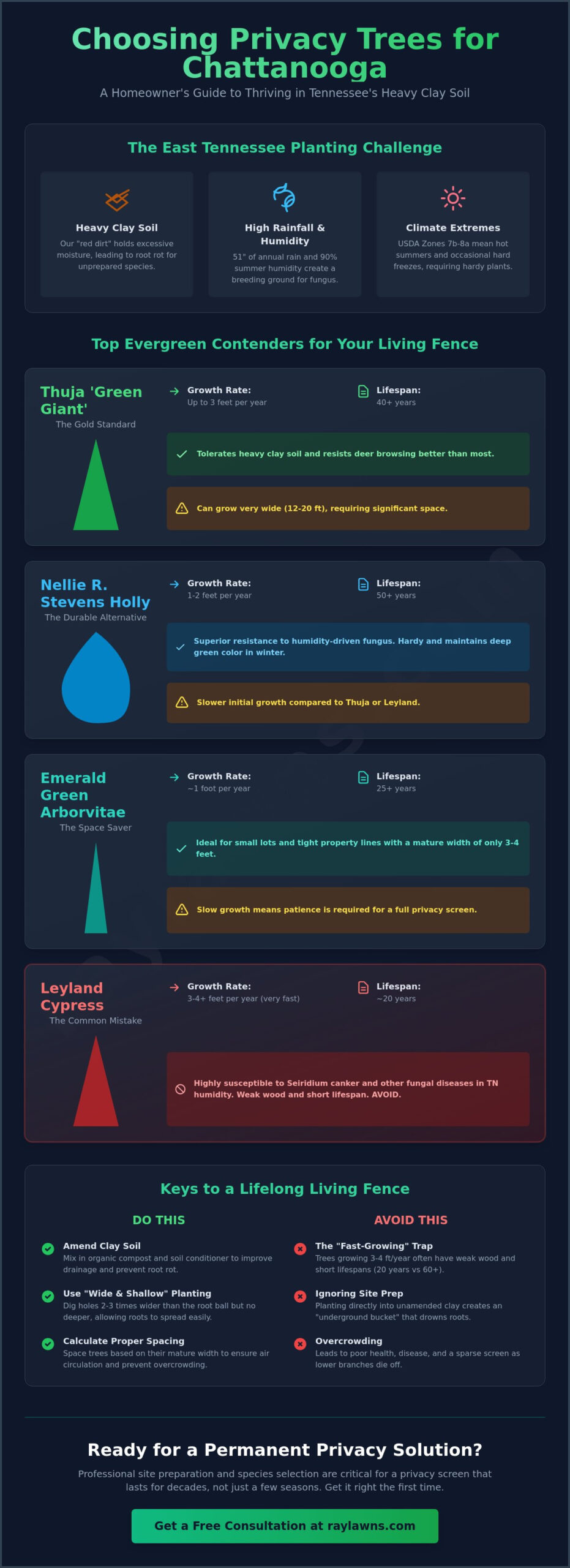
Planting in Ooltewah or East Brainerd requires a clear understanding of our local “red dirt.” This heavy clay holds moisture and can suffocate roots if you choose the wrong species. When searching for privacy trees near me, the Thuja Green Giant is often the first recommendation. It’s the gold standard for the Chattanooga area because it tolerates clay soil and resists deer browsing better than most. You can expect up to 3 feet of vertical growth annually once the root system settles after the first year.
Leyland Cypress is another common choice, but it comes with risks. While they provide a quick screen, they often struggle with the 90 percent humidity of a Tennessee summer. This moisture leads to Seiridium canker, a fungus that can destroy a 15 foot tree in a single season. If you want a similar look with much higher durability, the Nellie R. Stevens Holly is a superior alternative. It’s a hardy broadleaf that produces vibrant red berries and maintains a deep green color even during a harsh January freeze.
For homeowners with smaller lots or tight property lines, the Emerald Green Arborvitae is the practical solution. These trees stay narrow, typically reaching only 4 feet in width. They won’t encroach on your neighbor’s driveway or take over your entire backyard, making them ideal for modern subdivisions where space is at a premium.
The “Fast-Growing” Trap: What to Expect
Many homeowners prioritize speed above all else. However, trees that grow 3 to 4 feet per year often have weaker wood and shorter lifespans. A Leyland Cypress might only last 20 years, whereas a slightly slower-growing species could thrive for 60 years. Balancing immediate results with long-term health is vital. If you aren’t sure which variety fits your specific lot, consulting with tree planting services in Chattanooga ensures you choose a species that won’t require replacement in a decade.
Hardwood and Broadleaf Alternatives
Don’t feel limited to traditional conifers. The Southern Magnolia offers a classic, dense screen with the added benefit of large white flowers in early summer. For shaded corners where most evergreens become thin and leggy, Skip Laurels are the local workhorse. They thrive in partial sun and reach 10 feet quickly. If you want a unique aesthetic, the Cryptomeria, or Japanese Cedar, provides a feathery texture and excellent pest resistance. It rarely suffers from the bagworms that frequently plague other privacy trees near me.
Selecting the right species is only half the battle. Before you start digging, it’s wise to request a professional landscaping evaluation to check your soil drainage and ensure your new living screen has the best chance to thrive.
Privacy Tree Spacing and Growth: Planning for the Long Haul
The biggest mistake homeowners make is planting for “instant” privacy. It’s tempting to jam trees together to block the neighbor’s deck by next month. This backfires every time. When you search for privacy trees near me and start digging holes too close together, you’re suffocating your investment. Trees need sunlight to reach the trunk. If they’re crowded, the lower branches will brown, thin out, and eventually die. You’ll end up with a “lollipop” effect: plenty of green at the top but zero privacy at eye level where you actually need it.
You must plan for the drip line. This is the area directly under the outer circumference of the tree canopy. A mature Thuja Green Giant can spread 12 to 15 feet wide. If you plant it three feet from a fence or directly under a power line, you’re creating a future maintenance nightmare. In Ooltewah, we see many homeowners forced to top their trees because they didn’t account for vertical growth. This ruins the tree’s health and looks terrible. To calculate how many trees you need for an Ooltewah property line, take your total linear footage and divide it by the recommended spacing for your specific species. For a 100-foot line using Green Giants at 6-foot spacing, you need 16 to 17 trees, not 50.
The Staggered Double-Row Technique
If you want maximum density without sacrificing tree health, use a staggered zigzag pattern. Instead of one straight line, plant two parallel rows. Space the rows about 4 to 6 feet apart and offset the trees so they fill the gaps of the opposite row. This layout provides an immediate visual screen while allowing vital airflow between the branches. Good airflow is essential in the humid Chattanooga climate to prevent fungal diseases. After 5 years, a staggered row looks like a solid wall. By year 10, it’s a structural fortress. If you need help with a professional layout, our team offers expert landscaping in Chattanooga to ensure your screen is built to last.
Spacing Requirements by Species
Every species has a “sweet spot” for spacing. Following these guidelines ensures your privacy trees near me grow into a healthy, cohesive screen rather than a tangled mess. Wider spacing actually leads to a faster-closing screen over time because the trees aren’t competing for limited nutrients and water.
- Green Giants: 5 to 8 feet apart. These are fast growers and need room to breathe.
- Leyland Cypresses: 6 to 10 feet apart. Their wide base requires significant clearance.
- Emerald Greens: 3 to 4 feet apart. These stay narrow and are perfect for tighter Ooltewah lots.
Don’t take shortcuts by ignoring the mature width listed on the nursery tag. A tree that looks small in a 15-gallon pot today will eventually claim its full footprint. Respecting that footprint now saves you from removing dead, overcrowded trees five years down the road.
The Professional Installation Process: Beyond the Digging
Installing privacy trees near me in the Ooltewah area involves more than a shovel and a strong back. The heavy red clay found across Hamilton County acts like a brick when it’s dry and a sponge when it’s wet. Proper site preparation ensures your investment doesn’t fail within the first 24 months. We follow the “wide and shallow” rule for every installation. The hole must be at least two to three times the width of the root ball. This loosened soil allows new roots to push through the tough clay without exhausting their energy reserves. While the hole is wide, it should never be deeper than the root ball itself.
Soil amendment is a critical step in the Tennessee Valley. We never replace the local clay entirely. Instead, we mix the native soil with high-quality organic matter. This creates a necessary transition zone. If you fill a hole with only premium potting soil, the roots will refuse to leave that “comfort zone” to enter the surrounding clay, leading to a stunted tree. In areas with severe runoff or low spots, a standard hole isn’t enough. Many homeowners find that their new screen requires a French drain in Chattanooga to divert excess subsurface water away from the root systems and prevent total root rot.
Dealing with the Tennessee “Bathtub Effect”
The “bathtub effect” is the primary reason 75% of DIY tree projects fail in Ooltewah and Apison. When you dig a hole in heavy clay and fill it with loose soil, it acts as a basin. Water collects there and drowns the roots because it has nowhere to go. Professionals solve this by “planting high.” We keep the root flare roughly 2 inches above the surrounding grade. This allows the top of the root ball to breathe even during heavy spring rains. Piling mulch against the trunk in a “volcano” shape traps moisture against the bark and eventually kills the tree through rot and pest infestation.
Post-Planting Care: The First 12 Months
The first year is a critical window for survival. Chattanooga’s July and August heat frequently stays above 90 degrees for 15 or more consecutive days. New evergreens need consistent deep soaking rather than light daily sprays. If you live on a windy ridge or a steep slope, we use professional staking kits to prevent the wind from rocking the root ball loose. Proper maintenance also includes the surrounding area. Precision Chattanooga lawn care prevents weeds and grass from competing with your young trees for nutrients. When people search for privacy trees near me, they are looking for a long-term solution, which requires a meticulous start.
Transforming Your Property with Ray Lawns Privacy Screens
Choosing the right contractor is as vital as choosing the right species. Ray Lawns has served the Chattanooga area since 2002. This 22-year history means we’ve seen every type of Tennessee winter. We know which trees thrive in Ooltewah’s heavy clay and which ones fail when the temperature drops. When you search for privacy trees near me, you need a team that understands local soil biology and drainage patterns. We don’t just drop trees into holes. Our crew prepares the site through professional grading to protect your investment from root rot and wind throw. We focus on the long-term health of the screen so it provides value for decades.
A Comprehensive Landscape Solution
A living screen often functions best as part of a larger backyard retreat. We frequently integrate privacy tree installation with retaining walls or custom paver patios. This holistic approach ensures your property looks intentional rather than cluttered. Being a family-owned, no-nonsense contractor allows us to focus on the local terrain. We understand the steep slopes common in Apison and the drainage challenges in Collegedale. Our team provides the disciplined, manual work required to transform a neglected perimeter into a source of pride.
Next Steps for Your Privacy Project
Success starts with a thorough site evaluation. We visit your property to identify underground utility lines and assess how water moves across the land. Large trees require heavy equipment and precise logistics. We manage the entire process, from sourcing healthy specimens to the final mulch application. If your project involves significant ground disturbance, we can pair the planting with sod installation in Chattanooga to restore your lawn immediately. This prevents erosion and gives your new privacy trees near me a clean, professional backdrop. Reach out today to request a professional evaluation and a free quote for your Ooltewah or Apison home.
Take Control of Your Property’s Privacy
Building a natural screen requires more than just digging holes. It’s about matching the right evergreen species to the heavy clay soil found throughout Ooltewah and Chattanooga. When you prioritize professional spacing and correct drainage, you ensure your trees thrive for decades. Since 2002, our family-owned team has used professional-grade equipment to navigate the unique challenges of Tennessee landscapes. We focus on meticulous installation techniques that prevent root rot and promote rapid growth. If you’re searching for privacy trees near me to transform your property into a secluded retreat, don’t settle for a generic approach. A well-planned living wall increases your home’s curb appeal and provides the quiet atmosphere your family deserves. Take the guesswork out of landscaping by letting local experts handle the heavy lifting. We’ve spent over 20 years perfecting the art of the living screen in Hamilton County. Your property is a significant investment; it deserves a professional touch that stands the test of time.
Get a Professional Privacy Tree Evaluation from Ray Lawns
Your journey to a more private, beautiful backyard starts with a single phone call. We look forward to helping you reclaim your outdoor space.
Frequently Asked Questions
What is the fastest-growing privacy tree for the Chattanooga area?
The Thuja Green Giant is the fastest-growing option for our region, often adding 3 to 5 feet of height annually. These hardy evergreens thrive in the humid subtropical climate of East Tennessee and reach heights of 30 to 40 feet at maturity. When searching for privacy trees near me, homeowners consistently choose this variety because it resists local pests and handles our heavy ice storms better than the Leyland Cypress.
How far apart should I plant Thuja Green Giants for a privacy screen?
Plant Thuja Green Giants 5 to 6 feet apart for a dense, single-row privacy screen. If you have the space, a staggered double-row pattern with trees spaced 8 feet apart creates a thicker barrier and improves airflow. Proper spacing prevents the lower branches from thinning out due to a lack of sunlight as the trees reach their 12 foot width.
Will privacy trees grow in heavy Tennessee clay soil?
Privacy trees grow well in Tennessee clay if you avoid planting them too deep. Our local soil holds moisture, so we install root balls 2 inches above the soil line to prevent root rot. This high and dry method ensures the tree survives the 50 inches of annual rainfall we see in the Chattanooga area while still allowing roots to anchor in the heavy ground.
Can I plant privacy trees on a steep slope in Ooltewah?
You can successfully plant privacy trees on steep Ooltewah slopes to provide screening and stabilize the soil. We use a terracing technique or create a basin on the downhill side to catch water and prevent runoff. This ensures the 15 gallons of weekly water reaches the root system instead of sliding down the hill. This approach turns a difficult hillside into a functional green wall.
What is the best time of year to plant evergreens in Tennessee?
Late September through November is the ideal window for planting evergreens in Hamilton County. Planting in the fall allows roots to establish for 6 months before the July heat arrives. Early spring, specifically the month of March, serves as a secondary option, though these trees require more intensive monitoring during their first summer to ensure survival.
How do I stop my Leyland Cypress trees from turning brown?
Browning in Leyland Cypress is typically caused by fungal diseases like Seiridium canker, which often strikes when trees are stressed by drought. To stop the spread, prune dead branches 4 inches into healthy wood and sterilize your tools between every cut. Improving airflow by maintaining 8 foot spacing between trunks helps keep the foliage dry and fungus-free. Proper hydration is your best defense against these pathogens.
Do I need a permit to plant a line of privacy trees near my property line?
Most municipalities in the Chattanooga area don’t require a permit for planting trees, but you must call 811 to mark underground utilities first. Check your specific HOA bylaws in neighborhoods like Seven Lakes or Windstone, as some have 6 foot height restrictions for structures that might apply to living fences. It’s smart to keep plantings 3 feet inside your property line to avoid future disputes when the canopy expands.
How much water do new privacy trees need during a Tennessee summer?
New privacy trees require 10 to 15 gallons of water per week during a typical Tennessee summer. Instead of light daily sprinkling, use a soaker hose for 60 minutes twice a week to encourage deep root growth. This method ensures moisture reaches the bottom of the 18 inch root ball where it’s needed most during 90 degree heat waves. When you search for privacy trees near me, remember that the first two years of irrigation determine the long-term health of your screen.
get a quote today!
"*" indicates required fields

We take lawn care so seriously that we consider it an art. Our basic service is lawn maintenance, which includes lawn mowing, trimming, edging, and blowing off clippings.

Our landscaping services include most types of yard work. We are excellent at trimming hedges, installing mulch, and creating flowerbeds.

This is our rescue effort for yards that have become entirely overgrown. Includes multiple passes with the lawn mower to tame even the most unruly yards.