
Imagine walking out to your backyard in Ooltewah after a heavy spring rain, only to find a stagnant pond drowning your landscaping and attracting a swarm of mosquitoes. You aren’t alone. The dense red clay and steep ridges of the Tennessee Valley mean that learning how to fix pooling water in yard Chattanooga properties is a necessity for protecting your property value. It’s frustrating to watch your investment in sod rot away while your kids and pets track thick red mud across the clean kitchen floor.
We believe your lawn should be a source of pride, not a source of stress. This guide provides the professional methods we use to manage stormwater effectively, from precision grading to installing exterior French drains that typically range from $1,000 to $1,500 for a standard installation. You’ll discover how to identify the root cause of your drainage issues and implement a long-term solution that keeps your lawn dry and usable. We’ll preview the best ways to work with our local geography, including insights on the City’s RainSmart program and why standard DIY fixes often fail in our stubborn Appalachian soil.
Key Takeaways
- Learn how Chattanooga’s dense red clay prevents water absorption and why local drainage solutions must account for this stubborn soil.
- Discover how to fix pooling water in yard Chattanooga by accurately identifying the difference between surface runoff and high groundwater tables.
- Compare the effectiveness of surface grading and subsurface French drains to determine which professional solution fits your specific property layout.
- Understand the importance of precision trenching and topographic mapping to ensure a consistent slope that moves water away from your foundation permanently.
- See how integrating drainage with retaining walls and tree placement protects your landscaping investment from root rot and erosion.
Why Chattanooga Yards Struggle with Pooling Water
If you’re wondering how to fix pooling water in yard Chattanooga, you have to start by looking at what’s beneath your grass. Chattanooga isn’t just the Scenic City; it’s a region defined by some of the most stubborn soil in the country. In Hamilton County, we deal with a specific type of environment where the ground often works against you. Between the dense soil composition and the dramatic elevation changes of the Tennessee Valley, water rarely has a clear path to leave your property without professional intervention.
The “Red Clay” Problem
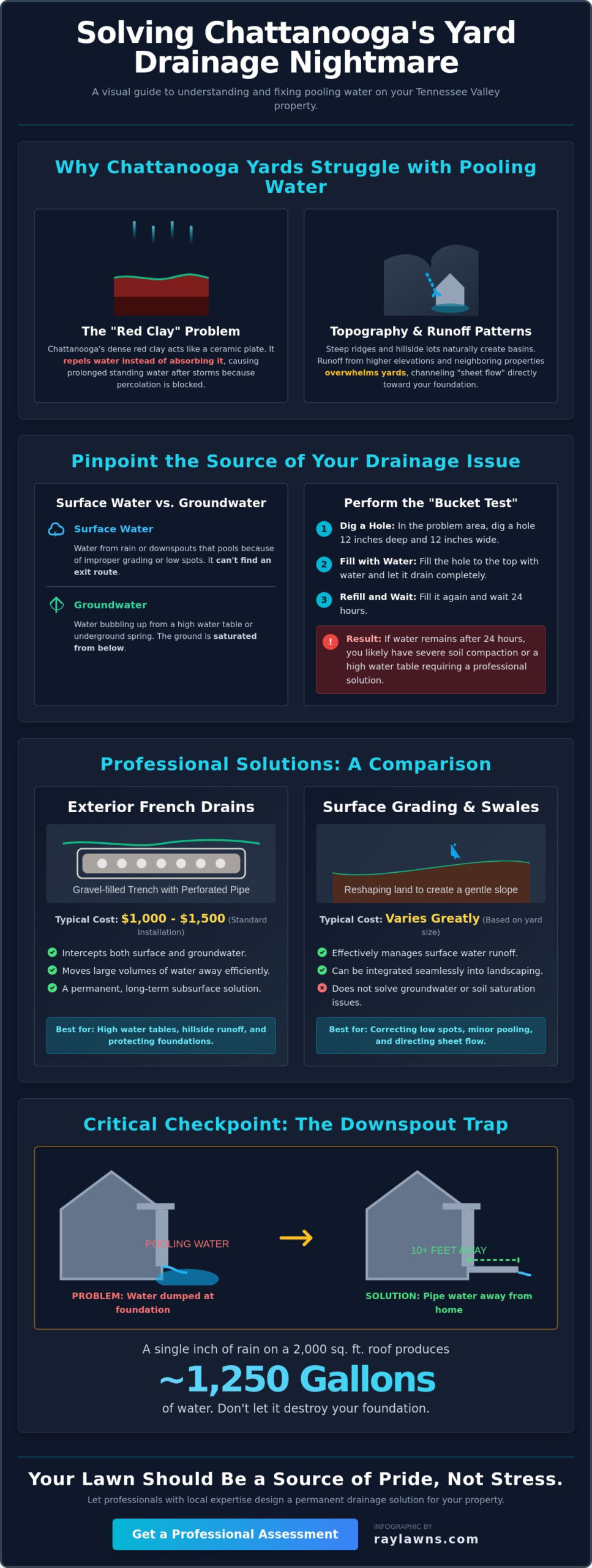
The primary hurdle for homeowners in Ooltewah and Apison is the local red clay. This soil is incredibly dense and lacks the pore space found in the sandy soils of West Tennessee. Think of our clay like a ceramic plate. It doesn’t absorb water; it repels it. When it rains, the clay particles expand and seal the surface, which completely stops the process of percolation. This is why you’ll see standing water in your yard for days after a storm. The water isn’t soaking in because it simply has nowhere to go. This density makes learning how to fix pooling water in yard Chattanooga a challenge that requires moving water across the surface rather than waiting for it to drain down.
Topography and Runoff Patterns
Our local geography plays a massive role in drainage issues. If you live in East Brainerd or at the base of Signal Mountain, you’re likely dealing with runoff from higher elevations. We often see “sheet flow” during heavy storms, where water moves across the land in a broad, shallow wave. Because many residential lots in our area were carved out of hillsides, they naturally form basins.
Your property’s water intake can also change overnight due to neighboring developments. When a neighbor uphill clears trees or installs a new patio, they often redirect their runoff directly into your lawn. To combat this, we frequently use French drains to intercept that water before it reaches your foundation. These systems are essential for managing the high volume of seasonal rainfall we receive in the spring and late summer, providing a dedicated exit route for water that the clay soil can’t handle.
Identifying these natural “low spots” is the first step in a professional assessment. Without understanding how the hills and soil interact, any drainage fix will only be temporary. We focus on the big picture to ensure your yard stays dry regardless of how much rain the valley gets.
Assessing the Source of Your Yard Drainage Issues
Before you start digging trenches, you need to pinpoint exactly why the water is staying put. In our experience across East Brainerd and Collegedale, most homeowners mistake simple runoff for a more complex groundwater issue. If you want to know how to fix pooling water in yard Chattanooga, you have to watch your property during a heavy downpour. Look at where the water gathers first. Is it bubbling up from the ground even hours after the rain stops, or is it rushing off your roof and sitting in a depressed area?
Surface Water vs. Groundwater
Distinguishing between these two is critical because the solutions are vastly different. Surface water is usually a grading issue where rain simply can’t find an exit. Groundwater, however, involves springs or a high water table, which are common in the Tennessee Valley foothills. You can perform a “Bucket Test” by digging a hole 12 inches deep and filling it with water. If it hasn’t drained within 24 hours, you are likely dealing with severe soil compaction or a high water table that requires a more aggressive approach.
Groundwater issues often require deeper, more robust French drains to intercept the water before it reaches the surface. Surface runoff can often be managed with simpler regrading or swales that guide water toward a safe discharge point.
Identifying Common Drainage Failures
Many drainage problems aren’t about the soil itself but about human-made failures. We often find the “Downspout Trap” during our site visits. A single inch of rain on a 2,000-square-foot roof produces about 1,250 gallons of water. If your gutters dump that volume right at your foundation, no amount of natural percolation will save your lawn. You need to ensure your downspouts are piped at least 10 feet away from the home structure.
Check for these specific signs of failure on your property:
- Silted Swales: Over time, grass clippings and sediment fill in the shallow valleys meant to carry water away.
- Blocked Pipes: Corrugated plastic pipes often collapse or get clogged with roots from nearby trees.
- Improper Grading: Look for areas where the ground slopes toward the house instead of away from it, creating a natural basin.
If your yard feels like a sponge days after a storm, it’s time for a professional eye. You can request a professional evaluation to map out your property’s specific exit points before the next big storm hits.
Professional Solutions: French Drains vs. Grading
Finding the right strategy for how to fix pooling water in yard Chattanooga properties usually involves a two-pronged approach. You can’t just throw gravel in a hole and hope for the best. Most projects begin with grading services to establish what we call “positive grade.” This means the land slopes away from your home at a rate of at least one inch per foot for the first 10 feet. If your yard slopes toward your crawl space, no drain in the world will keep up with the volume of water hitting your foundation. Grading is the first step because it handles the bulk of surface runoff before it has a chance to saturate the soil.
The Mechanics of a French Drain
When surface grading isn’t enough to overcome the density of Hamilton County clay, we turn to subsurface solutions. French drains work on the principle of the path of least resistance. We create a trench filled with clean, one inch round wash stone and a perforated pipe. In our local clay, filter fabric is non-negotiable. Without it, the fine clay particles will migrate into your gravel bed and clog the system within 24 months. We ensure every system “daylights” at a lower elevation, allowing gravity to do the heavy lifting. In Chattanooga, exterior French drain installations typically cost between $10 and $15 per linear foot, making them a cost effective way to protect your home’s structural integrity.
Corrective Grading and Swales
For many properties in Ooltewah or East Brainerd, we use swales or dry creek beds to manage water aesthetically. A swale is a shallow, wide valley lined with turf or river rock that directs water across the property. This is often superior to a catch basin when dealing with large volumes of “sheet flow” coming from a neighbor’s uphill lot. Catch basins are better for localized puddling in a single low spot or at the end of a driveway.
The biggest mistake we see with DIY grading is a lack of compaction. If the soil isn’t mechanically compacted after the grade is set, the loose dirt will simply wash away during the next heavy storm. We use professional plate compactors to ensure the “fall” we create remains permanent. Whether you choose a subsurface pipe or a surface swale, the goal is a dry, usable lawn that directs every drop of rain away from your living space.
The Professional Process for Fixing Yard Drainage Correctly
Knowing how to fix pooling water in yard Chattanooga starts with a laser level, not a shovel. We follow a disciplined, five-step process that accounts for the specific topography of the Tennessee Valley. First, we perform topographic mapping. Using a laser transit, we identify the natural “fall” of your land to ensure water moves toward a safe discharge point. Without this data, you’re just guessing where the water will go, which often leads to moving the problem from one side of the yard to the other.
Once the path is set, we move to precision trenching. A professional drain must maintain a consistent 1 to 2% slope. This means for every 100 feet of pipe, the elevation should drop at least 12 to 24 inches. If the trench is flat or has “bellies,” sediment will settle and eventually block the system. After trenching, we install rigid pipe and backfill with clean #57 stone. We finish the project with sod installation to restore your lawn’s curb appeal immediately.
Why Material Quality Matters
In many Ooltewah and Collegedale neighborhoods, we see drainage systems fail because they were built with thin-walled corrugated pipe. This black, coiled pipe is a favorite for DIY projects but a nightmare for long-term reliability. It’s easily crushed by heavy zero-turn mowers or shifting clay soil. Roots from nearby privacy trees can penetrate the thin walls with ease. We exclusively use Schedule 40 or SDR-35 rigid PVC. These pipes have smooth interior walls that prevent debris buildup and are strong enough to withstand decades of pressure without collapsing.
Ensuring Long-Term Functionality
A professional system is designed for maintenance. We install cleanouts at critical junctions so the pipes can be flushed or inspected if necessary. We also prefer using “pop-up emitters” at the exit point. These devices stay flush with the ground when dry, allowing you to mow right over them; however, they pop up to release water during a storm. This prevents rodents from nesting in your pipes and keeps the exit point clear of mulch and debris.
Integrating your downspouts directly into this main drainage trunk is another key step. By capturing roof runoff before it hits the ground, you significantly reduce the workload on your French drain. If you’re ready to stop the mud and protect your foundation, schedule a professional drainage consultation to see which materials are right for your property’s specific needs.
Integrating Drainage with Your Chattanooga Landscape
Many homeowners in Apison or East Brainerd make the mistake of investing thousands in new plants before addressing their underlying water issues. If you want to know how to fix pooling water in yard Chattanooga, the answer always involves a “drainage first” philosophy. A beautiful garden bed is useless if it turns into a stagnant pond every time we get a heavy Tennessee thunderstorm. We always recommend completing your grading or French drain installation before starting any major landscaping projects. This sequence ensures your investment is protected from the start and prevents you from having to dig up new plants later to install pipes.
Protecting Your Sod and Plants
Most plants in our region, including popular turfgrasses, cannot survive “wet feet” for long. When roots are submerged in standing water for more than 48 hours, they begin to rot due to a lack of oxygen in the soil. This is a common killer of newly planted trees, which are particularly vulnerable during their first two years. Proper drainage also supports successful long-term lawn care by preventing soil-borne diseases like Pythium blight or Brown Patch. A dry yard is a healthy yard. It requires much less intervention and fewer corrective measures to keep its curb appeal throughout the growing season.
Aesthetic Drainage Solutions
Functional drainage does not have to be an eyesore. We often design “river rock” swales that mimic natural dry creek beds. These features use various sizes of local stone to guide water across the property while adding visual texture to your beds. If your property has significant slope issues, we use retaining walls to create tiers that redirect water flow and prevent soil erosion. You can even hide the exit points of your drainage system with strategic privacy tree planting.
By using permeable pavers for new patios, you can further reduce the total runoff your lot produces. Managing water effectively is about more than just burying pipes; it is about creating a cohesive, functional outdoor living space. When you understand how to fix pooling water in yard Chattanooga by integrating it into your design, you turn a property liability into a source of pride. Focus on the foundation of your yard first, and the beauty of the landscape will follow naturally.
Take Control of Your Property’s Drainage
Managing the heavy red clay and steep slopes of the Tennessee Valley requires more than just a quick fix. You now understand that knowing how to fix pooling water in yard Chattanooga involves a combination of precision grading and high-quality subsurface drainage. By choosing rigid PVC over corrugated pipe and ensuring a consistent 1% slope, you protect your home’s foundation and preserve your landscaping investment for years to come.
Ray Lawns has been family-owned and operated in Ooltewah since 2002. We’ve spent over two decades mastering the specific challenges of Hamilton County’s soil and topography. We provide comprehensive grading and drainage solutions that turn soggy, unusable spaces into a source of pride for your family. Stop losing your yard to the rain; request a professional drainage evaluation from Ray Lawns today. We’re ready to help you reclaim your lawn and enjoy a dry, beautiful outdoor space.
Frequently Asked Questions
How much slope is needed for a French drain to work in Chattanooga?
A minimum slope of 1% is required for a French drain to function effectively in our local terrain. This translates to a 12 inch drop for every 100 feet of pipe. In the hilly areas of East Brainerd, we often aim for a 2% slope to ensure water moves quickly through the dense red clay. Without this consistent fall, sediment will settle in the pipe and eventually cause the system to fail.
Will a French drain attract mosquitoes or smell?
A properly installed drainage system won’t attract mosquitoes or produce odors because it doesn’t allow water to stand. We use pop-up emitters at the discharge point to ensure the system remains sealed when it isn’t raining. This prevents stagnant water from sitting in the pipe. Because the water is constantly moving toward the exit, there’s no opportunity for insect breeding or organic buildup that causes smells.
Can I just put more dirt in the low spots of my yard to fix pooling?
Adding dirt to low spots is a temporary fix that often makes the problem worse. In Chattanooga’s clay soil, simply filling a hole creates a new “dam” that forces water to pool in a different area, often closer to your foundation. Understanding how to fix pooling water in yard Chattanooga requires a plan that redirects water entirely. Without a clear exit path or a subsurface drain, the new soil will likely wash away or turn into mud.
Does a French drain need to be connected to the city storm sewer?
Most residential French drains discharge directly onto your own property at a lower elevation rather than connecting to city sewers. You must ensure the water doesn’t cross property lines or impact neighboring lots in Ooltewah or Apison. The City of Chattanooga has specific regulations regarding stormwater runoff. We focus on “daylighting” the pipe in a natural area or a rock swale where the water can safely disperse without causing erosion.
How long does a professional drainage system last in clay soil?
A drainage system built with rigid Schedule 40 PVC can last 20 to 30 years or more. Systems using cheap corrugated pipe often fail within 7 years because the thin walls collapse under the weight of the clay or get clogged with silt. By using heavy duty filter fabric and clean stone, we prevent the “fines” in Hamilton County soil from entering the pipe. This meticulous approach ensures your investment stays functional for decades.
Why is my crawl space still wet even though I fixed the yard drainage?
If your crawl space remains wet, you may be dealing with a high groundwater table rather than just surface runoff. While yard drainage handles rain, groundwater can push through the soil beneath your foundation. You might need an interior perimeter drain or a deeper exterior curtain drain. We often find that fixing the yard is only the first step; protecting the crawl space requires a specific approach to intercept water moving through the subsoil.
Will heavy lawn mowers crush my underground drainage pipes?
Rigid PVC pipes like SDR-35 are designed to withstand the weight of heavy zero-turn mowers and light equipment. Corrugated black plastic pipes are much more fragile and often collapse when a mower passes over them. We bury our pipes at a minimum depth of 12 inches to provide a protective soil buffer. This depth, combined with professional grade materials, allows you to maintain your lawn without worrying about damaging your drainage infrastructure.
What is the best time of year to fix yard drainage in Tennessee?
The best time to address drainage issues is during the drier months of late summer or early fall. This allows us to work with the soil while it isn’t completely saturated, leading to cleaner trenching and better compaction. Fixing your yard before the heavy spring rains arrive is a smart move for homeowners in Collegedale and Apison. It ensures your new sod has time to establish roots before the next major seasonal weather pattern hits.
get a quote today!
"*" indicates required fields

We take lawn care so seriously that we consider it an art. Our basic service is lawn maintenance, which includes lawn mowing, trimming, edging, and blowing off clippings.

Our landscaping services include most types of yard work. We are excellent at trimming hedges, installing mulch, and creating flowerbeds.

This is our rescue effort for yards that have become entirely overgrown. Includes multiple passes with the lawn mower to tame even the most unruly yards.