
If you live in Ooltewah, you know that a heavy afternoon storm can turn a steep backyard into a muddy river of red clay in less than thirty minutes. It’s a common frustration for neighbors in our community who feel like they’re losing their property to the elements every time it rains. You deserve a yard that works for you, not one that washes away. By exploring the right retaining wall ideas for slopes Ooltewah homeowners can implement, you can stop the sliding soil and finally start enjoying your outdoor space.
We understand the stress of watching a slope “creep” closer to your foundation or seeing a DIY wall begin to lean after a single season. The key to a permanent solution lies in balancing professional engineering with the unique demands of East Tennessee’s expansive clay. In this article, you’ll learn how to transform your vertical terrain into a stable, level, and functional landscape. We’ll cover the critical 4 foot height permit regulations, the physics of hydrostatic pressure, and why tiered wall systems are often the smartest choice for our local topography.
Key Takeaways
- Learn how to manage heavy Tennessee rainfall by understanding how steep grades impact soil stability and yard use.
- Discover why managing hydrostatic pressure in local red clay is the most important factor for preventing wall failure and leaning.
- Explore various retaining wall ideas for slopes Ooltewah homeowners can use, from durable interlocking blocks to rustic natural boulders.
- Understand why breaking a single tall slope into multiple tiered terraces creates a safer, more stable, and more usable outdoor living area.
- Identify the local permit requirements for walls over four feet and the essential steps for a professional site evaluation before you dig.
The Challenge of Sloped Landscapes in the Tennessee Valley
Ooltewah homeowners face a unique set of challenges with their backyards. Our region is famous for rolling hills and ridges, but those same scenic views often translate into steep grades that make standard mowing or playing with the kids nearly impossible. If you are searching for retaining wall ideas for slopes Ooltewah residents can actually use, you have to look beyond simple aesthetics. A slope isn’t just a landscaping hurdle; it’s a dynamic force that changes every time a storm rolls through the Tennessee Valley.
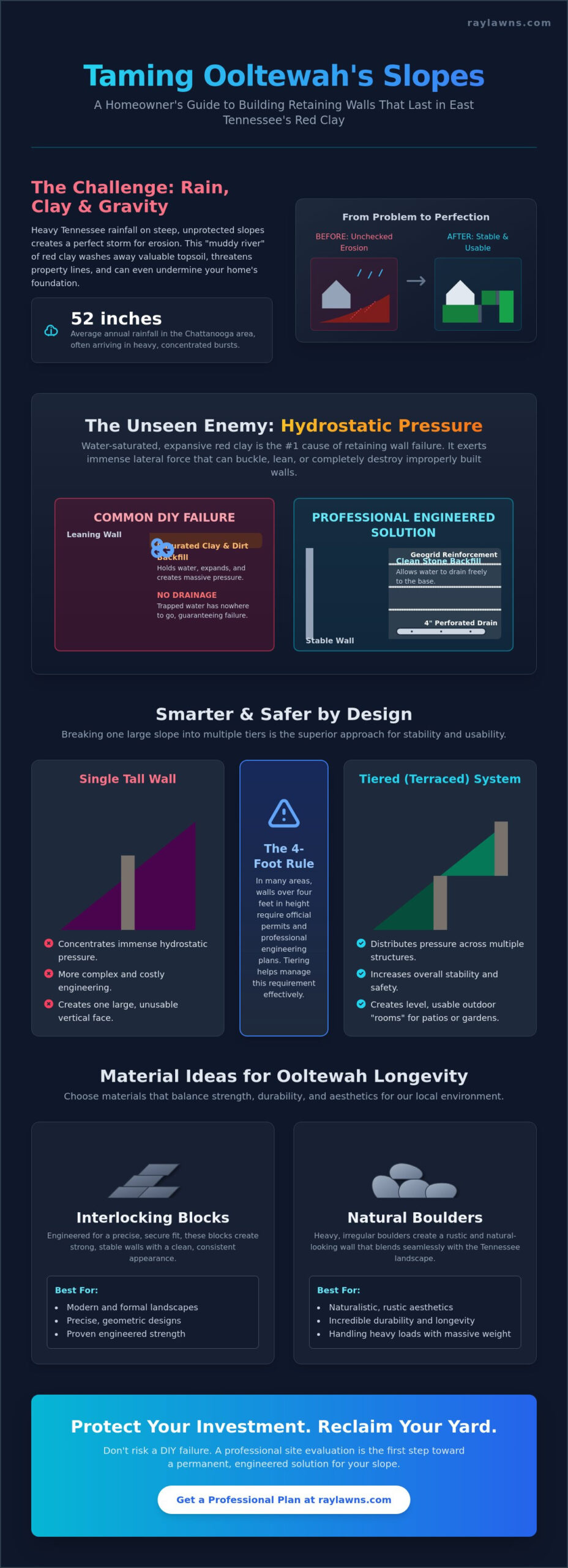
Rainfall in the Chattanooga area averages about 52 inches per year. It often arrives in heavy, concentrated bursts. On an unprotected incline, this water gains speed and power as it travels downhill. Without a structural retaining wall to terrace the land, that runoff carries away your topsoil and eventually threatens your property lines. Left unchecked, erosion doesn’t just ruin your grass. It can undermine your home’s foundation or cause silt to build up against your exterior walls. We view these structures as essential engineering components that protect your biggest investment.
Why Ooltewah Topography Requires Professional Planning
The rolling hills of Apison and East Brainerd are high-risk areas for soil movement. When elevation changes drastically over a short distance, water velocity increases exponentially. A small garden wall made of loose stones might look nice for a flower bed, but it won’t hold back the weight of a saturated hillside. DIY projects often fail because they don’t account for the sheer tonnage of wet earth. Professional planning ensures the wall is rooted deep enough to resist sliding and strong enough to stand up to our specific local conditions.
The Aesthetic Potential of a “Pesky” Slope
It’s easy to see a steep hill as a wasted corner of your lot. It is actually an opportunity for high-end design. By using hardscaping to create level outdoor rooms, you can reclaim space that was previously unusable. These tiered areas provide the perfect foundation for new landscaping beds or even a privacy tree installation to block out the neighbors. Instead of a problem area, your slope becomes a multi-level feature that adds massive curb appeal and functional value to your home.
Engineering for Stability: Managing Clay Soil and Hydrostatic Pressure
Building a wall in Ooltewah isn’t just about stacking blocks. It’s about fighting physics. Hydrostatic pressure is the primary enemy of any hillside structure. This term describes the immense weight exerted by water-saturated soil as it pushes against the back of your wall. In the Chattanooga area, we deal with heavy red clay that complicates this further. Clay doesn’t just get heavy when it’s wet; it expands. This expansion creates lateral force that can easily snap a wall that wasn’t built with the right reinforcement. When you’re looking for retaining wall ideas for slopes Ooltewah, the most beautiful designs are worthless if they don’t account for this underground pressure.
To ensure long-term stability, we follow rigorous engineering principles similar to those found in Caltrans geotechnical standards for retaining walls. For walls over three or four feet, we often use geogrid. This is a high-strength synthetic mesh that we layer into the soil behind the blocks. It pins the soil back and creates a reinforced mass, preventing the earth from sliding forward as a single heavy chunk. We also integrate weep holes, which are small gaps in the wall face that allow trapped water to escape before it can build up destructive pressure.
The Critical Role of Professional Drainage
Water must have a clear exit strategy. We install a 4-inch perforated drain tile at the very base of the wall, encased in a “chimney” of clean stone. This pipe carries subsurface water away to a safe discharge point. Managing water starts at the top of the hill, too. If your yard isn’t graded to direct surface runoff away from the wall’s edge, you’re inviting trouble. For properties with severe runoff issues, we often recommend integrating French drain solutions to intercept water before it ever reaches the structural zone.
Common Mistakes in Slope Stabilization
The most expensive mistake a homeowner can make is using “dirt” or the original site soil as backfill. You must use clean #57 gravel. Gravel doesn’t compress or hold water; it allows it to drop straight down to the drain pipe. Another common shortcut is skipping the non-woven geotextile fabric. This liner acts as a filter, preventing fine silt from clogging your gravel and pipes over time. Without it, your drainage system will fail within a few seasons. If you’re worried about an existing structure, a professional landscaping evaluation can help identify if your drainage is up to par.
Retaining Wall Material Ideas: Choosing for Longevity in Ooltewah
Selecting the right material for your hillside project is about more than just picking a color at a big-box store. You need a material that can withstand the unique environmental pressures of the Tennessee Valley. When exploring retaining wall ideas for slopes Ooltewah homeowners should prioritize structural integrity over short-term savings. The materials you choose must work in harmony with your existing Ooltewah landscaping to ensure the finished product looks natural and lasts for decades.
Segmental Retaining Wall (SRW) blocks are the industry standard for a reason. These engineered concrete units are designed to interlock, creating a cohesive unit that resists the weight of the hillside. We often recommend them because they offer a vast range of finishes, from modern split-face textures to weathered, tumbled looks that mimic natural stone. For a more rustic, mountain-inspired aesthetic in areas like Collegedale, natural boulder walls are an excellent choice. These rely on the sheer mass of the rocks to hold the earth in place.
You might be tempted by timber walls due to a lower initial cost. However, we rarely recommend them for permanent slope stabilization in the Southeast. Our local humidity levels, which often exceed 70% in the summer months, create a breeding ground for wood rot and termites. While a stone or block wall can easily last 50 years, a timber wall in Tennessee clay often begins to fail or lean within 10 to 15 years.
Segmental Blocks vs. Poured Concrete
Poured concrete walls are rigid and unforgiving. If the expansive clay soil underneath shifts or swells, a poured wall will likely crack, and those cracks are nearly impossible to repair invisibly. Interlocking SRW blocks are “flexible” structures. They have thousands of tiny joints that allow the wall to breathe and move slightly without losing its structural strength. This “give” is exactly what you want when dealing with the high-pressure slopes found in East Brainerd and Apison.
Natural Stone and Boulder Considerations
Using local Tennessee fieldstone provides a seamless look that feels like it has always been part of the landscape. When we install massive boulder walls, we follow the “gravity wall” principle. This means the weight of the stone itself does the work of holding back the soil. One warning for homeowners: be wary of “dry-stack” stone walls built without a proper gravel backfill or filter fabric. Without these professional components, small critters will quickly turn the gaps into homes, and silt will wash through the cracks, eventually causing the wall to collapse from the inside out.
The Professional Approach: Terracing vs. Single-Wall Construction
When you look at a steep backyard in Ooltewah, your first instinct might be to build one massive wall to hold everything back. In many cases, terracing is the superior engineering choice. Terracing involves breaking a single, intimidating slope into two or more smaller walls. This approach is one of the most effective retaining wall ideas for slopes Ooltewah homeowners can use because it distributes the soil’s weight across multiple structures. Instead of one wall bearing the full brunt of the hillside’s pressure, each level handles a fraction of the load.
A critical rule in terracing is the “setback.” To prevent the upper wall from adding weight to the lower one, the distance between them must be calculated carefully. As a general rule, the upper wall should be set back at least twice the height of the lower wall. For example, if your bottom wall is 3 feet tall, the next level should start 6 feet back. This prevents “surcharging,” which is when the weight of the top structure causes the bottom one to bulge or fail. These level tiers also create ideal pockets for tree planting services, allowing you to add vertical interest and privacy to your hillside.
When a Single High Wall is Necessary
Sometimes, tight property lines or existing structures don’t allow enough room for terracing. If you must build a single wall taller than 4 feet, local regulations in Ooltewah and Collegedale require a building permit and an engineered design. These taller structures demand deeper footings and more extensive geogrid reinforcement to remain stable. Safety is also a major factor. Any wall with a significant drop requires fall protection, such as a permanent fence or railing, to protect family and guests. If you are unsure which path fits your lot, we recommend a professional site evaluation to determine the safest height for your specific grade.
Maximizing Usable Flat Space
The ultimate goal for most of our clients is to turn a “cliff” into a yard. We use a “cut and fill” technique to achieve this. We excavate soil from the high side of the slope (the cut) and use it to level out the area behind the lower wall (the fill). This process requires heavy machinery and precise grading to ensure the new surface is compacted and stable. Once the grade is set and the drainage is verified, we can finish the area with a professional sod installation. This takes a previously unusable hillside and turns it into a level, green lawn that is ready for weekend gatherings.
Planning Your Project: From Site Grading to Finished Landscape
Success starts long before the first block is set. A professional site evaluation is the non-negotiable first step for any hillside project. We identify underground utility lines and assess the stability of the existing soil to determine how much excavation is required. In Hamilton County, regulations are clear: any wall measuring over 4 feet from the bottom of the footing to the top requires a building permit. These structural walls also must be designed by a licensed engineer to ensure they won’t fail under the pressure of our local clay. When researching retaining wall ideas for slopes Ooltewah homeowners often overlook these legal and safety requirements in favor of aesthetics.
A well-built wall is a central part of your long-term lawn care in Ooltewah. If the wall isn’t engineered correctly, it will eventually shift, causing drainage issues that ruin your grass and landscaping beds. Doing the work the right way the first time protects your property value and prevents the massive expense of a “re-do” five years down the road. It’s about building a foundation that stays put regardless of how much rain falls in the Tennessee Valley.
The Importance of Site Preparation
Excavation is a precise process. We don’t just dig next to the hill; we dig “into” it to create a stable bench for the wall’s foundation. This ensures the structure is tied directly into the land it’s meant to hold. Once the trench is ready, we focus on compaction. We use heavy machinery like vibratory plate compactors to consolidate the gravel base. A solid foundation prevents the “settling” that leads to wavy wall lines and leaning blocks. For more technical details on choosing a partner for this work, you should review our landscaping Chattanooga project standards.
Finishing Touches and Curb Appeal
The final details turn a structural necessity into a design feature. Capstones are essential for a finished look; they also shed water away from the wall’s interior. You can also integrate low-voltage LED lighting directly into the wall face. This adds a layer of safety for nighttime navigation and creates a dramatic look for your backyard. The very last step is restoring the surrounding ground. We finish every project with professional grading and sod to lock the soil in place. This prevents silt from washing over your new wall and ensures your yard is ready to enjoy immediately.
Reclaiming Your Backyard for the Long Term
Transforming a steep hill into a level lawn requires more than just stacking stone. It takes a deep understanding of our local red clay and the physics of hydrostatic pressure. By implementing the right retaining wall ideas for slopes Ooltewah homeowners can stop erosion and finally get full use of their property. Whether you choose a tiered terrace system or a reinforced segmental block wall, the focus must always be on professional drainage and a compacted foundation.
Ray Lawns has been family owned and operated since 2002. We’ve spent over two decades specializing in Ooltewah clay and complex drainage solutions. We provide no-nonsense site grading and construction that stands up to the heaviest Tennessee storms. Don’t let a “creeping” slope or a leaning wall stress you out any longer. We’re here to provide the stability and curb appeal your home deserves. Our team respects your property and delivers results that speak for themselves.
Request a Free Professional Evaluation for Your Ooltewah Slope and start planning your yard’s transformation today.
Frequently Asked Questions
Do I need a permit for a retaining wall in Ooltewah or Chattanooga?
Yes, you need a building permit for any wall over 4 feet tall measured from the bottom of the footing. This requirement is based on the 2018 International Residential Code adopted by the City of Collegedale. Walls supporting a surcharge, like a driveway or a steep slope, also require a permit and a design from a licensed engineer. Getting these approvals ensures your project meets local safety standards.
How much does a retaining wall typically cost per square foot in Tennessee?
The average cost for retaining wall construction in Tennessee ranges from $31 to $37 per square foot as of April 2025. In the Chattanooga area, interlocking concrete blocks are the most budget-friendly at $15 to $30 per square foot. Natural stone walls typically run $25 to $40 per square foot. Poured concrete averages between $30 and $40 per square foot. Labor costs generally range from $50 to $75 per hour.
How long will a professional segmental block retaining wall last?
A professionally installed segmental block wall can easily last 50 to 100 years. Unlike wood, which rots in our humid climate, these concrete units are impervious to moisture and pests. Their interlocking design allows the structure to flex with the natural movement of the soil. This prevents the cracks that often destroy rigid poured concrete walls when the ground shifts during our heavy seasonal rains.
Can I build a retaining wall myself on a steep slope?
We don’t recommend building a wall yourself on a significant incline due to the extreme soil pressure involved. Steep grades require precise site grading and geogrid reinforcement that most homeowners can’t install correctly. A failure on a steep slope can cause thousands of dollars in property damage. It can even threaten your home’s foundation if the hillside begins to slide after a heavy storm.
What is the best material for a retaining wall in Tennessee clay soil?
Interlocking concrete blocks are the best choice for the expansive red clay found in Ooltewah. This material handles the constant swelling and shrinking of the soil better than rigid poured concrete. When browsing retaining wall ideas for slopes Ooltewah, look for segmental systems that allow for built-in drainage paths. These systems relieve the hydrostatic pressure that clay often traps, preventing the wall from shifting or cracking over time.
How do I stop my existing retaining wall from leaning or bulging?
You must address the trapped water behind the wall to stop it from leaning further. Bulging is almost always caused by hydrostatic pressure from saturated soil. If the wall doesn’t have a perforated drain pipe or gravel backfill, you may need to excavate the soil behind it and install proper drainage. In some cases, adding a second tiered wall can help redistribute the weight and stabilize the slope.
Does a retaining wall increase my property value in Hamilton County?
A professional retaining wall can significantly increase property value by creating usable flat space in a hilly yard. Homebuyers in Hamilton County value level lawn areas and professional curb appeal. A wall that solves an erosion problem or protects a foundation also provides peace of mind. This makes the home much easier to sell compared to a property with a sliding hillside or a muddy, unusable backyard.
What happens if a retaining wall is built without proper drainage?
A wall built without drainage will eventually fail due to the massive weight of wet earth. Without a gravel chimney and a drain pipe, water builds up behind the wall and exerts thousands of pounds of pressure. This leads to bowing, leaning, and eventual collapse. In our region, skipping drainage is the fastest way to turn a new hardscape project into a liability. It’s much cheaper to install pipes now than to rebuild later.
get a quote today!
"*" indicates required fields

We take lawn care so seriously that we consider it an art. Our basic service is lawn maintenance, which includes lawn mowing, trimming, edging, and blowing off clippings.

Our landscaping services include most types of yard work. We are excellent at trimming hedges, installing mulch, and creating flowerbeds.

This is our rescue effort for yards that have become entirely overgrown. Includes multiple passes with the lawn mower to tame even the most unruly yards.