
Last Tuesday, a homeowner in Ooltewah watched the clouds clear after a 2-inch downpour only to see their fescue had jumped three inches overnight. You’re likely staring at a shaggy yard right now, wondering if you should pull the starter cord or wait another day. You might be asking yourself, can you cut grass after it rained, or will you end up doing more harm than good to your Hamilton County property?
It’s understandable to feel the pressure when the grass grows faster than you can keep up with it. You want a clean, professional look without the stress of a stalled mower or messy clumps. This guide will show you why mowing wet turf is a major risk to your soil and how to safely manage your lawn after a heavy Tennessee storm. We’ll provide a clear rule of thumb for timing your maintenance, techniques to prevent permanent ruts in our heavy clay soil, and ways to stop long-term lawn disease before it starts.
Key Takeaways
- Understand why Chattanooga’s heavy red clay makes mowing wet turf a recipe for soil compaction and long-term drainage issues.
- Learn how to apply the “Three-Hour Rule” to protect your lawn from fungal pathogens caused by shredded, wet grass blades.
- Master the simple “Squeeze Test” to determine if you can you cut grass after it rained without damaging your lawn’s root system.
- Avoid the “clumping effect” that smothers healthy turf and puts unnecessary strain on your mowing equipment.
- Discover how professional crews in Ooltewah and Apison manage rain delays to ensure a precision cut and lasting curb appeal.
The Short Answer: Is it Safe to Mow Wet Grass in Tennessee?
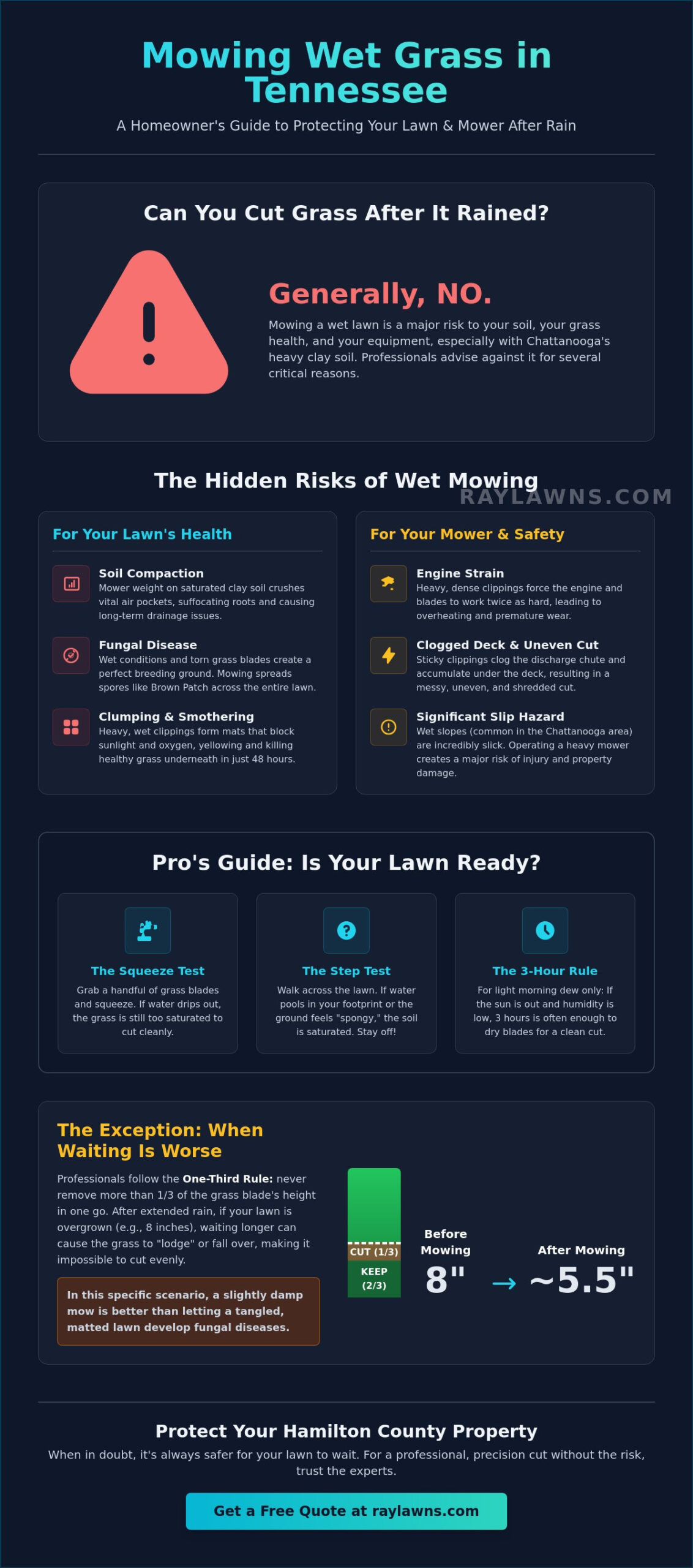
Technically, you can mow your lawn whenever you choose. However, most professionals advise against it for several practical reasons. When asking can you cut grass after it rained, the answer depends entirely on the volume of water and the current state of your soil. For a light morning dew, we typically follow the Three-Hour Rule. If the sun is out and the Tennessee Valley humidity stays below 70 percent, three hours of direct light usually dries the grass blades enough for a clean, sharp cut. If you just experienced a heavy downpour in East Brainerd, you need to wait at least 24 hours for the ground to stabilize.
Mowing wet turf puts immense strain on your lawn mower engine and blades. Wet clippings are heavy, dense, and sticky. They tend to clog the discharge chute and accumulate under the deck, which forces the engine to work twice as hard. Beyond the mechanical toll, safety is a primary concern. Many lawns in the Chattanooga area feature 10 to 20-degree slopes. These inclines become incredibly slick after a storm. Operating a 300-pound machine on slippery turf is a significant slip hazard that often leads to property damage or personal injury.
Distinguishing Between Damp Grass and Saturated Soil
Surface moisture on the grass blade is manageable, but saturated soil is a different beast entirely. In Ooltewah and Collegedale, our heavy clay soil acts like a giant sponge. It retains water much longer than sandy soils found in other regions. You can identify saturation by performing a simple “step test.” If you walk across the lawn and see water pooling in your footprint or feel a “spongy” sensation, stay off the grass. Mowing in these conditions causes deep rutting. The weight of the mower compacts the clay, crushing the air pockets that roots need to breathe. This compaction often requires professional Chattanooga lawn care interventions like aeration to fix.
When a Delay is More Dangerous Than a Wet Mow
There are rare moments when waiting is the worse option. Professional crews follow the One-Third Rule, which states you should never remove more than 33 percent of the grass height in a single session. If a week of steady rain in Apison has pushed your lawn to 8 inches tall, waiting another four days might cause the grass to “lodge” or fall over under its own weight. Once grass lays flat against the soil, a mower cannot lift it to create an even cut. In this specific scenario, you might decide can you cut grass after it rained even if it is damp. A slightly wet mow is sometimes necessary to prevent the grass from becoming a tangled, matted mess that invites fungal diseases like brown patch or pythium blight.
The Hidden Risks: How Wet Mowing Affects Grass Health and Machinery
When homeowners ask can you cut grass after it rained, they usually think about the visible mess. The real problem is the long-term health of the plant. Wet grass blades are heavy and flexible. Instead of a clean, surgical slice, your mower blade shreds the leaf. These jagged edges act like open wounds; they allow pathogens and bacteria to enter the plant easily. In the humid climate of Ooltewah and Chattanooga, this is an invitation for serious turf stress.
Clumping is another major issue that ruins curb appeal. Wet clippings don’t disperse evenly. They stick together in thick, heavy mats. These clumps sit on top of your lawn and block vital sunlight. Within 48 hours, the grass underneath begins to yellow from a lack of oxygen and light. This creates a smothering effect that can kill small patches of your lawn in days. When you consider can you cut grass after it rained, you have to account for the soil beneath the blades. Mowing turf through the rain often leads to soil compaction, especially in our local red clay, which stunts root growth for the entire season.
Wet environments also speed up the transmission of fungal diseases. Brown Patch is a common fungus in the Tennessee Valley that thrives in moisture and heat. Mowing a wet lawn spreads these spores across your entire property in minutes. You end up with a diseased yard that requires expensive chemical treatments to fix. Professionals avoid these risks by waiting for the canopy to dry completely.
The Impact on Different Turf Types
Tall Fescue is common in East Brainerd and Apison. Its vertical growth makes it very susceptible to tearing when the blades are saturated. Bermuda and Zoysia have dense, low-growing stolons that behave differently. When these grasses are soaked, mower wheels often sink into the turf, leading to uneven cuts or permanent scalping. Experienced lawn care in Chattanooga specialists prioritize dry conditions for these species to maintain that carpet-like finish homeowners expect.
Mower Deck Mechanics and Wet Clippings
Mowers rely on high-velocity airflow to lift grass blades before the cut. Water disrupts this physics entirely. Wet grass is heavy and sticks to the underside of the mower deck, which forces the engine to work harder. This leads to overheating and premature belt wear. If you use a mulching kit, it will fail completely once grass moisture exceeds 30 percent. You must scrape the deck clean immediately after a wet cut to prevent rust and hardened debris from ruining your equipment. If your yard is currently overgrown and saturated, getting a professional evaluation for Chattanooga lawn care can prevent these mechanical headaches and keep your grass healthy.
The Tennessee Clay Factor: Why Chattanooga’s Soil Makes Wet Mowing Dangerous
In Ooltewah and East Brainerd, we deal with heavy East Tennessee red clay. This soil is made of tiny, flat particles that pack together tightly. Unlike sandy soils found in other regions, our clay holds water for long periods and lacks the natural pore space needed for quick drainage. When homeowners ask can you cut grass after it rained, the answer depends entirely on how much weight this clay can support without collapsing. A standard residential zero-turn mower can weigh 700 to 900 pounds. On saturated clay, that concentrated weight crushes the microscopic air pockets in the soil. This process, known as compaction, effectively suffocates your lawn from the bottom up.
Clay soil has a “memory” for weight. When you drive a heavy machine over wet clay, you aren’t just flattening the grass. You’re creating physical depressions that stay for years. These ruts collect more water during the next rain, which softens the soil further and leads to deeper tracks. This cycle prevents roots from growing deeper than an inch or two, making your lawn much more vulnerable to the heat of a typical Chattanooga summer.
Irreversible Damage to Soil Structure
Compacted clay is like concrete for grass roots. It prevents oxygen, water, and nutrients from traveling through the soil profile. Purdue University turf specialists recommend waiting until the soil is firm enough that you don’t leave footprints before you even consider bringing out the mower. If you ignore this and create deep ruts, the damage is often permanent without major intervention. Fixing these tracks in our local area usually requires professional grading or full sod installation to restore a level playing surface and healthy growing environment.
Managing Drainage Issues Before the Rain Starts
If you find yourself constantly wondering can you cut grass after it rained because your yard stays soggy, you likely have a drainage problem. Identifying low spots that hold water for more than 24 hours is the first step. In many Chattanooga neighborhoods, poor site grading causes water to pool in backyards rather than flowing toward the street or storm drains. A professional French drain installation can intercept this subsurface water and redirect it. This keeps the soil firm and allows you to get back on your mowing schedule much faster after a heavy downpour. Proper grading ensures your yard doesn’t become a lake every time a storm rolls through the Tennessee Valley.
The Pro’s Guide to Testing and Mowing a Damp Lawn
Homeowners in East Brainerd and Apison deal with heavy clay soil that holds moisture for 48 hours or more after a typical Tennessee thunderstorm. Before you pull the starter cord, you must determine if can you cut grass after it rained without destroying your curb appeal. We use the Squeeze Test to make this call. Pick up a handful of soil from a low-lying area of your yard. If you squeeze it and water trickles out, or if it forms a tight, muddy ball, the ground is too saturated for a mower. A standard residential zero-turn mower weighs between 400 and 700 pounds. Operating that much weight on soft soil will collapse the air pockets your grass roots need to breathe.
The Boots Check is your second line of defense. Walk across the lawn in your work boots. If you see water pooling around the edges of your soles or hear a squishing sound, stop immediately. In the Chattanooga area, our soil density means that surface water often hides a deeper layer of mud. If you proceed, those boots will leave depressions, and the mower tires will create deep ruts that require topsoil and reseeding to fix. For an emergency cut, you must set your mower to its highest possible setting. Cutting high reduces the stress on the grass plant and prevents the mower deck from suctioning up mud and debris into the blades.
Cleaning is the most neglected part of mowing a damp lawn. Wet grass contains high levels of cellulose and moisture that create a green, glue-like paste inside your mower deck. You must stop every 10 minutes to clear the deck. If you don’t, the buildup kills the airflow necessary to stand the grass up for a clean cut. This leads to “stragglers” and an uneven finish that looks sloppy once the sun comes out.
Step-by-Step: The Professional Dry Test
- Step 1: Walk the perimeter of your property. Focus on the most shaded areas, usually under large oaks or on the north side of the house, as these stay wet the longest.
- Step 2: Drag your foot firmly across the top of the grass. If a spray of water hits your boot, it’s too wet. If the grass just feels cool and damp to the touch, you might be clear to proceed.
- Step 3: Check the “bounce back” by stepping firmly on a patch of grass. Healthy, mowable turf should spring back to its upright position within 3 seconds. If it stays flattened, the blades are too heavy with moisture.
- Step 4: Use a 6-inch screwdriver to test soil resistance. Push it into the ground; if it slides in like butter with no effort, the soil is too soft to support machinery.
Technical Adjustments for Emergency Mowing
If timing forces you to mow before the lawn is 100% dry, you must sharpen your blades first. Wet grass fiber is incredibly resilient and slippery. A dull blade will shred the grass rather than slicing it, leaving jagged edges that turn brown and invite fungal diseases like Brown Patch, which is common in Ooltewah. Switch your mower to side-discharge mode. You should never mulch or bag wet grass. Mulching will clog the deck instantly, and bagging adds hundreds of pounds of wet weight to your mower, increasing the risk of soil compaction. When driving, overlap your rows by at least 50 percent. This distributes the weight of the mower more evenly across the soft turf and prevents the wheels from sinking into the same track twice.
Keep your lawn healthy and professional with expert maintenance. Explore our chattanooga lawn care services to ensure your yard stays in peak condition regardless of the weather.
Professional Strategies for Managing Rain-Soaked Lawns in Hamilton County
Professional crews in Ooltewah and Apison don’t fight the weather; they adapt to it. When heavy Tennessee rains hit, we pivot our schedules to prioritize hardscape projects or equipment maintenance. We follow a strict “Wait and See” approach. Waiting for just 24 hours of direct sunlight can save a homeowner 10 hours of grueling repair work later. It’s the difference between a clean cut and a mangled lawn that requires weeks of recovery. If you see standing water, stay off the grass. Even a light mower can leave deep impressions in our soft local soil.
Building long-term resilience is the best way to ensure your yard dries quickly. In Hamilton County, our heavy clay soil traps moisture near the surface. Annual core aeration reduces this compaction, allowing water to move through the soil profile rather than sitting on the roots. When combined with a balanced fertilization program, your grass develops a stronger, more rigid root system. This helps the turf stand upright even when damp, making it easier to answer the question, can you cut grass after it rained? If your yard has become an overgrown jungle during a week of heavy rain, calling a professional is often the safest move to avoid damaging your equipment or your turf.
The Importance of Sharp Blades and High Lift
Professional-grade mowers use engines with significantly higher torque than standard residential models. This power maintains consistent blade speed even when hitting heavy, water-laden grass. We use “High Lift” blades designed with a pronounced curve on the back edge. This shape creates a powerful vacuum that pulls damp grass upright before the cutting edge strikes. High blade tip speeds ensure that wet grass is sliced cleanly rather than being shredded or pulled out by the roots. Without this suction and speed, residential mowers often just push wet grass down, resulting in an uneven, ragged look.
Restoring a Lawn Damaged by Wet Mowing
If you’ve already made the mistake of mowing too soon, you have to act fast to prevent permanent damage. Large clumps of wet clippings will smother the grass underneath within 48 hours, leading to yellowing or dead spots. Following a professional chattanooga lawn care routine involves several recovery steps:
- Clear the clumps: Use a leaf blower or a plastic rake to break up and disperse grass piles immediately.
- Treat for fungus: Watch for Brown Patch or Dollar Spot, which can spread across a 5,000 square foot lawn in just a few days in our humid climate.
- Level the ruts: For deep tracks, use a garden fork to gently lift the compressed soil and top-dress the area with a sand and soil mix.
Restoring a damaged lawn takes patience. Don’t try to fix everything at once with heavy machinery. Let the soil dry completely before attempting to re-seed or level out any paths carved by mower tires. Taking these steps quickly ensures your lawn remains a source of pride rather than a maintenance headache.
Protect Your Chattanooga Lawn After the Rain
Mowing at the wrong time does more than just make a mess; it creates long term damage to your turf and soil structure. In areas like Ooltewah and Chattanooga, our heavy red clay holds moisture far longer than sandy soils found in other regions. If you’ve wondered can you cut grass after it rained, the answer usually involves waiting for the grass blades to dry and the ground to firm up. Rushing onto a wet lawn leads to deep ruts and compacted soil that chokes out root systems. You’ll end up with uneven growth and potential fungal issues that take months to repair.
Ray Lawns has been family owned and operated since 2002. We understand that Hamilton County weather is unpredictable. Our teams use professional grade equipment designed to handle tough conditions, but we always prioritize the health of your grass over a quick cut. We’ve spent 22 years mastering the nuances of local soil health and precision maintenance. Don’t let a poorly timed mow ruin your curb appeal. Request a Free Professional Lawn Evaluation from Ray Lawns to keep your property in peak condition all year long. We look forward to helping your lawn thrive.
Frequently Asked Questions
How long should I wait to mow after it rains?
You should wait at least 2 to 5 hours after the rain stops before you start your mower. Many homeowners ask can you cut grass after it rained only to find their mower sinking into Ooltewah’s heavy clay soil. If the ground feels soft under your boots, wait a full day to avoid leaving deep ruts that ruin your curb appeal.
Will mowing wet grass ruin my lawn mower?
Mowing wet grass won’t immediately destroy your machine, but it causes significant wear on the belt and engine. Wet clippings are 3 times heavier than dry ones, which forces the motor to work harder and can lead to overheating. Moisture also accelerates corrosion on the steel deck, shortening the mower’s lifespan by 2 or 3 years if you don’t clean it immediately.
Can I mow if there is only morning dew on the grass?
You should wait until the dew evaporates, usually by 10:00 AM in Ooltewah during the humid summer months. Even light moisture makes the grass slick, causing the mower blade to tear the plant rather than cutting it cleanly. This jagged edge turns brown within 48 hours and leaves your lawn vulnerable to local pests and heat stress during the Tennessee afternoons.
What happens if I leave wet grass clumps on my lawn?
Wet clumps create a smothering effect that kills the grass underneath in as little as 2 days. These heavy mats block 90 percent of sunlight and trap moisture against the soil, which invites rot and mold. If you must mow, always rake up the clumps or use a blower to disperse them across the yard to maintain a professional, healthy look.
Is it better to mow wet grass or let it grow too long?
It’s better to let the grass grow an extra 3 days than to damage the soil structure by mowing while it’s saturated. Cutting more than 1/3 of the grass blade at once is stressful, but rutting your yard in East Brainerd’s clay soil causes long-term drainage issues. Wait for a dry window to ensure a clean, healthy cut that promotes deep root growth.
How do I stop my mower from clogging with wet grass?
You can reduce clogging by raising your mower deck to its highest setting and slowing your walking pace by 50 percent. Spraying the underside of the deck with a silicone-based lubricant before you start helps prevent the heavy, wet blades from sticking to the metal. Stop every 15 minutes to safely clear any buildup from the discharge chute to keep the air flowing.
Does cutting wet grass cause fungus or disease?
Yes, cutting wet grass is a primary cause of Brown Patch and Dollar Spot in Chattanooga lawns. The open wound on a wet grass blade acts as an entry point for waterborne pathogens. When you ask can you cut grass after it rained, remember that damp conditions allow fungi to spread across 100 percent of your turf via the mower’s wheels.
What is the best mower blade for cutting damp grass?
High-lift blades are the best choice for damp conditions because they generate more suction to stand the heavy grass up. These blades are designed with a deeper curve that moves 20 percent more air than standard mulching blades. This extra airflow helps discharge the wet clippings more efficiently, though we still recommend waiting for dry conditions in Ooltewah whenever the weather allows for it.
get a quote today!
"*" indicates required fields

We take lawn care so seriously that we consider it an art. Our basic service is lawn maintenance, which includes lawn mowing, trimming, edging, and blowing off clippings.

Our landscaping services include most types of yard work. We are excellent at trimming hedges, installing mulch, and creating flowerbeds.

This is our rescue effort for yards that have become entirely overgrown. Includes multiple passes with the lawn mower to tame even the most unruly yards.