
Last Tuesday, after three straight days of heavy Chattanooga rain, a homeowner in Ooltewah watched their mower stall out in a thick clump of soggy fescue. You’ve likely stood on your porch in East Brainerd or Apison, looking at grass that’s grown three inches since Monday, wondering: can you mow in the rain? It’s frustrating to watch your curb appeal disappear while the forecast stays gray. You want a clean cut, but you don’t want to turn your yard into a muddy mess or destroy your equipment.
This guide breaks down the real-world risks of wet-weather maintenance and why Tennessee’s high humidity makes timing critical. You’ll discover exactly when it’s safe to start the engine and how to protect your soil from the compaction common in our local clay. We’ll also cover the professional steps to repair a lawn if you’ve already made the mistake of cutting while it’s soaked. Knowing when to wait and when to work is the key to a healthy lawn.
Key Takeaways
- Understand why the answer to “can you mow in the rain” is technically yes, but why local experts almost always advise against it to protect your turf health.
- Discover the hidden dangers of Hamilton County’s heavy clay soil and how operating machinery on wet ground causes lasting soil compaction.
- Learn how to identify and prevent common fungal diseases like Brown Patch that thrive in the humid, damp conditions of a Chattanooga summer.
- Master the “walk test” to determine if your lawn is stable enough for a mower without risking ruts or root damage.
- Get professional tips on equipment maintenance, including why razor-sharp blades are essential for handling heavy, hydrated Tennessee grass.
The Reality of Mowing in the Rain: Can vs. Should
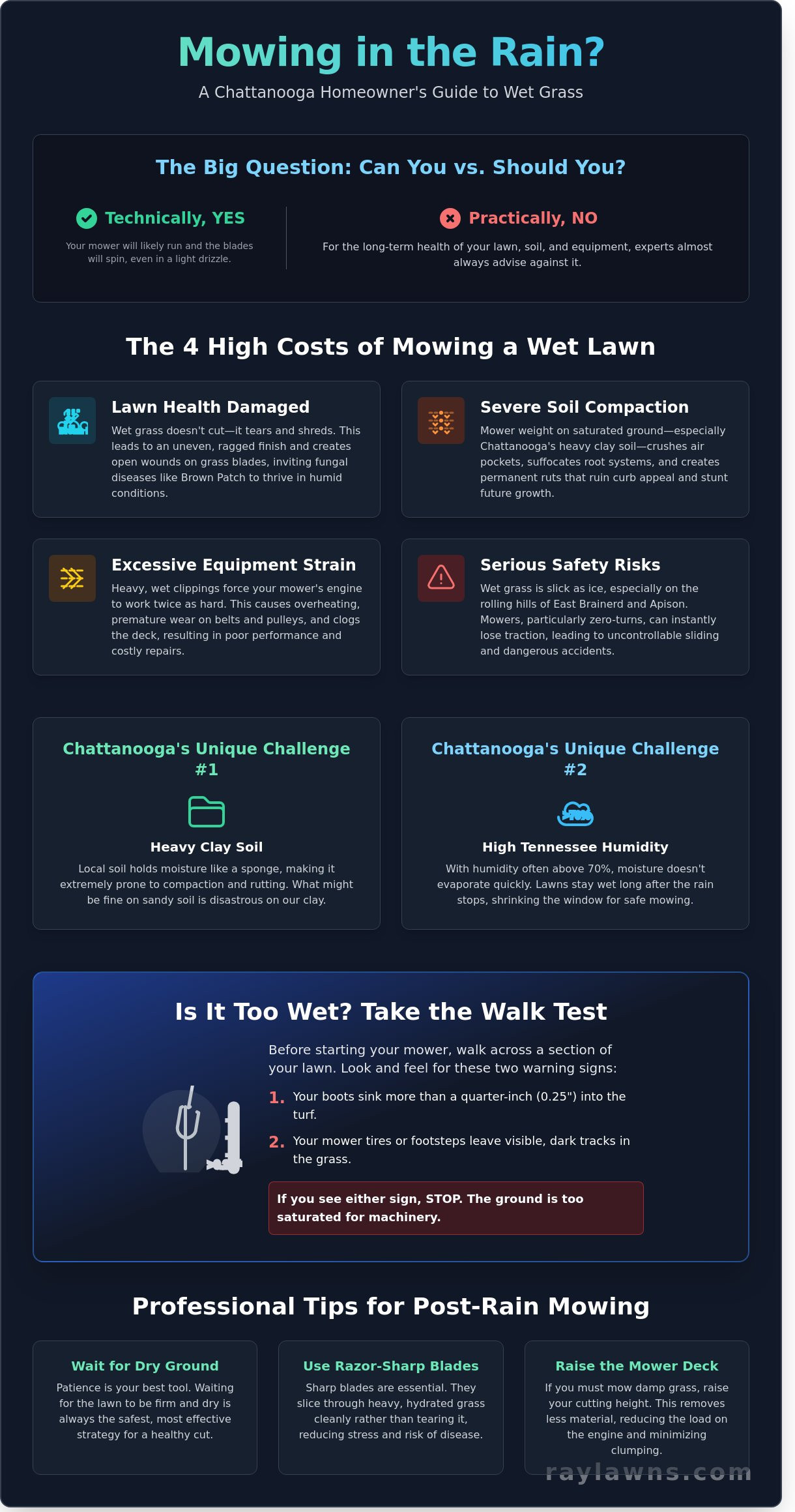
Homeowners in Chattanooga often ask, can you mow in the rain? The technical answer is yes. Your mower engine will likely run, and the blades will spin. However, the practical answer for anyone concerned about turf health is almost always no. There is a massive difference between a light morning mist in Ooltewah and a steady Tennessee downpour that turns our local red clay into a slick, unstable mess.
Wet grass doesn’t cut; it shreds. When grass blades are heavy with moisture, they lean over instead of standing tall. This results in an uneven finish and jagged edges that invite fungal diseases. I tell my clients that the “point of no return” is simple to spot. If your mower tires leave a visible track or if your boots sink more than 0.25 inches into the turf, you are doing permanent damage. Saturated soil compacts under the weight of even a small push mower. This compaction suffocates the root system and stunts growth for the rest of the season. The question of can you mow in the rain often comes down to whether you value a temporary haircut over the long-term health of your soil.
Why Commercial Crews Mow in the Rain
Professional teams face different pressures than a typical homeowner. A local crew might have 50 properties scheduled for a Tuesday in East Brainerd or Apison. If they stop for every shower, they’ll fall behind for the entire month. Commercial mowers utilize high-vacuum decks that create significantly more lift than residential units. These machines are engineered to pull wet, heavy grass upright before the blade makes contact. While we prefer dry conditions for chattanooga lawn care, a professional sometimes accepts the trade-off of minor turf stress to prevent a property from becoming an unmanageable jungle that requires three separate passes to clean up.
The Impact of Tennessee Humidity
In the Chattanooga area, humidity levels often hover above 70% during the peak growing season. This prevents moisture from evaporating, meaning your grass stays wet long after the clouds clear. This persistent dampness is a core challenge of lawn maintenance, often making it difficult to find truly dry conditions for mowing.
Why Wet Mowing is Hard on Your Lawn and Equipment
Mowing a wet lawn is a recipe for frustration. When you ask yourself, “can you mow in the rain,” the short answer is usually no. Wet grass blades are heavy. They lean over rather than standing tall. This prevents the mower blade from making a clean, level pass. You end up with a ragged, uneven finish that looks sloppy once the sun comes out. Beyond aesthetics, the physical weight of wet clippings creates a massive mechanical load. Your mower engine has to work twice as hard to process clumps of sodden grass. This leads to overheating and premature wear on belts and pulleys.
The damage extends below the surface. Chattanooga is known for its heavy clay soil. This material holds moisture like a sponge. Operating a heavy commercial mower on saturated ground causes soil compaction, which suffocates the root system. You will also see “rutting.” This happens when mower wheels sink into the soft turf, leaving permanent grooves that ruin your curb appeal. A single session in the mud can take months of professional chattanooga lawn care to repair.
The Danger of Fungal Spread
Wet mower blades act as perfect vectors for pathogens. In the humid Ooltewah summers, diseases like Brown Patch thrive. When you cut damp grass, the mower often tears the blade instead of slicing it cleanly. These ragged edges are open wounds. They invite infection immediately. A diseased lawn is expensive to fix. Fungicide treatments for a standard quarter-acre lot can cost hundreds of dollars per application. It is much cheaper to wait for a dry afternoon than to risk your lawn’s health just because you feel the urge to mow in the rain.
Safety Risks on Tennessee Slopes
Safety is a major concern on the rolling hills of East Brainerd and Apison. Wet grass is as slick as ice. Traction vanishes instantly. Zero-turn mowers are particularly dangerous on inclines because they rely entirely on the rear wheels for steering and braking. If those tires lose their grip, the machine becomes a 700-pound sled. Always check the ground before starting. If your boots leave a visible impression or slide when you plant your heel, it is too wet to mow safely. Keep your equipment in the garage until the turf is firm and dry. Professional results require the right conditions, and a wet slope is never the place for precision work.
Chattanooga Clay: The Hidden Victim of Wet Mowing
Hamilton County is famous for its dense, red clay soil. This material consists of microscopic, flat particles that pack together tightly. While this soil holds nutrients well, its structure is incredibly fragile when saturated. If you are wondering, can you mow in the rain in a place like Ooltewah or Apison, the answer usually depends on what is happening beneath the surface. A commercial zero-turn mower can weigh between 800 and 1,200 pounds. On wet clay, that weight acts like a hydraulic press. It doesn’t just trim the grass; it destroys the physical architecture of your yard by forcing every bit of air out of the ground.
The damage is most severe for a recent sod installation in Chattanooga. New sod has a shallow, developing root system that hasn’t yet anchored into the subsoil. Heavy machinery on a wet, newly sodded lawn can cause the entire layer to shift or slide. This creates uneven surfaces and tears the delicate new roots before they have a chance to establish. Protecting that investment means keeping heavy equipment off the grass until the soil has reached a firm, workable consistency.
Compaction and Root Suffocation
Healthy soil requires roughly 25 percent air and 25 percent water to support turf life. Wet mowing in our local clay collapses those vital air pores. When you crush the soil, you eliminate the oxygen that roots need to breathe. This leads to “dead spots” that often don’t appear until the next dry spell. Compaction is a stubborn problem. It is much harder to fix than simply letting the grass grow an extra inch. While standard core aeration can help, severe compaction from wet mowing often requires deep mechanical intervention to restore the lawn’s health.
Drainage Issues and French Drains
Ruts are the most immediate sign of trouble. A single pass on saturated ground can leave depressions two inches deep. These ruts act as small canals that trap water and prevent it from shedding naturally across the property. Over time, these tracks lead to consistent standing water problems and mud holes. When soil damage reaches this level, you may need to call a French drain company to install a professional drainage system to move the water. Can you mow in the rain safely? In Chattanooga, the risk to your drainage is rarely worth the reward of a fresh cut. Choosing long-term landscape health over a short-term aesthetic fix keeps your yard functional and beautiful for years to come.
Professional Tips for Mowing After a Tennessee Downpour
Managing a lawn after a heavy Chattanooga storm requires patience. While you might wonder can you mow in the rain, the better question is how soon you should start once the clouds clear. Perform the walk test first. Step onto the lowest point of your yard. If water pools around your boot or the ground feels spongy, wait another 24 to 48 hours. Mowing on saturated soil compacts the heavy clay common in Hamilton County, which suffocates root systems and kills your grass from the bottom up.
Prepare your equipment for the added resistance of hydrated blades. Sharpen your mower blades before you pull the starter cord. Dull blades shred wet grass instead of cutting it, leaving jagged edges that invite disease. You should also raise your mower deck to its highest setting, typically 3.5 to 4 inches. This reduces the load on your engine and prevents the mower from “scalping” the lawn if the wheels sink slightly into the soft turf. Once the job is finished, scrape the underside of the mower deck immediately. Wet clippings stick to the metal like glue, trapping moisture that causes rust and mold growth within 72 hours.
The Proper Way to Handle Wet Clippings
Never mulch wet grass. The high moisture content causes clippings to ball up into heavy mats that the mower can’t process. These clumps stay on the surface and block sunlight, killing the grass underneath in less than three days. Use the side-discharge chute or a bagging attachment instead. If you see large clumps left behind, use a leaf rake or a blower to disperse them across the yard. This ensures the turf can breathe and prevents “dead spots” from forming during the drying process.
Post-Mow Recovery Protocol
Monitor the lawn closely as it dries. Look for signs of “tearing” or a yellow tint on the tips of the grass blades. If the weather remains humid and overcast after your cut, consider applying a preventative fungicide to stop brown patch or dollar spot before they take hold. Heavy mowers often leave ruts in soft Tennessee soil. If you notice deep tracks or uneven areas, you might need professional landscaping Ooltewah repairs to level the grade and restore your curb appeal. Acting quickly prevents these minor ruts from becoming permanent drainage issues.
When to Call a Pro for Your Ooltewah Lawn Maintenance
Deciding if can you mow in the rain is a risk worth taking often comes down to a simple cost analysis. A standard residential mower isn’t built to handle the heavy, wet grass common in Ooltewah during a humid Tennessee summer. When wet clippings clog the mower deck, it puts immense strain on the drive belt and the engine. A professional repair for a burned-out belt or a moisture-damaged carburetor typically costs between $120 and $300. Hiring a professional service eliminates these surprise expenses and keeps your personal equipment safely in the garage.
Professional-grade equipment offers a massive advantage in unpredictable weather. Our commercial zero-turn mowers feature high-lift blades with tip speeds exceeding 18,000 feet per minute. This velocity creates enough suction to lift wet, heavy grass and discharge it without the clumping that plagues residential push mowers. This power ensures a clean cut even when the humidity is at 90 percent, preventing the ragged, torn edges that lead to lawn diseases like brown patch.
The Ray Lawns Reliability Standard
Our team doesn’t guess about the weather. We monitor local soil saturation levels to protect the integrity of your turf. Chattanooga clay soil is notorious for holding water and compacting easily. If the ground is too soft, heavy equipment will leave ruts 2 inches deep that require expensive top-dressing to fix. We serve homeowners in Ringgold, Apison, and Ooltewah by following a strict safety protocol. If the soil can’t support the weight of our machines, we adjust the schedule to prevent property damage. This ensures your lawn remains level and healthy throughout the rainy season.
Beyond Mowing: Total Yard Health
A professional eye does more than just cut grass. We look for drainage issues or fungal outbreaks that thrive in our local climate. Integrating your mowing with tree planting services and seasonal bed maintenance creates a cohesive, resilient landscape. We catch small problems, like bagworm infestations or localized root rot, before they destroy your investment. Transitioning to a reliable Chattanooga lawn care schedule takes the frustration out of your weekends.
Stop fighting the mud and the mechanical failures. We provide a straightforward, hassle-free evaluation for your property to ensure your yard stays a source of pride for your family. Contact us today to secure a spot on our seasonal rotation and experience the difference that professional consistency makes for your curb appeal.
Keep Your Lawn Healthy Through the Next Downpour
Deciding can you mow in the rain often comes down to balancing a busy schedule against the long-term health of your turf. Mowing wet grass creates uneven cuts and heavy clumps that suffocate your lawn, while the weight of a mower on saturated Chattanooga clay leads to severe soil compaction. These common mistakes often result in thin patches and drainage issues that take months of recovery to repair. Since 2002, Ray Lawns has provided family-owned expertise to homeowners across Ooltewah and Chattanooga who want professional results without the hassle. We specialize in managing the unique challenges of local soil and unpredictable Tennessee weather patterns. Our team uses meticulous techniques to ensure your yard remains a source of pride regardless of the forecast. If you’re tired of guessing when it’s safe to cut or struggling with soggy turf, it’s time to partner with a local expert who values your property’s health. Take the guesswork out of your yard work today.
Get a Free Professional Lawn Evaluation from Ray Lawns
Your lawn deserves the precision and care that only decades of local experience can provide.
Frequently Asked Questions
Will mowing in the rain ruin my lawn mower?
Mowing in the rain won’t destroy your machine instantly, but it causes long term damage through corrosion and engine strain. Wet clippings are heavy and force the motor to work 30 percent harder than usual. Moisture also finds its way into the fuel system and air filters, which leads to rust on the deck underside within a single season. It’s a fast way to shorten a mower’s lifespan.
How long should I wait to mow after it stops raining in Chattanooga?
You should wait at least 2 to 4 hours after the rain stops before starting your mower. In areas like Ooltewah and East Brainerd, our heavy clay soil holds moisture much longer than sandy regions. If you walk across the lawn and see a visible footprint or feel any “squish” under your boots, the ground is too saturated. Proper drying time ensures a clean cut without damaging the root system.
Is it better to let the grass grow long or mow it while it is wet?
It’s always better to let the grass grow an extra day rather than trying to mow while it is wet. Cutting damp blades results in an uneven finish because the grass leans over instead of standing straight for the blade. If you must mow, raise your deck height by 1 inch to reduce stress on the plant. Waiting prevents the 15 percent increase in fungal disease risk associated with wet cutting.
Can I mow if the grass is wet but the ground is dry?
You can mow if the grass is wet but the ground is dry, though it still isn’t the ideal scenario for your turf. When you decide can you mow in the rain or immediately after, the main concern shifts from soil compaction to the quality of the cut. Wet blades tear rather than slice, which leaves the tips brown and ragged. If the ground is firm, you won’t leave ruts, but you’ll still deal with heavy cleanup.
What is the “clumping” effect and why is it bad for my lawn?
The clumping effect happens when wet clippings stick together and drop onto the lawn in thick mats. These clumps block 100 percent of sunlight from reaching the grass underneath, which can yellow or kill the turf in less than 48 hours. They also trap moisture against the soil, creating a breeding ground for Pythium blight and other fungal pathogens common in the humid Chattanooga climate.
How do I clean my mower deck after cutting wet grass?
Clean your mower deck immediately after use by using a plastic putty knife or a stiff brush to scrape away the paste. Wet grass turns into a thick, acidic layer that eats through powder coating and causes deck rot if left to dry. Avoid spraying a high pressure hose directly into the spindle area or near a hot engine, as this can cause parts to warp or bearings to fail prematurely.
get a quote today!
"*" indicates required fields

We take lawn care so seriously that we consider it an art. Our basic service is lawn maintenance, which includes lawn mowing, trimming, edging, and blowing off clippings.

Our landscaping services include most types of yard work. We are excellent at trimming hedges, installing mulch, and creating flowerbeds.

This is our rescue effort for yards that have become entirely overgrown. Includes multiple passes with the lawn mower to tame even the most unruly yards.