
Last Tuesday, a family in Ooltewah watched from their back porch as three inches of rain transformed their yard into a stagnant pond in less than 45 minutes. It’s a common sight across the Chattanooga area, where our dense red clay soil acts more like a swimming pool liner than a natural filter. If you’ve spent your weekends digging shallow trenches or buying plastic pipes from big-box stores, you likely realized these DIY efforts often fail within 12 months. Most homeowners eventually search for professional french drain companies because they’re tired of seeing their home equity wash away with every storm.
You deserve a lawn that stays dry and a basement that stays waterproof even during our heaviest spring downpours. This guide explains how a correctly engineered system solves the unique drainage problems of the Tennessee Valley. We will walk through the professional installation process, the specific materials required to prevent clay clogs, and how to protect your foundation for the long haul.
Key Takeaways
- Understand why Hamilton County’s heavy clay soil requires specific subsurface drainage designs to prevent foundation damage and standing water.
- Learn the essential components of a professional system, including precise 1% grading and the use of non-woven geotextile fabric.
- Discover why standard DIY kits fail and how local french drain companies avoid common traps like “sock pipes” that clog in local soil.
- Identify how a properly installed subsurface drain protects your retaining walls and maintains the structural integrity of your landscaping.
Identifying the Need for a French Drain in Ooltewah and Chattanooga
Homeowners in the Tennessee Valley deal with a unique set of water management challenges. To solve these, you first need to understand what a French drain is and why it matters for your property. At its core, this system is a subsurface trench filled with clean gravel and a perforated pipe. Unlike a gutter or a surface ditch, it works out of sight to intercept and redirect water before it can damage your home. It’s a permanent solution for a persistent problem.
The goal is simple. You want to move groundwater and surface saturation away from your foundation and low spots. In Ooltewah and East Brainerd, many homes sit on sloped lots where water naturally migrates toward the structure. While catch basins handle immediate surface runoff from downspouts, French drains manage the water that has already soaked into the earth. If you’re searching for french drain companies, you likely have a saturation problem that surface-level solutions can’t touch. Chattanooga receives an average of 52 inches of rain per year, making effective drainage a necessity rather than a luxury.
Signs Your Hamilton County Property Has a Drainage Problem
Walk your yard two days after a heavy storm. If the turf feels “spongy” or holds water 48 hours later, you have a subsurface issue. Look for mulch washout or soil erosion near your downspouts. These are red flags. Inside the home, check for efflorescence. This white, powdery salt deposit on basement or crawl space walls indicates that water is pressing against your foundation from the outside. If you see these signs, it’s time to call professional french drain companies to assess the soil pressure.
The Role of Clay Soil in Local Drainage Issues
Chattanooga soil is notorious for high clay content. Clay particles are tiny and pack together tightly, which prevents water from percolating downward. This creates a “bathtub effect.” The top few inches of soil become a muddy mess because the water has nowhere to go. Standard lawn care services like aeration won’t fix this level of saturation. You have to bypass the clay layer to get water moving again. Professional drainage contractors understand that local clay requires specific gravel backfill techniques to ensure the pipe doesn’t clog with fine sediment over time.
Relying on surface-level fixes for deep-seated water issues often leads to wasted money and continued property damage. Identifying the difference between a simple puddle and a groundwater saturation problem is the first step toward protecting your investment. In the next section, we’ll look at the specific components that make a professional installation successful in the local climate.
The Anatomy of a Professional Drainage System for Tennessee Clay
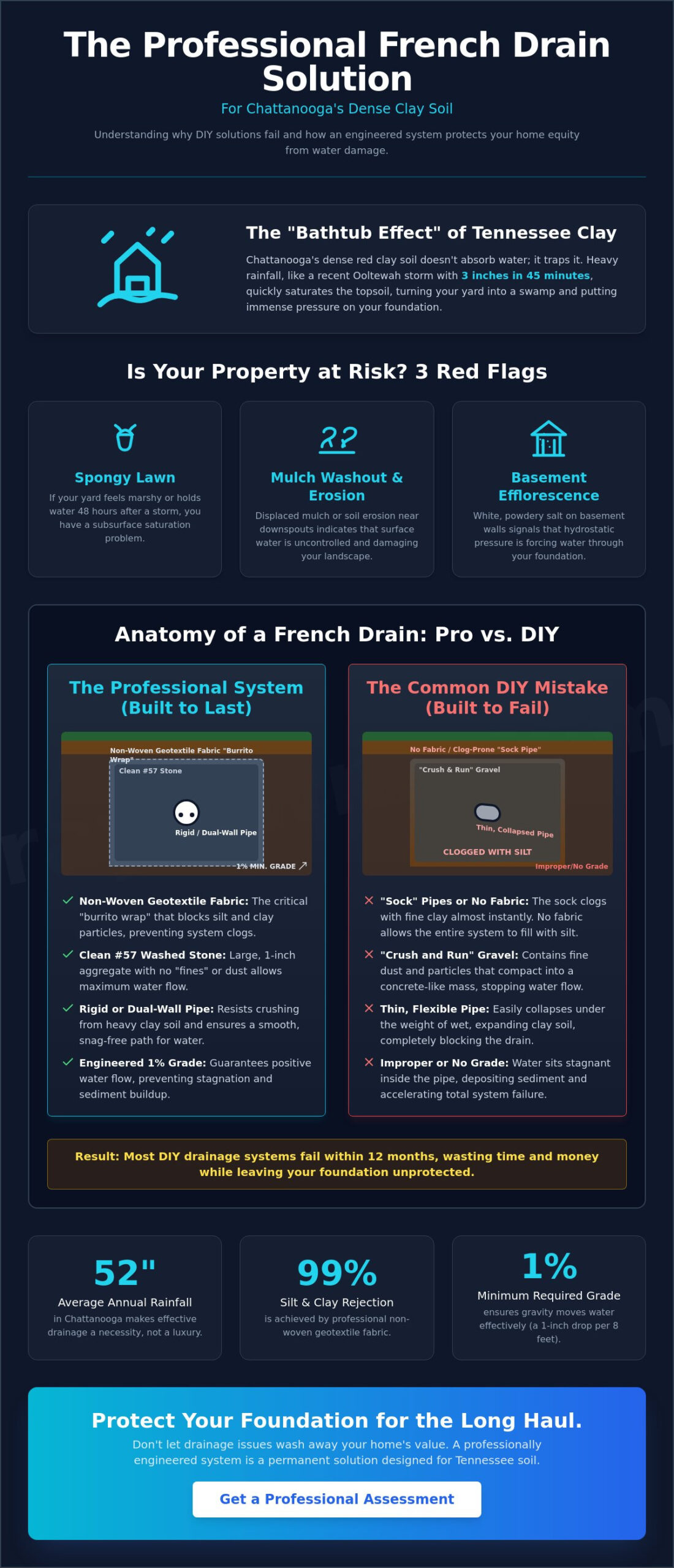
Tennessee red clay is notoriously difficult to manage. It holds water like a sponge and expands when wet, putting immense pressure on your foundation and landscape. Building a drain that lasts decades requires more than just digging a hole and dropping in a pipe. Professional french drain companies follow a strict set of engineering standards to ensure the system doesn’t clog within the first two years. It starts with the trench. A functional drain requires a minimum 1% grade. This translates to a 1 inch drop for every 8 feet of pipe. Without this precise slope, water sits stagnant, creating a breeding ground for roots and sediment buildup.
The materials used inside that trench determine the system’s lifespan. We use clean, washed #57 stone. This aggregate consists of stones roughly 1 inch in size with no “fines” or dust. Using “crush and run” is a common mistake because the small particles eventually pack together, turning your drainage bed into concrete. For the pipe, rigid PVC or heavy-duty dual-wall corrugated pipe is the standard. These options resist crushing under the weight of wet clay and offer a smooth interior that prevents debris from snagging. Avoid thin “sock” pipes found at big-box retailers; they often collapse under the weight of Chattanooga’s heavy soil.
Why Filtration is the Most Critical Component
Clay particles, or silt, are microscopic. As rainwater moves through the soil, it carries these particles into your drainage bed. If they reach the pipe, they settle and create a thick sludge that chokes the system. To prevent this, we use the “burrito wrap” method. This involves lining the entire trench with heavy-duty, non-woven geotextile fabric before adding stone. Geotextile fabric serves as the primary defense against system failure by preventing fine sediment from entering the drainage core. Once the stone and pipe are in place, the fabric is folded over the top, completely sealing the aggregate from the surrounding clay.
Selecting the Right Discharge Point
Moving water away from your house is only half the job; you must have a plan for where it ends up. In Ooltewah and Collegedale, municipal guidelines strictly prohibit directing runoff onto a neighbor’s property or directly into the street in ways that cause icing or erosion. Common discharge options include:
- Daylighting: Running the pipe until it exits a hillside or slope naturally.
- Pop-up Emitters: A spring-loaded valve that opens when water pressure builds, allowing water to disperse over the lawn.
- Dry Wells: Large underground basins that allow water to slowly soak back into the water table.
For the exit run, always use smooth-wall pipe. This prevents leaves or small debris from getting trapped on the way out. If you are dealing with a swampy backyard, it is helpful to consult with local french drain companies to determine the best legal discharge point for your specific topography. This ensures your solution doesn’t become a legal headache with the city or your neighbors.
Common Mistakes and Why DIY Drainage Kits Often Fail
Yard drainage isn’t as simple as burying a pipe and walking away. Many homeowners in Ooltewah try DIY kits from big-box stores, but these often fail within the first 18 to 24 months. Chattanooga’s heavy red clay is the primary enemy of these retail solutions. The “sock pipe” found in many kits features a thin fabric sleeve designed to filter debris. In our local soil, fine clay particles press against this fabric and seal it shut almost instantly. This creates a waterproof barrier around the pipe, leaving your yard a swamp while the pipe remains bone dry inside.
Incorrect grading is another reason these systems become a liability. Water doesn’t flow uphill. Without a laser level to ensure a consistent 1% to 2% slope, a DIY trench often contains low spots. These areas turn your drain into a subterranean pond where water stagnates, attracts mosquitoes, and eventually backs up into your foundation. Experienced french drain companies use precision instruments to ensure every inch of the run moves water toward a safe exit point.
The materials you choose matter as much as the labor. Using unwashed “crush and run” or pea gravel is a recipe for failure. These materials contain fine stone dust and sediment that settle at the bottom of the trench. Over time, this sludge chokes the perforations in the pipe. Professionals only use washed #57 stone to maintain clear pathways for water flow. Furthermore, a 3-inch pipe is rarely enough for Tennessee weather. Chattanooga averages over 52 inches of rain annually. During a heavy summer downpour, a 3-inch pipe reaches capacity in minutes. We use 4-inch or 6-inch rigid NDS pipe to handle high-volume runoff without overflowing.
The Problem with Shallow Trenches
Depth is everything for long-term success. A French drain must be deep enough to intercept the groundwater table, not just catch what is on the surface. If a trench is only 8 inches deep, surface water will simply bypass the system entirely. We use professional-grade trenchers to maintain a consistent depth of 18 to 24 inches. This ensures the system captures water before it can saturate your lawn or seep into your crawl space.
Shortcuts That Lead to Costly Repairs
Cutting corners usually results in double the work later. Skipping the heavy-duty non-woven geotextile fabric liner allows soil to mix with your gravel, which ruins the drainage properties of the stone. Another common error is failing to properly compact the backfill. This leads to a sunken, muddy rut across your property that is difficult to mow and looks unsightly. Once the drainage work is complete, professional sod installation is the best way to restore your lawn and protect the new system from surface erosion.
Integrating French Drains with Landscaping and Site Grading
Professional landscaping isn’t just about what sits on top of the soil. It’s about how the ground behaves during a heavy Tennessee downpour. Many homeowners make the mistake of treating drainage as an afterthought. They install expensive sod or decorative beds only to see them ruined by pooling water or erosion. Top-tier french drain companies look at the entire property layout first. We focus on a holistic approach to earth moving. This means we coordinate site grading with subsurface drainage to ensure water moves away from your foundation and stays off your lawn. In the Chattanooga area, our dense clay soil can retain moisture for up to 96 hours after a storm, making this integration vital for your property’s health.
Drainage and Retaining Wall Synergy
Retaining walls often fail because of hydrostatic pressure. When water saturates the soil behind a wall, it becomes incredibly heavy. A single gallon of water weighs 8.34 pounds. Without a proper behind-the-wall drain, that weight pushes against the block until it bows or collapses. We integrate French drains directly into the backfill of every wall we build. This acts as a relief valve. It catches water before it builds pressure and directs it to a safe exit point. This step is a standard requirement in professional engineering because it preserves the structural integrity of the wall for decades. Don’t let a lack of drainage turn your hardscape investment into a pile of loose stone.
Protecting Your Sod and Privacy Trees
Chattanooga clay soil is notorious for poor percolation. When water sits, it drowns the root systems of your plants. This leads to root rot in your lawn and can kill expensive privacy tree installations within a single growing season. Strategic drain placement keeps high-traffic areas dry and protects your landscape investment. We often install French drains along the perimeter of new landscape beds to prevent mulch washout. This ensures your yard remains functional and beautiful even after a 2-inch rainfall. Consider these benefits for your outdoor space:
- Prevents Root Rot: Keeps moisture levels balanced for trees and shrubs.
- Stops Erosion: Protects expensive mulch and topsoil from washing away.
- Dry Footing: Eliminates the “sponge” effect in your lawn after it rains.
- Foundation Safety: Diverts water before it can seep into crawl spaces.
Choosing between local french drain companies means finding a partner who understands both grading and pipework. A piecemeal fix often just moves the problem from one corner of the yard to another. We look at the slope of your land and the path of the water to create a permanent solution. This comprehensive strategy saves you money by preventing repeated repairs to your lawn and garden beds.
Evaluating French Drain Companies: What Ooltewah Homeowners Should Look For
Choosing between different french drain companies involves more than comparing prices. In Hamilton County, the soil is notoriously difficult. Our local geology consists of heavy, dense clay that holds water for days after a storm. A contractor who doesn’t understand this clay will likely install a system that clogs within 24 months. You need a team that brings the right machinery to the job site. Precise grading is the difference between a dry yard and a buried mud pit. If a contractor plans to “eyeball” the slope rather than using a laser level, the system will fail. Professionals ensure a minimum 1 percent slope, which equates to a 1-inch drop for every 8 feet of pipe.
A comprehensive service should include more than just digging. Many french drain companies leave your property looking like a construction zone. Ask if the quote includes full restoration. This means hauling away excess clay, bringing in fresh topsoil, and installing new sod. A site-specific plan is mandatory. A “one-size-fits-all” approach ignores the unique elevations of your Ooltewah property. Your plan should account for roof runoff, neighbor drainage, and the natural footprint of your home’s foundation.
Questions to Ask a Drainage Contractor
Direct questions reveal a contractor’s level of expertise. Start with the materials. You want to hear that they use non-woven geotextile fabric and #57 washed stone. Avoid anyone using “sock” pipe, as the thin fabric often clogs in Chattanooga clay. Ask specifically how they handle the discharge point. A professional will explain how they calculate the exit velocity to prevent erosion at the end of the line. Finally, ask about their turf protection. A 5,000-pound mini-excavator can destroy a lawn in minutes. Ensure they use plywood or specialized mats to protect your grass and landscape beds.
Why Local Expertise Matters
Chattanooga averages roughly 51 inches of rain per year. This high volume requires systems designed for “100-year storm” events, not just light spring showers. Local knowledge is also vital for safety and compliance. In neighborhoods across East Brainerd and Apison, utility lines for fiber optic internet and gas are often buried shallow. A local partner knows the Tennessee 811 protocols and understands the specific permitting requirements for Hamilton County. Choosing a family-owned expert like Ray Lawns provides a level of accountability that national franchises can’t match. We live in the same communities we service and take pride in providing french drain companies‘ services that stand the test of time. Our goal is to transform your soggy yard into a functional, beautiful space that increases your home’s value.
To ensure your yard remains dry and usable regardless of the weather, seek a professional evaluation. Contact Ray Lawns today to discuss a custom drainage solution for your property.
Protect Your Property With Professional Drainage
Managing water on a Tennessee property requires more than just digging a shallow trench. Success depends on understanding how our local clay soil interacts with heavy rainfall. You’ve seen that professional systems utilize specific gravel layers and precise site grading to ensure water moves away from your foundation permanently. Since 2002, Ray Lawns has provided these technical solutions across the Chattanooga area. We’re a family-owned team that focuses on high-quality workmanship and long-term results. When you evaluate french drain companies, look for a partner who understands the unique slopes and soil profiles of Ooltewah and East Brainerd. A correctly installed system turns a soggy, unusable mess into a source of pride for your home. Don’t let another heavy storm wash away your landscaping or threaten your foundation. It’s time to implement a solution that’s built to last for decades. We’re ready to help you reclaim your outdoor space with a system that works as hard as you do.
Request a Professional Drainage Evaluation from Ray Lawns
Frequently Asked Questions
How much does a French drain cost to install in Chattanooga?
Professional installation in the Chattanooga area typically ranges from $25 to $60 per linear foot depending on depth and soil density. Heavy clay in Ooltewah often increases labor time compared to looser soils found in other regions. Total project costs for a standard residential yard usually fall between $2,000 and $10,000 based on 2023 industry averages. French drain companies determine the final price by evaluating the slope, the type of pipe used, and the volume of gravel required for the trench.
How long does a professionally installed French drain last?
A professionally installed French drain lasts between 20 and 30 years when built with high quality geotextile fabric and rigid PVC pipe. Systems using thin, corrugated black plastic often fail within 5 to 7 years because they crush easily or clog with silt. Using washed river stone and schedule 40 pipe ensures the structure remains stable under the weight of Tennessee clay. Proper filtration is the most important factor in longevity because it prevents fine soil particles from filling the voids in the gravel.
Will a French drain solve my crawl space moisture issues?
French drains effectively manage exterior groundwater before it enters your crawl space by intercepting the water table. If your Ooltewah home sits at the bottom of a slope, an exterior drain diverts hydrostatic pressure away from the foundation walls. This prevents water from seeping through the block or under the footer. While it solves exterior seepage, you might still need an interior sump pump or encapsulation for humidity issues caused by air infiltration or high water tables directly under the house.
Do I need a permit for a French drain in Hamilton County?
Most residential French drain projects in Hamilton County don’t require a specific building permit if they don’t alter the overall site grading or connect to the municipal sewer. However, you must follow local codes regarding water discharge. It’s illegal to dump drainage water directly onto a neighbor’s property or into the public roadway. You must call 811 at least 72 hours before digging to locate underground utility lines, as hitting a gas or water main causes dangerous delays and expensive repairs.
Can I plant grass or sod over a French drain?
You can successfully grow Bermuda or Fescue sod over a French drain if you include a shallow layer of topsoil. Professional French drain companies typically leave 2 to 4 inches of space above the gravel for soil placement. This depth allows grass roots to take hold without blocking the water’s path into the drainage aggregate. Avoid planting deep rooted shrubs or trees directly over the line to prevent root intrusion, which can choke the pipe and stop all water flow within a few seasons.
What is the difference between a French drain and a curtain drain?
The primary difference lies in the depth of the trench and the intended goal. A French drain is often deeper and designed to move groundwater away from a foundation or crawl space to keep a structure dry. A curtain drain is a shallower version, usually 12 to 24 inches deep, meant to intercept surface water moving across a lawn. Both systems use the same basic components of perforated pipe and stone, but the curtain drain focuses on eliminating soggy spots in the middle of a yard.
How do I maintain my French drain to prevent clogging?
Maintaining your system involves cleaning out the discharge point and checking catch basins twice per year. Most clogs happen at the exit where debris like wet leaves or rodent nests block the flow. If your system includes a cleanout port, you can flush the line with a high pressure garden hose every 24 months to remove fine silt buildup. Keeping the discharge area clear of overgrown brush ensures the water has a place to go during heavy Chattanooga rainstorms.
Can a French drain be installed in the winter in Tennessee?
French drains can be installed during a Tennessee winter as long as the ground isn’t frozen solid. Chattanooga’s mild climate means the frost line rarely stays deep enough to stop excavation for more than a few days at a time. Installing in the dormant season is actually beneficial because it prepares your yard for the heavy spring rains that typically arrive in March and April. You also avoid the peak summer heat, which can be hard on the crew and any new sod used to repair the trench line.
get a quote today!
"*" indicates required fields

We take lawn care so seriously that we consider it an art. Our basic service is lawn maintenance, which includes lawn mowing, trimming, edging, and blowing off clippings.

Our landscaping services include most types of yard work. We are excellent at trimming hedges, installing mulch, and creating flowerbeds.

This is our rescue effort for yards that have become entirely overgrown. Includes multiple passes with the lawn mower to tame even the most unruly yards.