Last April, a homeowner in East Brainerd watched as a $12,000 backyard renovation literally slid down a 30 degree slope during a three inch rainfall. It’s a heartbreaking sight. This happens far too often when contractors ignore the physics of our local geography. You’ve likely felt that same frustration when your lawn stays saturated for five days after a storm. Finding the right Chattanooga landscaping companies means looking for teams that prioritize structural integrity over simple aesthetics.
You already know that Tennessee red clay is stubborn; it holds water like a sponge and turns a beautiful yard into a swamp. You deserve an outdoor space that stays functional and beautiful through every season. This guide teaches you how to navigate these unique terrain challenges to choose a partner that builds for longevity. We’ll examine the professional standards for retaining walls, the mechanics of proper drainage, and the specific markers of a contractor who actually stands by their work.
Key Takeaways
- Understand why Chattanooga’s dense red clay and heavy annual rainfall require a specialized approach to drainage to protect your home’s foundation.
- Discover why professional site grading is the most critical foundation for any outdoor project and how it prevents common structural failures.
- Learn how to evaluate Chattanooga landscaping companies based on their ability to manage hydrostatic pressure through engineered retaining walls.
- Compare Fescue and Bermuda turf options to determine which “instant yard” solution best handles the sloped environments of Hamilton County.
- Identify why site-specific planning and local experience are more valuable for long-term property health than choosing the lowest bid.
Understanding the Chattanooga Landscape: Clay, Slopes, and Stormwater
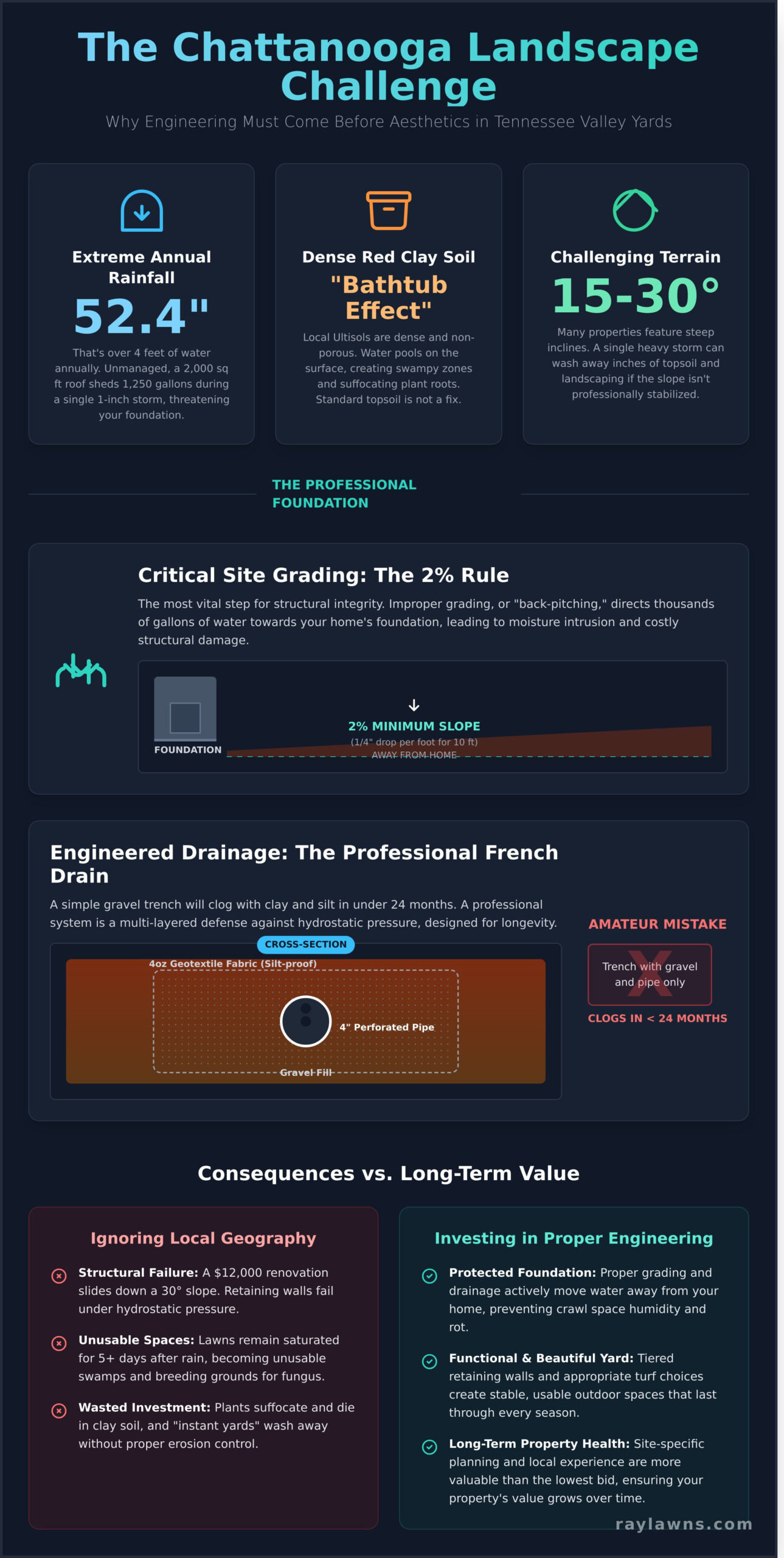
Chattanooga’s geography isn’t just a backdrop; it’s the primary hurdle for any outdoor project. Hamilton County sits in a region where the geology dictates the design. You deal with 52.4 inches of average annual rainfall. That is over four feet of water hitting your property every year. Without aggressive drainage planning, your yard becomes a retention pond. Professional Chattanooga landscaping companies must account for these heavy volumes immediately. They don’t just look at the grass; they look at the watershed of your entire lot.
The Tennessee Valley presents a unique set of micro-climates that vary significantly by elevation. A lawn in Ooltewah handles heat differently than a property on the 2,000-foot peaks of Signal Mountain. Humidity levels often exceed 70 percent during summer months. This moisture creates a breeding ground for brown patch and other fungal diseases. Selecting the right turf isn’t about what looks best in a catalog. It’s about what survives the local “steamer” effect while maintaining a deep root system in difficult earth.
The Problem with Red Clay Soil
Local soil is dominated by Ultisols, commonly known as East Tennessee red clay. This material is dense and acidic. It lacks the pore space necessary for oxygen to reach plant roots. Because of the specific properties of clay soil, it acts like a seal when compacted. Water sits on the surface instead of soaking in. This leads to swampy corners that never dry out, even days after a storm. It’s a structural challenge that requires more than just a layer of topsoil to fix.
Professional teams don’t guess about soil health. They perform percolation tests to see how fast water moves through your specific ground. If the water stands for hours, the soil requires mechanical aeration or the addition of organic soil amendments to break the chemical bonds of the clay. We often see homeowners waste thousands on plants that suffocate because the installer didn’t address the “bathtub effect” created by digging a hole in raw clay.
Managing Steep Terrain in the Tennessee Valley
Gravity defines the landscape in East Brainerd and surrounding ridges. Many lots feature a 15-degree incline or steeper. This verticality makes standard maintenance dangerous and ineffective. Mowing a steep hill doesn’t just exhaust the operator; it tears the turf and leads to ruts. When Chattanooga landscaping companies evaluate these sites, they prioritize stabilization over aesthetics. A single heavy thunderstorm can wash away three inches of topsoil in twenty minutes if the slope isn’t anchored correctly.
Effective erosion control requires a mix of hardscaping and deep-rooted vegetation. Off-the-shelf plans fail because they don’t account for the velocity of runoff on a Tennessee hillside. We use tiered retaining walls or boulder outcroppings to break the fall of water. This slows the flow and protects your investment. Every stone and plant must serve a functional purpose in holding the earth together. If your landscaper isn’t talking about “riprap” or “silt fencing” during a slope renovation, they aren’t planning for the reality of our region’s weather patterns.
Site Grading and Drainage: The Foundation of Professional Landscaping
In Chattanooga, the ground isn’t just dirt; it is heavy, non-porous red clay. This soil type creates a unique challenge for homeowners in East Brainerd and Ooltewah. When a typical afternoon thunderstorm drops 1 inch of rain, a 2,000-square-foot roof sheds roughly 1,250 gallons of water. Without proper grading, that volume of water settles against your foundation or pools in the middle of your lawn. Top-tier Chattanooga landscaping companies view grading as the most critical step of any project. If the “bones” of the yard are crooked, every dollar spent on plants or pavers is at risk.
The professional process focuses on the 2% rule. This means the ground must slope away from the home at a rate of at least 1/4 inch per foot for the first 10 feet. We use 74-horsepower skid steers to move bulk tonnage quickly, but we switch to manual labor with specialized grading rakes for the final 3 inches of soil. This precision ensures we don’t nick underground utility lines or damage the root systems of established oaks. Cutting corners here leads to “back-pitching,” where water flows toward the house. We’ve seen this mistake cause 100% humidity levels in crawl spaces, leading to wood rot and structural issues within 3 years of a bad install.
The Anatomy of a Professional French Drain
A common myth is that a French drain is just a trench filled with gravel. In the humid Tennessee climate, a “naked” drain like that will clog with silt in less than 24 months. We use 4-inch perforated NDS pipe wrapped in a 4-ounce non-woven geotextile fabric. This fabric acts as a filter, letting water in while keeping the fine Chattanooga clay out. We calculate a minimum 1% slope, ensuring the water moves at a velocity of at least 2 feet per second to keep the pipe self-cleaning. We also integrate gutter downspouts into solid PVC lines, keeping roof water separate from the sub-surface groundwater system.
Steps to Effective Site Grading
The process begins with a laser level survey to identify high points and natural runoff paths. We don’t guess where the water goes; we measure it to the tenth of an inch. After the initial cut, we focus on sub-soil compaction. We use a 3,000-pound plate compactor to ensure the ground won’t settle unevenly under new patios or walkways. The final grade involves hand-tilling the top 2 inches of soil to create a smooth, debris-free bed. This preparation is essential for successful Tennessee turfgrass selection, as even the best sod will fail if it can’t establish deep roots in well-drained soil. Whether you are in Apison or Collegedale, a smooth finish is the difference between a lawn that looks like a golf course and one that looks like a cow pasture.
If you notice standing water that lasts more than 24 hours after a rain, your current grading is failing. It’s best to schedule a professional site evaluation to identify these drainage bottlenecks before they impact your home’s value or your family’s comfort.
Structural Hardscaping: Engineering Retaining Walls and Paver Patios
Chattanooga is not flat. If you live in Ooltewah or near the ridges of Signal Mountain, you deal with elevation changes daily. Many homeowners view a retaining wall as a simple stack of stones. In reality, it is a complex engineering project designed to fight gravity. The primary enemy of any wall in Tennessee is hydrostatic pressure. When our heavy seasonal rains saturate the local red clay, that soil becomes immensely heavy. Saturated earth can exert over 60 pounds of pressure per square foot for every foot of wall height. Without a way for that water to escape, even the thickest stone will eventually bow and fail. Top-tier Chattanooga landscaping companies prioritize drainage over aesthetics for this exact reason.
There is a massive difference between a 12-inch decorative garden border and a structural earth retention system. Decorative walls rely on their own weight to stay upright. Structural walls, typically anything over 36 inches tall, require deep footings and internal reinforcement. Choosing the right materials is also vital for the Hamilton County climate. Our region experiences 40 to 50 freeze-thaw cycles every winter. This constant expanding and contracting of the ground can shatter low-quality concrete or shift poorly laid stone. We recommend using high-density concrete pavers or natural Tennessee fieldstone that can withstand these temperature swings without cracking or scaling.
For flat surfaces, pavers are superior to poured concrete in our shifting soil. Poured concrete is rigid. When the clay soil in Apison or East Brainerd expands in the spring, the concrete must crack to relieve the stress. Paver systems are flexible. They consist of individual units that “breathe” and move independently. This allows the patio to shift slightly without any visible damage or structural failure.
Building Retaining Walls to Last
Success starts underground. A wall that stands 4 feet tall requires a trench at least 12 to 18 inches deep to accommodate a compacted stone footing. We never build on raw dirt. We backfill the space behind the wall with at least 12 inches of clean #57 stone. This creates a vertical drainage column that directs water toward a perforated pipe at the base. Following standards taught in the UT Extension Certified Landscape Professional Program ensures these structures remain stable for decades. For steep slopes in Ringgold, we integrate geogrid reinforcement. This high-strength grid extends up to 6 feet back into the hillside, locking the wall blocks into the soil mass itself.
Paver Installation Standards
A professional paver patio is a multi-layer system. We start with a minimum 6-inch base of crushed, compacted stone. This base provides the structural integrity needed to prevent dipping and settling. We use polymeric sand to fill the joints between pavers. This specialized sand contains a binder that hardens when misted with water, creating a barrier that stops 95% of weed growth and prevents ants from nesting. To finish the job, we install heavy-duty edge restraints secured with 10-inch steel spikes. This prevents “lateral creep,” which is when the outer edges of a patio begin to migrate into the lawn after a few years of use. Reliable Chattanooga landscaping companies don’t skip these hidden steps because they know the base is what determines the lifespan of the project.
Sod Installation and Plant Selection for the 2026 Season
Choosing the right turf for a Chattanooga lawn requires a clear understanding of our local transition zone. In 2026, homeowners must decide between Fescue and Bermuda based on their specific lot conditions. Tall Fescue remains a favorite for its deep green color during the winter months. However, it requires 1.5 inches of water per week when July temperatures hit 95 degrees. Bermuda is a heat-loving workhorse that thrives in the humidity of August. It goes dormant and turns tan when temperatures drop below 50 degrees, but its ability to self-repair makes it ideal for high-traffic yards in Ooltewah and East Brainerd.
For properties with significant slopes, sod is the only reliable option. A single 30-minute thunderstorm can wash away $600 worth of seed and straw on a 20-degree incline. Sod provides an instant root matrix that stabilizes the soil immediately. Most professional Chattanooga landscaping companies prioritize sod for new builds to prevent red clay runoff from staining driveways and sidewalks. Timing is equally vital. We schedule Fescue installations between September and October, while Bermuda performs best when installed during the warming trends of April and May.
Professional Sod Installation Process
Success starts 6 inches below the surface. We till the existing ground to break up compacted red clay and mix in organic soil amendments to lower the bulk density. Our crews lay each piece in a staggered brick pattern. This technique eliminates long, continuous seams that allow water to channel and erode the subgrade. The first 14 days are the most critical period. You must keep the soil consistently moist to encourage the new roots to knit into the amended bed. Skipping a single afternoon of watering during this window can result in a 30 percent loss of the total area.
Best Privacy Trees for Chattanooga
Creating a natural screen in Ooltewah requires species that can survive heavy clay and occasional drought. While many people ask for Leyland Cypress, we often steer them toward Green Giant Arborvitae. Leyland Cypress is highly susceptible to Seiridium canker in our humid climate, which can kill a 15-foot tree in one season. Green Giants are more resilient and grow up to 3 feet per year. We also recommend native Tennessee species like the Eastern Red Cedar. These are adapted to our local rainfall patterns and require zero supplemental fertilizer once established. We space these trees 8 to 10 feet apart to ensure proper airflow, which prevents fungal growth and needle drop.
Strategic placement is a technical necessity. We map out utility lines and drainage paths before any hole is dug. Planting a row of trees directly over a French drain or a primary sewer line will lead to expensive repairs within 5 to 7 years. Our goal is to block the neighbor’s view without creating a dam that traps water against your foundation. Using a mix of heights and textures creates a more natural look and provides a better habitat for local birds.
If you are ready to transform your backyard into a private retreat, get a professional landscaping evaluation today.
Evaluating Chattanooga Landscaping Companies: Beyond the Quote
Choosing a contractor based solely on a bottom-line price often leads to expensive repairs within 24 months. In the Chattanooga area, roughly 18% of our annual projects involve fixing structural failures caused by cut-rate crews who didn’t account for local soil conditions. A low bid usually indicates a lack of familiarity with East Tennessee’s heavy red clay or the specific grading needs of our region. Experience matters when you’re moving tons of earth. A team with 20 years in the dirt knows how our 51 inches of annual rainfall affects a newly graded yard. They won’t just spread mulch and leave; they’ll ensure the foundation is secure before the first plant is installed.
National franchises often use “cookie-cutter” templates that ignore the reality of your property. In Ooltewah or East Brainerd, two adjacent lots can have entirely different needs. One yard might sit on a 12-degree incline while the neighbor’s lot acts as a basin for neighborhood runoff. Proper planning requires a site-specific approach. This means analyzing the watershed of your specific parcel rather than applying a generic design. If a contractor doesn’t discuss soil percolation or slope stabilization during the initial walkthrough, they aren’t planning for the long-term health of your home.
Operating a 6,500-pound compact track loader requires more than just a trailer and a truck. You must verify insurance and licensing for heavy equipment operation. If an uninsured contractor hits a buried utility line or damages a retaining wall, the homeowner is often left liable for the costs. Professional Chattanooga landscaping companies carry comprehensive general liability and workers’ compensation policies that protect your property. Always ask to see a current certificate of insurance before any machines arrive at your home. This simple step separates legitimate professionals from fly-by-night operations.
The value of a family-owned approach can’t be overstated. While national chains focus on quarterly volume and high employee turnover, local specialists focus on community reputation. We live in these neighborhoods. We see our clients at the grocery store in Collegedale or the parks in Apison. That local accountability ensures the work meets a higher standard. You aren’t just a line item on a spreadsheet; you’re a neighbor who expects a professional result from Chattanooga landscaping companies that actually know the local terrain.
Questions to Ask Your Contractor
Before you sign a contract, ask how they handle unexpected drainage issues. If they dig into a hidden spring or a pocket of saturated clay, they need a plan ready to go. Ask if they own their equipment or rely on local rental yards. Companies that own their fleet avoid the scheduling delays that happen when rentals are booked up. Finally, ask to see a project in the Chattanooga area that is at least 5 years old. Any yard looks great on day one. The real test is how it looks after five seasons of Tennessee humidity and winter freezes.
The Ray Lawns Difference
Our “no-nonsense” philosophy is built on the idea that results should speak for themselves. We’ve been rooted in Ooltewah since 2002, giving us over 22 years of experience with the unique challenges of Hamilton County terrain. We prioritize the structural health of your lawn above all else. If the drainage isn’t right, the most expensive sod in the world won’t survive the summer. We don’t hide behind corporate jargon or flashy sales pitches. We show up on time, work with precision, and respect your property from the first shovel turn to the final cleanup.
Secure the Future of Your Chattanooga Property
Investing in your outdoor space requires more than just a fresh layer of mulch or a few new shrubs. Since 2002, we’ve seen how our region’s heavy red clay and steep ridges can compromise poorly planned projects within a single rainy season. Choosing the right partner among Chattanooga landscaping companies means finding a team that prioritizes subsurface drainage and structural engineering before the first piece of sod hits the ground. Your yard should look as good in 2030 as it does for the 2026 season. Focus on contractors who treat a retaining wall as a critical piece of infrastructure rather than a decorative border. When you address grading and soil composition correctly from day one; you protect your home’s foundation and your financial investment.
Ray Lawns remains a family-owned operation dedicated to the Ooltewah and Chattanooga communities. We bring 22 years of hands-on experience to every sloped lot and drainage challenge we encounter. Our team provides a stress-free transformation that turns a difficult yard into a functional source of pride. Request a Free Professional Evaluation from Ray Lawns to start your project today. Let’s build a landscape that stands the test of time.
Frequently Asked Questions
How much does professional landscaping cost in Chattanooga?
Most residential landscaping projects in the area range from $3,500 to $15,000 depending on the scope of work. Basic softscaping like mulch and shrub installation sits at the lower end, while hardscapes like stone patios or retaining walls often exceed $20,000. Factors like site accessibility and the amount of red clay excavation required will impact your final investment.
What is the best time of year for sod installation in Tennessee?
The ideal window for laying fescue sod is between September 15 and November 15 or during the early spring months of March and April. These periods offer temperatures between 60 and 75 degrees, which allows roots to establish without the stress of 90-degree summer heat. Successful installs require consistent watering for the first 21 days to ensure the turf bonds with the local soil.
Do I need a permit for a retaining wall in Hamilton County?
You must obtain a building permit for any retaining wall that stands over 4 feet tall from the bottom of the footing to the top of the wall. Structures exceeding this 48-inch height limit require a design certified by a licensed engineer to ensure they can handle the lateral pressure of wet clay. Smaller walls don’t usually require paperwork, but they still need 12 inches of gravel backfill for proper drainage.
How do I fix standing water in my backyard after it rains?
The most effective solution for local yards is installing a French drain system using 4-inch perforated pipe and washed stone. Chattanooga landscaping companies frequently deal with heavy clay that prevents natural absorption, leading to puddles that last more than 48 hours. A professional drainage system captures this subsurface water and redirects it toward a lower point or a dedicated dry well away from your foundation.
What is the difference between grading and simple yard leveling?
Grading involves using heavy machinery to change the actual slope of the land, while leveling focuses on filling small depressions with a sand and topsoil mix. You need grading if water flows toward your home or pools against the crawl space. Leveling is a cosmetic fix for a bumpy lawn that uses a 70/30 soil blend to create a smooth surface for mowing and foot traffic.
Are paver patios better than stamped concrete for sloped yards?
Paver patios are the better choice for sloped terrain because they are flexible and won’t crack when the ground shifts. Stamped concrete is a rigid slab that often fails on a 10 percent grade due to soil expansion and contraction. If a paver settles over 5 years, you can lift and reset that specific 12-inch section rather than replacing the entire 400-square-foot patio.
How long does a typical landscaping project take to complete?
A standard residential installation typically takes 3 to 8 business days once the crew arrives on-site. A 500-square-foot paver patio usually requires 4 days of labor, including excavation and base preparation. Weather is the primary variable in Hamilton County, as 1 inch of rainfall can saturate the clay and delay heavy equipment use for at least 24 hours.
Which privacy trees grow the fastest in the Ooltewah area?
Green Giant Arborvitae and Nellie R. Stevens Hollies are the most reliable fast-growing options for local homeowners. Green Giants can grow up to 3 feet per year when planted in well-draining soil with 6 hours of daily sunlight. These species are more resistant to the bagworms and root rot that often kill Leyland Cypresses in our humid climate within 7 to 10 years.
get a quote today!
"*" indicates required fields

We take lawn care so seriously that we consider it an art. Our basic service is lawn maintenance, which includes lawn mowing, trimming, edging, and blowing off clippings.

Our landscaping services include most types of yard work. We are excellent at trimming hedges, installing mulch, and creating flowerbeds.

This is our rescue effort for yards that have become entirely overgrown. Includes multiple passes with the lawn mower to tame even the most unruly yards.