
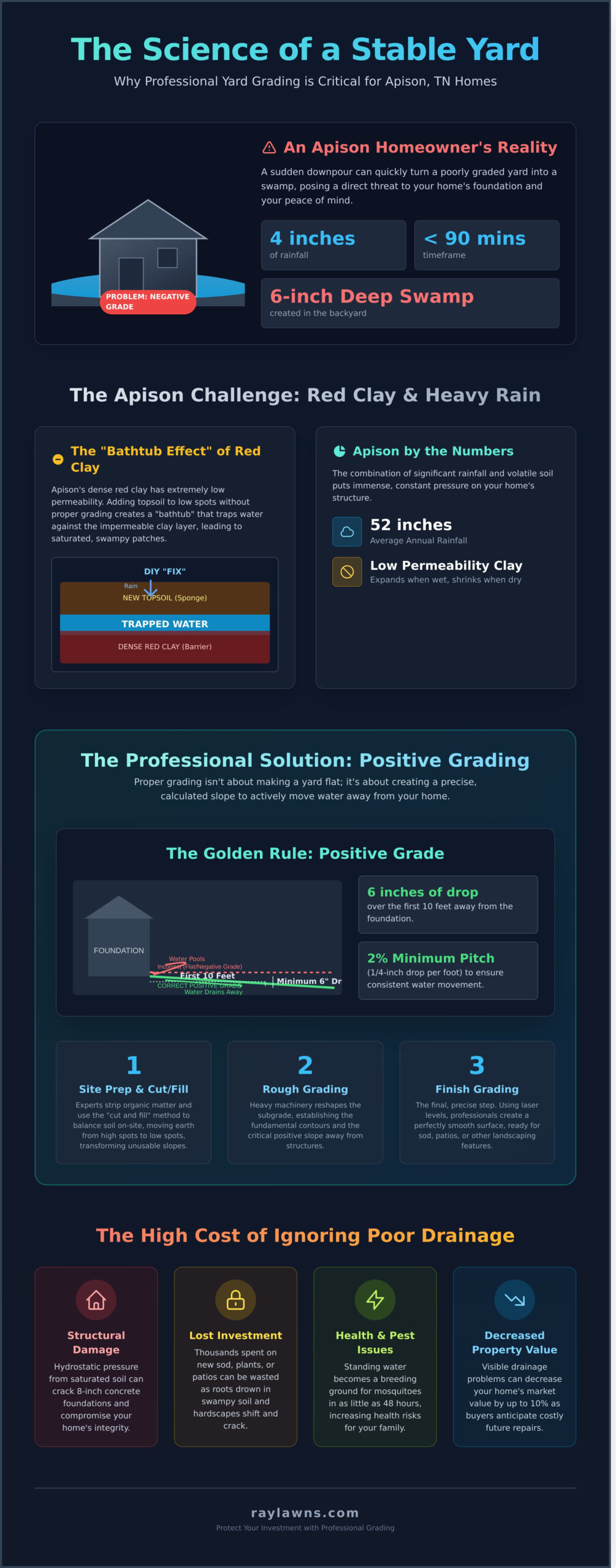
On May 4, 2023, an Apison homeowner watched as 4 inches of sudden rainfall transformed their backyard into a 6-inch deep swamp in under 90 minutes. When you’re dealing with the steep runoff from White Oak Mountain, professional yard grading Apison TN becomes a necessity rather than a luxury. It’s frustrating to watch your lawn wash away or see water pooling dangerously close to your foundation. You shouldn’t have to worry about structural rot or a muddy mess every time a thunderstorm crosses Hamilton County.
This guide shows you how proper site grading protects your home’s integrity and transforms unusable slopes into functional outdoor living areas. We’ll explore the specific challenges of Apison’s heavy clay soil and the exact methods professionals use to ensure your property drains efficiently. You’ll learn how a calculated slope can prep your yard for a healthy new lawn or a stable stone patio that stays dry for years. By the end of this article, you’ll understand why getting the elevation right is the most critical step in any landscaping project.
Key Takeaways
- Learn the “Positive Grade” rule and how moving water at least 10 feet away from your foundation prevents long-term structural damage.
- Understand why East Tennessee’s red clay requires professional yard grading Apison TN instead of simply adding more dirt to low spots.
- Discover how laser-leveled precision during the rough and finish grading phases ensures a perfect, stable base for sod and landscaping.
- Explore the “cut and fill” method used by experts to balance soil on-site and transform steep, unusable slopes into functional yard space.
- See why proper site preparation is the critical first step for protecting your investment in new paver patios and hardscape features.
What is Yard Grading and Why is it Critical for Apison Homes?
Yard grading is the strategic process of reshaping the land around a home to control how water moves across the surface. It is not just about making a lawn look smooth; it is a technical necessity. In the field of Grading (earthworks), the goal is to use gravity to protect structures. For homeowners looking into yard grading Apison TN, the focus is usually on establishing a “Positive Grade.” This industry standard requires the ground to slope away from the foundation at a minimum rate of 6 inches of drop over the first 10 feet. This ensures that the 52 inches of average annual rainfall we see in the Chattanooga area is directed toward a safe discharge point rather than sitting against your home.
Apison properties face unique challenges due to the regional topography and soil composition. Much of the land in Hamilton County consists of heavy red clay. This soil is dense and holds moisture for long periods. When water isn’t moved at least 10 feet away from the foundation, the clay becomes saturated and expands. This puts immense pressure on your home’s footings. Professional grading distinguishes itself from simple aesthetic leveling. While a level yard looks nice, a functionally graded yard incorporates subtle, calculated slopes that prevent water from becoming trapped. Without this precision, even the most beautiful lawn can become a liability.
Signs Your Apison Property Needs Professional Regrading
You don’t need to be an engineer to spot a failing grade. If you notice spongy turf or standing water that lasts more than 24 hours after a typical Tennessee thunderstorm, your soil isn’t draining. Look for “riverbeds” or visible soil erosion paths carved into your lawn or mulch beds. These are clear indicators that runoff is uncontrolled. Most importantly, check your crawl space or foundation walls for dampness or pooling water. If the ground slopes toward your house rather than away from it, your property is a candidate for professional yard grading Apison TN.
The Consequences of Ignoring Poor Yard Drainage
Ignoring drainage issues leads to expensive structural repairs. When water stays trapped near your home, it creates hydrostatic pressure. This force is strong enough to crack 8-inch concrete blocks and push basement walls inward. Beyond the foundation, poor grading ruins your landscape investment. We often see homeowners spend thousands on new sod only for it to fail because the roots drown in “swampy” soil. Saturated ground lacks the oxygen necessary for grass to survive. There are also health and financial risks to consider. Standing water becomes a breeding ground for mosquitoes in as little as 48 hours. Furthermore, visible drainage problems can decrease a property’s market value by up to 10 percent, as savvy buyers recognize the potential for future structural damage.
The Science of Grading: Managing Apison’s Red Clay and Slopes
Apison sits in a unique geological pocket of Hamilton County. The soil here is dominated by East Tennessee red clay, a material known for its high iron content and extremely low permeability. This clay consists of tiny, flat particles that pack together tightly. When it rains, these particles swell and create a nearly waterproof barrier. Because Apison receives an average of 52 inches of rainfall annually, this soil often stays saturated for days.
Many homeowners try to fix low spots by simply dumping loose topsoil into a hole. This is a mistake. Without proper integration, the new soil acts like a sponge sitting on top of a concrete floor. Water moves through the topsoil, hits the hard clay underneath, and stays there. This creates a “bathtub effect” that leads to soft, muddy patches. Professional yard grading Apison TN requires stripping back organic matter and reshaping the subgrade itself. We focus on surface runoff because “perc” (percolation) rates in local clay are often too slow to handle heavy storms. Successful drainage depends on moving water across the surface to a designated exit point. Following Land Grading best practices ensures that this water movement doesn’t cause erosion or damage neighboring properties.
Understanding the “Clay Factor” in Hamilton County
Clay is a volatile building material. It expands significantly when wet and shrinks during our hot, dry August weeks. This constant movement can shift patios and put pressure on foundation walls. To combat this, we establish a minimum pitch of 2%. This translates to a 1/4-inch drop for every foot of distance. This precise slope is the industry standard for moving water away from a home’s foundation. We also remove “dead” soil, which is soil mixed with old roots or rotting debris. This ensures that any clean fill we add bonds directly to the earth, creating a stable, long-term solution.
Working with the Natural Slopes of the Tennessee Valley
The topography in Apison varies wildly. You might have a flat lot near the valley floor or a steep, rolling yard near the foothills of White Oak Mountain. If your property is lower than your neighbor’s, you are likely dealing with their runoff as well as your own. We manage this by installing engineered swales. These are shallow, wide channels lined with grass or stone that catch water and redirect it naturally. In areas where the slope exceeds a 3-to-1 ratio, we often recommend a retaining wall. This allows us to flatten out sections of the yard while providing a structural barrier against soil creep.
Professional yard grading Apison TN starts with an accurate assessment of these elevation changes. If you aren’t sure where your water is going, it’s a good idea to request a professional site evaluation to identify the high and low points of your property. This data-driven approach prevents the common trial-and-error mistakes that lead to flooded crawl spaces and ruined turf.
Rough Grading vs. Finish Grading: What Homeowners Need to Know
Successful yard grading Apison TN projects depend on understanding that site preparation happens in layers. You can’t just throw dirt down and expect it to drain properly. Professionals divide the work into two distinct phases: rough grading and finish grading. Skipping either step is a recipe for standing water and potential foundation damage. Each phase requires different tools and serves a specific purpose in the longevity of your landscape.
The Rough Grading Phase: Setting the Foundation
Rough grading is the heavy lifting of the project. We use 75-horsepower skid steers or mini-excavators to cut into hillsides and fill low spots. In Apison, this often involves clearing dense brush and removing large limestone rocks that interfere with the sub-grade. This phase establishes the fundamental principles of yard grading by creating a 2% minimum slope away from your home’s foundation. Without this structural base, your property won’t shed water correctly during a heavy Tennessee downpour.
Many homeowners try to tackle this with a standard 25-horsepower DIY tractor. Those machines lack the hydraulic down-pressure needed to compact red clay effectively. If the sub-grade isn’t packed down tight, the soil will settle unevenly within 6 months. This creates new puddles and soft spots where you least want them. Professional equipment ensures the ground is stable enough to support future structures or heavy turf.
Finish Grading: The Secret to a Perfect Lawn
Finish grading is the precision work that happens once the heavy shaping is complete. This stage focuses on the top 2 to 4 inches of the soil profile. We use specialized Harley rakes or power box rakes to pulverize clay clumps and screen out stones larger than 1 inch. This creates a smooth, friable seedbed that allows new grass roots to penetrate the soil easily. It’s the difference between a bumpy field and a professional-grade lawn that is easy to mow.
This process is about more than just looks. A well-executed finish grade ensures that water doesn’t sit in small micro-depressions. In the Chattanooga area, our 52 inches of annual rainfall will quickly find any small dip in your yard. We use hand-raking for the final pass around delicate areas like flower beds and walkways to ensure the transition is seamless. This level of detail prevents the “scalping” that happens when a mower hits a high spot in an uneven yard.
- Rough grading moves 90% of the bulk material to ensure water flows toward drainage outlets.
- Finish grading incorporates high-quality topsoil to provide nutrients for sod or seed.
- Failing to rough grade leads to structural drainage failure within the first year.
- Failing to finish grade results in a lumpy lawn that is difficult to maintain and walk on.
Professional yard grading Apison TN requires the right sequence. We see too many properties where someone tried to fix a drainage issue by just spreading a few loads of topsoil. That’s a temporary fix. Without a solid sub-grade established during the rough grading phase, that new soil will eventually wash away or settle into the same old holes. Proper grading is a permanent solution that protects your investment and your home.
The Professional Yard Grading Process: Step-by-Step
Successful yard grading Apison TN requires more than a skid steer and a good eye. The dense red clay found throughout Hamilton County is notoriously difficult to manage because it holds water like a sponge and resists natural drainage. We approach every project with a clear sequence designed to move water away from your home’s foundation and prevent pooling in the middle of your lawn. Precision is the difference between a dry, usable backyard and a muddy swamp that kills your grass.
We begin by establishing a baseline for the entire property. Local terrain in Apison often features rolling hills or steep drops that can hide subtle dips where water collects. Without a professional plan, you risk simply moving the water problem from one side of the house to the other. Our process ensures the water has a clear, unobstructed path to a safe exit point.
Site Evaluation and Laser Leveling
We use high-precision transit levels to identify the exact “high” and “low” points of your yard. You can’t accurately judge a 2% slope across a 60-foot span with the naked eye. This 2% grade is our gold standard; it’s enough to move water effectively without causing soil erosion. Before any machinery touches the ground, we coordinate with 811 to mark all underground utilities. Damaging a water line or fiber optic cable can stall a project for days and create unnecessary costs. Once the utilities are flagged, we map out the new water flow path. We look for the most efficient route to the street, a storm drain, or a wooded area at the property line.
Execution: Moving Earth with Precision
The first physical step involves stripping away the existing “bad” turf. We don’t grade over old grass because decaying organic matter creates air pockets that lead to uneven settling later. We utilize the “cut and fill” method to balance the soil on-site. This involves cutting down the high spots and using that exact same soil to fill in the depressions. By balancing the dirt we already have, we reduce the need for expensive imported fill dirt. If the natural slope of the land is too flat, we sculpt swales. These are shallow, wide channels designed to act as natural water highways. A well-constructed swale is subtle enough to mow over but deep enough to carry thousands of gallons of runoff during a Tennessee downpour.
Integration and Final Compaction
In many cases, yard grading Apison TN needs an extra boost from mechanical drainage. If the soil is too saturated or the slope is restricted, we integrate French drains or catch basins into the grade. These systems capture subsurface water and whisk it away before it can soften the ground. The final, and perhaps most vital, step is soil compaction. We use heavy plate compactors to press the soil into a stable base. Loose soil can settle by as much as 15% after the first three heavy rains, which would ruin the precision of the new grade. We ensure the ground is firm and ready for sod or seed. To ensure your property is protected from the next storm, you should schedule a professional site evaluation to identify your yard’s specific drainage needs.
Beyond the Grade: Completing Your Apison Landscape
Proper grading isn’t a standalone task. It’s the structural backbone for every outdoor feature you build or plant. Whether you’re laying 2,500 square feet of Bermuda sod or installing a heavy stone fire pit, the dirt beneath must be stable and shed water correctly. In Apison, our heavy red clay holds moisture like a sponge. If the grade isn’t right, your landscape investment will likely wash away or rot within the first 18 months. We treat the soil as a foundation, ensuring it supports the weight of your vision while managing the 52 inches of average annual rainfall we see in Hamilton County.
Pairing Grading with Sod for Instant Curb Appeal
Professional sod installation fails most often because of poor site prep. We ensure a 2% minimum slope away from your home to keep water moving toward designated drainage zones. Without a perfectly smooth surface, you’ll feel every bump and dip under your lawnmower. On the steep hills common in the Ooltewah and Apison area, we use specific grading techniques to prevent “sod slip.” This occurs when water gets trapped between the new sod and the hard-packed clay, causing the grass to slide down the incline before roots can take hold. Proper yard grading Apison TN creates a porous, level surface where roots can dive 4 to 6 inches deep into the soil within 14 days. This prevents the “bathtub effect” where standing water rots the root system from the bottom up.
Grading for Hardscapes and Retaining Walls
Building a paver patio on uncompacted or uneven soil is a recipe for shifted stones and trip hazards. We excavate and grade to create a stable base, typically requiring 6 inches of compacted crushed stone. For retaining walls, the grade behind the structure is just as vital as the base below it. We focus on backfilling with clean gravel to relieve hydrostatic pressure. Without this step, a 4-foot wall can lean or collapse under the weight of saturated Tennessee clay during a heavy storm.
to ensure your hardscape stands for decades without shifting an inch.
Trees and shrubs require oxygen as much as they need water. In Apison, flat spots in the yard often lead to standing water that drowns root balls. We grade planting beds to ensure a slight rise, keeping the “crown” of the plant above the saturation line. This simple adjustment can increase plant survival rates by 45% in our local climate. Ray Lawns has spent 23 years perfecting these techniques across Ooltewah, Apison, and East Brainerd. We’ve seen how local weather patterns can wreak havoc on a poorly graded site. Our team uses laser levels and professional equipment to transform your property into a functional, beautiful space. We don’t just move dirt; we build the foundation for your home’s long-term value and curb appeal. Let us handle the heavy lifting so your landscape can thrive for years to come.
Protect Your Home With Professional Site Preparation
Proper drainage isn’t a luxury; it’s a necessity for every property owner in Hamilton County. When you ignore slope issues, Tennessee red clay traps water against your foundation and eventually destroys your landscape. Our family-owned team has served the Chattanooga area since 2002, and we’ve spent over 20 years mastering the unique challenges of the local terrain. We understand how to move soil with precision to ensure your home remains dry and your lawn stays healthy. Investing in professional yard grading Apison TN prevents basement leaks and soil erosion that often lead to five-figure repair bills later. We focus on the technical details of rough and finish grading so you don’t have to worry about the next heavy rainstorm. Let our local specialists provide the reliable, hardworking service your property deserves. You’ve worked hard for your home; we’ll work hard to protect it.
Get your free yard grading estimate in Apison today!
You deserve an outdoor space that is both beautiful and functional, and we’re ready to help you start that transformation today.
Frequently Asked Questions
How much does yard grading cost in Apison, TN?
Most residential grading projects in Apison range from $3,000 to $9,500 depending on the scope of the work. Factors like the volume of dirt moved, the number of trees cleared, and the need for 20 tons of imported topsoil drive these numbers. Every property has unique elevation challenges, so a detailed site assessment is necessary to determine the exact resources required.
Will yard grading fix my wet crawl space?
Proper yard grading is the most effective way to keep your crawl space dry. By creating a 5 percent slope away from your foundation, we ensure that the 51 inches of annual rainfall in Hamilton County doesn’t pool against your footings. This eliminates the hydrostatic pressure that typically forces water through block walls and into your home’s substructure.
How long does a typical yard grading project take?
A standard residential grading job takes 2 to 4 days to complete from start to finish. Small drainage corrections might wrap up in 24 hours, while complex site prep for a new shop or pole barn can take a full week. We work efficiently to minimize the time your lawn looks like a construction zone.
Do I need a permit for yard grading in Hamilton County?
You generally don’t need a permit for minor landscaping or grading that disturbs less than 1 acre of land in Hamilton County. However, if your project involves moving more than 50 cubic yards of dirt or alters a major drainage easement, local building codes require a site plan review. We check these specific regulations before the first bucket of dirt is moved.
Can I stay in my home while the grading work is being done?
You can absolutely stay in your home throughout the entire process. The work happens entirely outdoors, so your daily routine inside won’t be interrupted. We just ask that you keep pets inside and clear any vehicles from the driveway so our skid steers and dump trucks have 12 feet of clearance to maneuver safely.
What is the best time of year for yard grading in Tennessee?
Late summer and early fall are the best times for yard grading Apison TN because the ground is driest and most stable. Tennessee clay becomes heavy and difficult to manage during the wet spring months between March and May. Grading in September or October also allows us to seed your new lawn during the optimal fall growth window when temperatures stay between 60 and 75 degrees.
Will grading my yard affect my neighbor’s drainage?
Professional grading is designed to manage water on your property without dumping it onto your neighbor’s lot. We follow the natural topography of the Chattanooga area to direct runoff toward existing swales or street drains. Legally, you can’t divert water in a way that causes damage to adjacent properties; we use precision transit levels to ensure every slope remains compliant.
What is the difference between grading and leveling?
Grading involves changing the slope of the land to control water flow, while leveling simply creates a flat surface for a patio or pool. For yard grading Apison TN, the goal is usually a subtle pitch that moves water toward a specific exit point like a French drain or a creek. Leveling is a component of the grading process, but grading is the overall strategy for a dry and functional property.
get a quote today!
"*" indicates required fields

We take lawn care so seriously that we consider it an art. Our basic service is lawn maintenance, which includes lawn mowing, trimming, edging, and blowing off clippings.

Our landscaping services include most types of yard work. We are excellent at trimming hedges, installing mulch, and creating flowerbeds.

This is our rescue effort for yards that have become entirely overgrown. Includes multiple passes with the lawn mower to tame even the most unruly yards.