
On May 4, 2024, a homeowner in Ooltewah watched as 15 tons of saturated clay soil pushed their old timber wall three inches closer to their foundation during a single storm. If you live on the ridges of East Brainerd or the steep slopes of Apison, you already know that soil isn’t just dirt. It’s a massive weight that wants to move downhill. Determining the retaining wall cost Chattanooga homeowners face involves more than just picking a block style. You’re balancing the need for structural integrity against the reality of 52 inches of annual rainfall.
We understand that the fear of a leaning or collapsing wall keeps you up at night when the clouds turn gray. You want a solution that looks great and stays put for decades. This guide provides a clear breakdown of the geographic, regulatory, and material factors that determine your project’s price in 2026. We’ll walk through when an engineer is legally required, how to handle Tennessee clay, and which materials offer the best return for your specific terrain.
Key Takeaways
- Learn how Chattanooga’s steep slopes and heavy clay soil dictate the specific excavation and structural requirements for a long-lasting wall.
- Discover how material selection and site accessibility influence your total retaining wall cost Chattanooga when planning for 2026.
- Understand the local “4-foot rule” and why Hamilton County requires professional engineering for walls exceeding certain heights to ensure structural integrity.
- Identify common causes of structural failure, such as hydrostatic pressure, and learn the professional drainage techniques used to prevent the “Chattanooga Lean.”
- Gain insights into selecting a qualified hardscape specialist who understands the geological challenges of the Tennessee Valley over a general landscaper.
The Reality of Retaining Wall Costs in Chattanooga’s Hilly Terrain
The Tennessee Valley presents a unique set of challenges for any homeowner looking to improve their outdoor space. If you live in Ooltewah, East Brainerd, or near the ridges of Signal Mountain, you know that flat land is a luxury. Most properties in our region sit on significant inclines that require structural intervention to remain functional. Retaining walls are the primary solution for these elevation changes. They aren’t just cosmetic additions. They are hard-working structures that prevent erosion and create usable square footage where there was once only a steep, muddy slope.
When researching the retaining wall cost Chattanooga homeowners can expect, it is vital to look past national averages. A “standard” wall in a flat Midwestern state doesn’t face the 30-degree slopes common in our area. Local geology plays a massive role in your final budget. We deal with heavy limestone deposits and dense red clay that complicate every stage of the build. A professional installation ensures the wall stands for 50 years, whereas a DIY attempt often results in a leaning structure that requires a total teardown within 36 months. Investing in a professional wall in high-demand areas like Ooltewah can increase your total property value by 12% to 15% by turning a cliffside into a functional backyard.
Geography and Soil: The Hidden Cost Drivers
Effective landscaping Chattanooga projects must prioritize soil mechanics over aesthetics. Our regional soil is dominated by heavy clay that expands by nearly 10% when it’s saturated with water. This expansion creates thousands of pounds of lateral pressure against a wall. If your contractor doesn’t account for this “clay heave,” the wall will fail. Steep ridges also dictate deeper foundations. While a 6-inch gravel base might work in sandy soil, Chattanooga slopes often require a foundation trench 18 to 24 inches deep to reach stable ground. If we hit limestone shelves during excavation, which happens in 40% of our local jobs, specialized machinery is required, adding to the labor hours.
Gravity Walls vs. Reinforced Structures
The intended use of your land dictates the wall’s design and its price tag. A gravity wall relies on its own weight and a slight backward lean to hold the earth. These are cost-effective for garden beds or small tiers under 3 feet tall. However, the retaining wall cost Chattanooga projects incur often rises when walls exceed the 4-foot mark. At this height, geogrid reinforcement becomes a non-negotiable expense. Geogrid is a high-strength synthetic mesh that anchors the wall into the soil behind it.
- Garden Walls: Usually 1 to 2 feet tall. These focus on aesthetics and minor erosion control.
- Structural Walls: These support parking pads or home foundations. They require engineered drainage and reinforced footings.
- Tiered Systems: Multiple smaller walls used to break up a massive hill. This approach often costs 20% more in labor but provides a more natural look.
A wall built to support a new driveway in Collegedale requires a different level of compaction and reinforcement than a simple flower bed in Apison. Skimping on the internal drainage or the geogrid might save $1,500 today, but it leads to a catastrophic failure that costs $15,000 to fix later. We focus on the structural integrity of the backfill and the precision of the base course to ensure your investment stays exactly where we put it.
Key Factors That Influence Your Chattanooga Retaining Wall Estimate
Calculating an accurate retaining wall cost Chattanooga requires a deep dive into the specific variables of your property. No two yards in Hamilton County are identical. A project in the flat stretches of Ooltewah differs significantly from a tiered build on a 20 percent slope in Signal Mountain. Your estimate reflects the physical labor, the specialized machinery required, and the long-term stability of the structure. We focus on building walls that survive the heavy Tennessee rains and the pressure of our dense red clay soil.
Material Breakdown: Pros, Cons, and Price Points
Material choice is your primary cost driver. Segmental Retaining Wall (SRW) blocks are the professional standard for most residential projects. These engineered blocks interlock for maximum stability and come in various textures. They offer a predictable installation timeline. Natural Tennessee fieldstone is a premium alternative. It provides a timeless look but requires meticulous hand-sorting and masonry skills. Expect labor hours to increase by 50 percent when choosing natural stone over manufactured blocks. For high-load areas or vertical heights exceeding four feet, poured concrete or CMU blocks with a stone veneer provide the necessary structural reinforcement to prevent blowouts.
Site Accessibility and Equipment Logistics
Accessibility often dictates the pace of the job. In established East Brainerd neighborhoods, narrow side yards and 36-inch gates can prevent us from using a standard skid steer. If we cannot get heavy machinery to the build site, we move tons of material using power wheelbarrows or manual labor. This shift can increase labor costs by $800 to $1,200 on a mid-sized project. Staging areas also play a role. If your driveway is too steep for a dump truck, we must drop materials at the curb and move them twice. Efficient logistics keep your budget on track; complicated access adds time and expense.
The Reality of Backfill and Hidden Costs
Chattanooga receives an average of 52 inches of rain per year. This rainfall turns our local clay into a heavy, hydraulic mess that can crush a poorly built wall. We never use native soil for backfill. Instead, we budget for #57 clean stone to ensure proper drainage. This gravel allows water to flow to the perforated drain tile rather than pushing against the blocks. Site preparation also includes the demolition of old structures. Removing a failing 40-foot timber wall and disposing of the rotted wood at a local landfill can add several days to the project timeline. We handle these details upfront so there are no surprises during construction.
Integration with Other Landscaping Features
A retaining wall rarely exists in a vacuum. It is often the first step in a total backyard transformation. Many homeowners coordinate tree planting services to add privacy or shade once the grade is leveled. We also look for existing irrigation lines or underground utilities that might cross the excavation path. Planning for finishing touches like fresh sod or mulch prevents your yard from looking like a construction zone for months. If you are ready to see how these factors apply to your specific lot, you can request a professional evaluation to get a clear picture of your project scope.
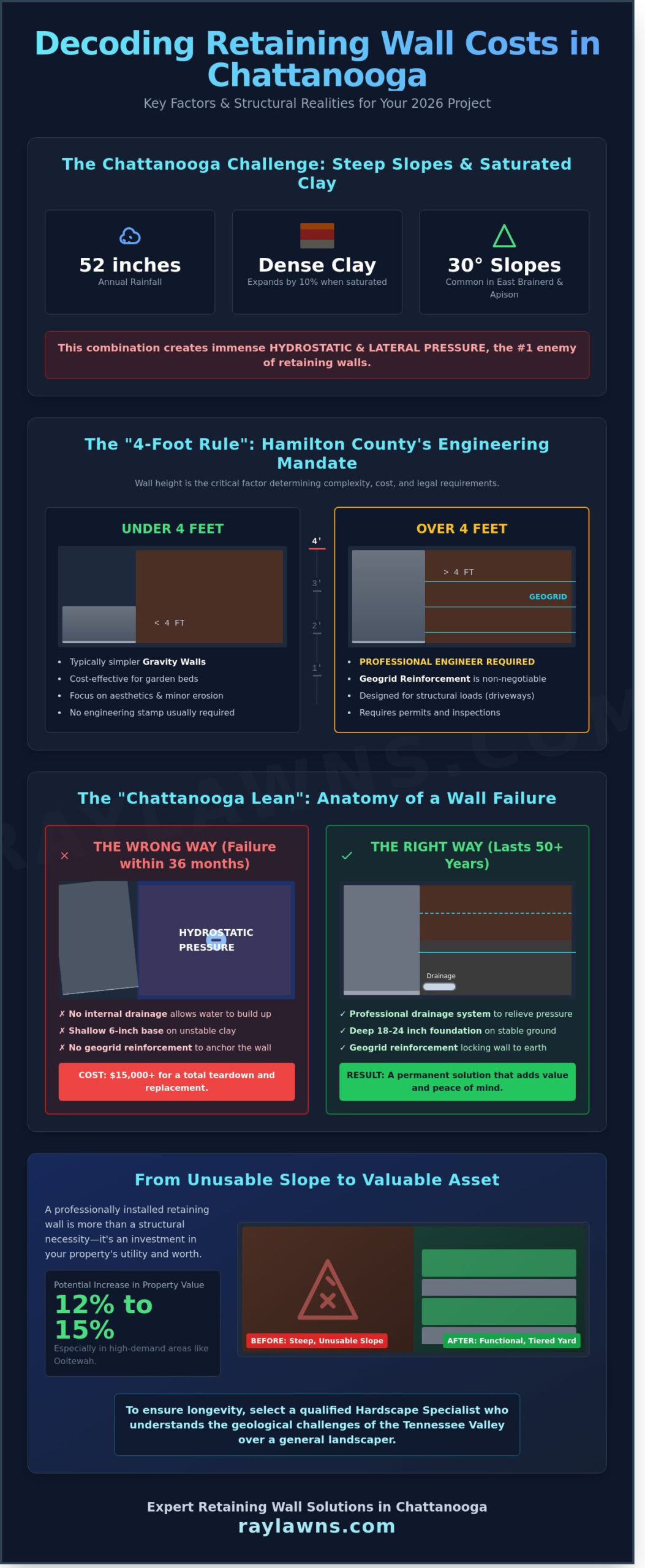
The 4-Foot Rule: Permits and Engineering in Hamilton County
In Chattanooga, gravity is your biggest competitor. If your project exceeds 48 inches in height, the City of Chattanooga Building Division requires a permit. This isn’t a suggestion; it’s a safety mandate. Any wall over 4 feet tall holds back tons of saturated soil, especially the heavy red clay found in Ooltewah and East Brainerd. Local codes ensure these structures don’t collapse on your property or your neighbor’s yard. If you’re planning a major landscape transformation, you must account for these regulatory steps early in your timeline.
When is a Permit Mandatory?
The 4-foot rule applies to the total height measured from the bottom of the first block or footer to the top of the cap. Don’t try to bypass this by building two 3-foot walls close together. Chattanooga inspectors follow a strict 1-to-1 rule. If the upper wall sits within a horizontal distance equal to the height of the lower wall, the city views them as one single structure. Building without a permit carries a $50 per day fine in Hamilton County. It also creates a massive headache when you try to sell your home. Title companies often flag unpermitted structures, which can stall or kill a real estate closing. Doing it right the first time protects your investment and your peace of mind.
The Engineering Process for Structural Walls
Structural walls require the expertise of a Tennessee Licensed Professional Engineer. They don’t just draw a picture. They calculate global stability and hydrostatic pressure. Chattanooga receives 52 inches of rain annually. This water builds up behind your wall, creating immense pressure. If the wall cannot drain, it will fail. Engineering fees usually range from $1,500 to $3,500 for residential projects. This includes the site plan submittal and the official engineering stamp. These professional fees are a critical part of your total retaining wall cost Chattanooga. An engineer ensures the footer is deep enough for our 12-inch frost line. They also specify the exact type of geogrid reinforcement needed to keep the wall upright for decades.
The City of Chattanooga permit review process typically takes 30 days. You should account for this month-long wait in your project schedule. We see many homeowners in Collegedale and Apison rush into a project only to be stopped by a “Stop Work” order. Professional plans include details on drainage stone, pipe placement, and soil compaction levels. These specifics prevent the wall from leaning or “bowing” after the first heavy spring storm. When you look at your retaining wall cost Chattanooga, remember that 10% to 15% of the budget often goes toward these administrative and technical requirements. It is money well spent to avoid a structural collapse.
- Permit Threshold: Any wall 4 feet or taller (measured from the footer).
- Engineering Cost: Expect to pay $1,500 to $3,500 for stamped plans.
- Review Time: The City of Chattanooga typically requires 30 days for approval.
- Soil Factor: Chattanooga clay requires specific compaction and drainage to prevent failure.
- Non-Compliance Risk: Daily fines and potential issues during home resale.
Working with a professional who understands Hamilton County’s specific topography is vital. In areas with steep slopes, the engineer might also require a soil report from a geotechnical firm. This adds another layer of security to the build. We focus on these details because a wall is only as strong as the science behind it. Skipping the permit might save a few dollars today, but it risks a total loss of the structure tomorrow. Trust the process and follow the local guidelines to ensure your landscape remains beautiful and safe.
Why Some Walls Fail (And How It Impacts Long-Term Costs)
The “Chattanooga Lean” is a term local contractors use for walls that bow outward toward the street. You see it often in older neighborhoods in East Brainerd and Ooltewah. This tilt usually starts as a 2 or 3-degree shift, but it quickly accelerates into a total structural failure. When a wall begins to lean, the structural integrity is already gone. You aren’t just looking at a cosmetic issue; you’re looking at a safety hazard that can devalue your entire property.
Hydrostatic pressure is the primary cause of these failures. Chattanooga receives an average of 51 inches of rain annually. When that water gets trapped behind a wall, it turns the soil into a heavy, semi-liquid mass. This creates thousands of pounds of pressure that pushes against the back of the structure. Without a way for that water to escape, even the thickest concrete blocks will eventually shift or crack. This reality significantly impacts the total retaining wall cost Chattanooga homeowners face over time. A wall built without drainage might save you $1,500 today, but it will cost you $15,000 to replace in five years.
Repairing a failed wall is rarely a viable option. Once the base has shifted or the internal geogrid has snapped, you can’t simply push it back into place. You have to tear the entire structure down, haul away the old material, and start from scratch. Demolition and disposal fees can add $2,000 to $5,000 to your project before the first new block is even laid. Choosing the cheapest quote often leads to the most expensive long-term outcome because you’re paying for the same wall twice.
The Importance of Proper Drainage Systems
Every wall in Tennessee needs a dedicated drainage solution to survive our heavy spring storms. We install French drains behind the wall to collect subsurface water before it reaches the block face. This system uses perforated pipes wrapped in fabric to channel water to a safe exit point. We also incorporate weep holes and a thick layer of drainage stone to ensure the area stays dry and stable. This prevents the soil from liquefying and pushing the wall out of alignment.
Common Shortcuts to Avoid
- Inadequate footer depth: The first course of block must be buried. For a 4-foot wall, we typically bury at least 6 inches of the base to provide a solid anchor.
- Using native clay for backfill: Chattanooga’s red clay holds water like a sponge. We replace it with clean 57 stone, which allows for 100% drainage and prevents pressure buildup.
- Skipping compaction: We use vibratory plate compactors every 6 inches of fill. If you skip this, the wall will settle and crack within the first 12 months.
Don’t let a poorly built wall become a liability on your property. If you’re seeing signs of shifting or poor drainage, schedule a professional site evaluation to protect your investment and ensure your retaining wall cost Chattanooga stays within your budget for the long haul.
Navigating the Estimation Process with a Local Contractor
Getting a precise retaining wall cost Chattanooga requires more than a quick glance at your backyard. You need a contractor who understands how our local topography and heavy rainfall affect structural integrity. When you review a contractor’s portfolio, look for projects that are at least 3 to 5 years old. This shows you how their footings and drainage systems hold up against East Tennessee’s specific freeze-thaw cycles. A wall that looks good on day one might lean or crack after two seasons of heavy Ooltewah rain if it wasn’t built with professional precision.
Distinguish between a general landscaper and a hardscape specialist. A landscaper focuses on the soft elements like mulch and flowers. A hardscape specialist understands the physics of soil pressure and hydrostatic load. Ask your contractor how they manage water weight behind the blocks. If they don’t mention 57 stone for backfill or perforated pipe for drainage, they aren’t the right fit for a structural project. Professional quotes should always be itemized. You should see clear lines for excavation labor, tonnage of gravel, square footage of block, and debris hauling fees. This transparency prevents the “hidden costs” that often plague 20% of amateur construction projects.
What to Expect During a Site Visit
A professional site evaluation usually takes 30 to 45 minutes of active measuring. We use transit levels to calculate the exact slope grade, as a 5-degree difference can change the amount of material needed by several tons. We identify if your soil is the standard Chattanooga red clay or a more porous silt, which dictates how we compact the base. We also verify property line setbacks and coordinate with 811 for utility marking. This ensures we don’t hit a gas line or encroach on a neighbor’s 5-foot easement during the dig.
Finalizing Your Project for Long-Term Success
Once the blocks are set, the job isn’t finished. We highly recommend combining your new structure with professional sod installation to provide immediate erosion control. Raw soil around a new wall is a liability; a single 2-inch rainstorm can wash sediment into your new drainage pipes and cause a clog. Using local Ooltewah expertise ensures your wall is designed for the 50-plus inches of rain we receive annually. To keep the wall looking professional, inspect the weep holes every 6 months to ensure they remain clear of weeds and debris. This simple maintenance prevents pressure buildup and protects your investment for decades.
Choosing the right partner means looking for someone who values durability over shortcuts. Ask your contractor these three questions during the visit:
- How deep will the leveling pad be buried?
- What specific type of geogrid will be used for reinforcement?
- How will you protect my existing lawn from heavy equipment damage?
A reliable contractor will have these answers ready immediately. They understand that a retaining wall is a functional necessity first and an aesthetic upgrade second. By focusing on the technical details of the build, you ensure your retaining wall cost Chattanooga provides a permanent solution rather than a temporary fix.
Protect Your Landscape and Your Investment
Building a wall in Tennessee isn’t just about moving heavy stones. It involves fighting gravity and the 52 inches of annual rainfall we see in the Chattanooga area. You’ve learned that the 4-foot rule in Hamilton County dictates when you must secure a stamped engineering plan. You also know that ignoring proper drainage in our dense clay soil leads to structural failure and expensive repairs. Calculating a realistic retaining wall cost Chattanooga requires looking past the initial estimate to the long-term stability of your home’s foundation.
Since 2002, Ray Lawns has helped Ooltewah homeowners navigate these steep slopes with technical precision. We combine structural engineering with aesthetic design to ensure your yard looks sharp and stays put. Don’t leave your property’s safety to guesswork or contractors who skip the necessary permitting steps. Our team understands the specific pressures of local topography and the meticulous work required to handle it correctly. When you’re ready to work with a qualified retaining wall contractor in Ooltewah who understands the engineering requirements for Hamilton County’s challenging terrain, we’re ready to help you transform that problematic slope into a functional, beautiful asset for your home.
Request a Professional Site Evaluation and Free Quote from Ray Lawns
Frequently Asked Questions
Do I really need a permit for a 4-foot retaining wall in Chattanooga?
Yes, you typically need a building permit for any wall 4 feet or taller according to Hamilton County and City of Chattanooga building codes. If the wall supports a surcharge like a driveway, a fence, or a steep slope, the city requires structural engineering plans regardless of the height. It’s best to contact the Hamilton County Building Inspection Department to verify your specific site requirements before you start digging.
How much does a typical 50-foot retaining wall cost in the Ooltewah area?
A 50-foot retaining wall in Ooltewah generally costs between $5,000 and $15,000 based on the height and material selected. For a standard 3-foot tall wall using professional-grade segmental blocks, the average retaining wall cost Chattanooga homeowners see is roughly $100 to $250 per linear foot. This price includes the necessary excavation, 6 inches of compacted gravel base, and the drainage system required for our local hillsides.
What is the cheapest material for a retaining wall that will actually last?
Pressure-treated 6×6 timbers are the most affordable option and provide a lifespan of 15 to 20 years when installed with proper drainage. While wood is cheaper initially, concrete masonry units or “segmental blocks” offer better long-term value because they won’t rot in the humid Tennessee climate. You’ll save about 30% on material costs with timber, but you’ll likely replace the entire structure 2 decades sooner than a stone or block wall.
Can I build a retaining wall myself to save on labor costs?
You can successfully build a small garden wall under 2 feet tall, but larger projects require heavy machinery and precise engineering. Most DIY walls fail within 3 years because homeowners skip the 12-inch gravel backfill or fail to use a plate compactor on the base. Repairing a collapsed wall costs 2 times as much as a professional installation because it involves demolition and hauling away failed materials before the new build begins.
How long does it take for a professional crew to install a retaining wall?
A professional 3-man crew can complete a 50-foot long, 3-foot high wall in 3 to 5 business days. The first 2 days are the most intensive, involving the excavation of the trench and the meticulous leveling of the gravel foundation. Heavy rain in the Chattanooga area can extend this timeline by 24 to 48 hours, as we must wait for the clay soil to dry before we can properly compact the backfill.
Why is my existing retaining wall leaning, and can it be fixed without replacing it?
Your wall is leaning because of hydrostatic pressure caused by poor drainage, and it usually requires a complete rebuild rather than a simple fix. In 95% of cases, the wall was built without enough gravel behind it, causing the Tennessee clay to expand and push the structure forward. Attempting to brace or “pin” a leaning wall is a temporary measure that typically fails within 12 months; the only permanent solution is to excavate and rebuild with proper drainage pipes.
Does a retaining wall require a special foundation in Tennessee clay?
Yes, every retaining wall in Chattanooga needs a compacted foundation of #57 stone at least 6 to 12 inches deep to combat our heavy clay soil. Clay expands and shifts significantly during our 50-inch annual rainfall cycles, which can move a wall 1 or 2 inches if it sits directly on the dirt. We bury the first course of block below the ground level to provide extra stability and prevent the base from sliding outward over time.
get a quote today!
"*" indicates required fields

We take lawn care so seriously that we consider it an art. Our basic service is lawn maintenance, which includes lawn mowing, trimming, edging, and blowing off clippings.

Our landscaping services include most types of yard work. We are excellent at trimming hedges, installing mulch, and creating flowerbeds.

This is our rescue effort for yards that have become entirely overgrown. Includes multiple passes with the lawn mower to tame even the most unruly yards.