
Last March, a homeowner in the Seven Lakes community watched 4 inches of red clay topsoil wash toward their foundation during a single 2 hour thunderstorm. When you’re dealing with the 20 degree slopes common in Hamilton County, a simple stack of stones won’t stop the earth from moving. Finding a qualified retaining wall contractor in Ooltewah is about more than aesthetics; it’s about protecting your home’s structural integrity from the massive weight of saturated soil.
You likely realize that Ooltewah’s heavy annual rainfall and steep terrain make traditional DIY landscaping nearly impossible. It’s stressful to look at a backyard you can’t use while worrying if your current hillside is one storm away from a total failure. You’ll learn exactly how to vet local professionals and choose the right structural solutions for our region’s unique soil profile. We’re going to examine the technical standards for wall reinforcement, proper drainage pipe placement, and the specific installation steps that turn a failing slope into a level, functional asset for your family.
Key Takeaways
- Understand how the steep slopes of White Oak Mountain and the expansion of Tennessee red clay require specific engineering to prevent wall failure.
- Learn why a long-lasting wall requires at least 25% of its structure to be buried underground to resist heavy soil pressure.
- Discover the specific equipment and local experience a professional retaining wall contractor Ooltewah homeowners trust must have to handle regional clay excavation.
- Compare the drainage benefits of segmental blocks against the natural aesthetic of boulder walls to find the right structural fit for your property.
- Identify the essential site preparation steps, including utility locating and base stabilization, that ensure your investment stands the test of time.
The Unique Challenges of Ooltewah Terrain and Soil Mechanics
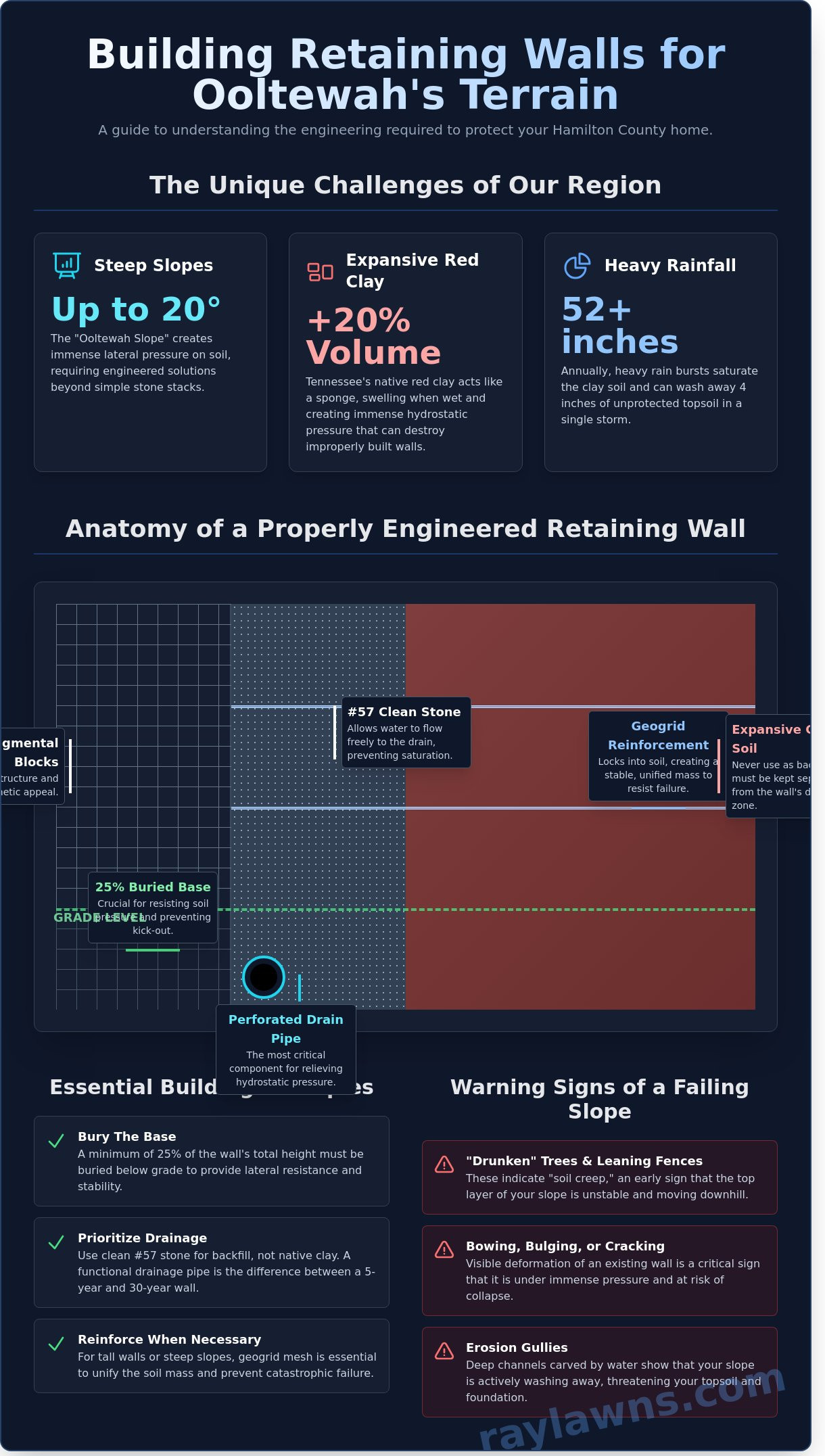
Ooltewah sits in a geographically complex spot. The foothills of White Oak Mountain define much of the local landscape. This “Ooltewah Slope” creates beautiful views, but it presents a massive engineering challenge for homeowners. Most properties in the 37363 zip code deal with elevation changes exceeding 15 feet across a single lot. These steep grades put immense pressure on the earth. An expert retaining wall contractor Ooltewah residents trust understands these specific geological hurdles. A professional retaining wall must counteract the constant pull of gravity while managing the unique soil found in Hamilton County.
The main culprit behind wall failure in East Tennessee is red clay. This soil is highly expansive. It acts like a sponge, holding onto water and increasing in volume by up to 20% during heavy rain cycles. When this clay saturates, it creates hydrostatic pressure. This is a physical force of water pushing against the back of your structure. If your wall isn’t built to vent this pressure, it’ll eventually bow or collapse. You might notice “soil creep” first. This is when the top layer of dirt moves faster than the bottom. Look for leaning fence posts or “drunken” trees on your hillside. These are early warnings that your slope is unstable. Hiring a retaining wall contractor Ooltewah homeowners rely on is the only way to ensure your structure survives these regional conditions.
Why Tennessee Clay Demands Better Backfill
Don’t use native clay as backfill. It’s a common mistake that leads to disaster. When clay gets wet, it stays wet. This puts thousands of pounds of extra weight on the blocks or timber. We use #57 clean stone for the first 12 to 24 inches behind every wall. This angular gravel creates voids that allow water to drop straight down to the drainage pipe. Without this stone, clay saturation causes a “wall lean” that becomes visible within 3 seasons. Proper drainage is the difference between a 30 year wall and a 5 year mistake.
Erosion Patterns in the Chattanooga Area
Chattanooga averages over 52 inches of rainfall annually. Much of this comes in heavy, concentrated bursts. On un-retained slopes in Ooltewah and Apison, this water carves deep gullies in minutes. A well-placed wall serves as the foundation for high-quality landscaping Chattanooga homeowners can be proud of. It stops the loss of topsoil and protects your home’s foundation from shifting. Stable slopes lead to stable houses. We’ve seen unmanaged erosion move 4 inches of dirt in a single afternoon storm, threatening patios and crawl spaces alike.
Structural Engineering: How a Professional Wall Defies Gravity
A wall isn’t just the stone or block you see above ground. A reliable retaining wall contractor Ooltewah homeowners trust knows that at least 25% of the total wall height must be buried. This embedment provides the lateral resistance needed to prevent the base from kicking out under pressure. For a 4-foot wall, this means at least 12 inches of block sits below the finished grade. Without this “hidden” structure, the weight of the soil behind the wall would eventually push the bottom courses forward, leading to a total collapse.
Gravity walls rely on their sheer weight to hold back the earth. These work well for small garden borders or low planters. However, Ooltewah’s steep ridges and 15% to 20% slopes often require reinforced walls. These systems use geogrid, a high-strength polymer mesh that extends deep into the hillside. Geogrid isn’t just a plastic sheet; it’s a structural component that locks into the gravel backfill to turn the soil itself into a stable mass. This reinforcement is essential for taller structures or when dealing with the heavy clay common in East Tennessee.
We also calculate surcharge loads before the first block is set. If you plan to install a fence, a swimming pool, or a driveway within 10 feet of the wall, the engineering requirements change. These external weights exert downward pressure that translates into lateral force against the blocks. For a deeper understanding of these requirements, you can review Retaining Wall Basics for Homeowners. If you’re noticing shifting soil or failing timbers on your property, it’s time to request a professional site evaluation to protect your investment.
The Critical Role of the Footer
Tennessee’s clay expands and contracts with moisture changes. We don’t just set blocks on raw dirt. A professional installation starts with a trench 24 inches wide and 12 inches deep. We fill this with 6 inches of #57 stone or crush-and-run gravel, then use a 3,000-pound plate compactor to create a rock-hard base. This footer must sit below the local frost line, which typically reaches 6 to 12 inches in the Chattanooga region, to prevent the wall from heaving during winter freeze-thaw cycles. A level wall depends entirely on a perfectly trenched and compacted foundation.
Integrating Comprehensive Drainage Solutions
Water is the primary cause of wall failure. Ooltewah receives roughly 52 inches of rain annually, and simple weep holes can’t handle a heavy East Tennessee downpour. We install a 4-inch perforated pipe wrapped in a filter sock directly behind the first course of block. This system, often integrated with professional French drains Chattanooga residents use to manage runoff, moves water away from the structure. We backfill with at least 12 inches of clean, angular gravel to ensure water reaches the pipe rather than building up hydrostatic pressure behind the wall. Proper discharge planning ensures this water doesn’t flood your neighbor’s yard or erode your own foundation.
Material Comparison for Hamilton County Landscapes
Hamilton County terrain is famous for heavy red clay and sudden elevation changes. These conditions put immense pressure on any structure holding back earth. Choosing a material isn’t just about looks; it is about managing the 120 pounds per cubic foot that wet Tennessee soil often weighs. A professional retaining wall contractor Ooltewah homeowners hire must prioritize drainage and structural mass over simple aesthetics.
Timber walls are a common sight in older neighborhoods, but they are a short-term fix in our climate. The 90 percent humidity levels and high termite activity in East Tennessee typically rot 6×6 pressure-treated beams within 7 to 12 years. Poured concrete offers incredible strength for tight spaces where a 12-inch footprint is all you have, but it requires 4,000 PSI mixes and meticulous finishing to prevent surface cracking. Most modern projects in the Tennessee Valley now favor systems that move with the ground rather than fighting it.
SRW Blocks: The Modern Standard
Segmental Retaining Wall (SRW) blocks are the most reliable choice for Ooltewah properties. These units use an interlocking lip or pin system that allows the wall to flex during the freeze-thaw cycles we see every January. Unlike rigid masonry, they don’t crack when the ground shifts. These systems feature a hollow core or a gravel backfill design that provides built-in drainage paths. This is vital for protecting your landscaping Chattanooga investments from hydrostatic pressure. You can expect a 50-year lifespan from a correctly installed block wall. Manufacturers now offer color palettes like “Appalachian Blend” or “Chattanooga Smoke” that perfectly complement local brick and stone architecture.
Natural Stone and Boulders
Sourcing local Tennessee fieldstone or sandstone creates a look that feels like it has been part of the ridge for centuries. We use large boulders for massive grade changes where we have the machine access to move 2,000-pound rocks. Stacking these for structural integrity requires a 1:1 or 2:1 slope ratio to ensure gravity works in your favor. While smaller fieldstone is excellent for decorative garden borders, any wall over 3 feet tall needs the sheer mass of heavy boulders or a reinforced core. An expert retaining wall contractor Ooltewah relies on will always prioritize the “tie-back” method, ensuring the stone is anchored deep into the hillside rather than just leaning against it. This prevents the common “bowing” effect seen in amateur stone stacks after a heavy spring rain.
The Professional Installation Process: Avoiding Common Shortcuts
A wall is only as good as the work you can’t see. Choosing a professional retaining wall contractor Ooltewah homeowners trust means following a strict sequence of operations. This process ensures the structure survives the heavy rains and clay expansion common in East Tennessee. We don’t cut corners because we know the local soil conditions will eventually expose them.
- Step 1: Site Marking and Utility Locating. We start by calling Tennessee 811. It’s a legal requirement to locate underground lines 72 hours before digging. This prevents dangerous strikes on gas or water mains.
- Step 2: Excavation and Base Stabilization. We dig a trench roughly 24 inches wide. We remove the soft Ooltewah clay and replace it with a 6-inch layer of compacted crushed limestone. This provides a stable, non-shifting foundation.
- Step 3: The First Course. This is the most critical hour of the build. We level each block with meticulous precision. If the base course is off by even 1/8th of an inch, the error multiplies as the wall grows taller.
- Step 4: Layered Compaction. We add backfill in 6-inch lifts. We use a vibrating plate compactor on every layer to reach 95% soil density. Skipping this leads to the wall sinking or shifting within 24 months.
- Step 5: Capstone Application and Final Grading. We secure the top blocks with industrial-strength concrete adhesive. We then grade the soil to direct surface water away from the wall’s face.
Shortcuts to Watch Out For
Many cut-rate installers skip the gravel backfill to save money. They use native dirt instead. Dirt holds water and expands, which puts thousands of pounds of hydrostatic pressure on your blocks. This causes walls to lean or “blow out” during heavy spring storms. Another common error is skipping the plate compactor. Hand-tamping doesn’t provide the force needed to stabilize 80-pound blocks. Finally, we always use heavy-duty filter fabric. This prevents fine clay from clogging your drainage stone and causing structural failure.
Site Restoration and Finishing
Heavy equipment leaves a footprint. We don’t leave your yard looking like a construction site. We specialize in professional sod installation service in Ooltewah & Chattanooga to restore your lawn immediately after wall completion. Many homeowners also opt for privacy tree installation along the new wall line. This adds vertical interest and helps anchor the soil. An expert retaining wall contractor Ooltewah residents rely on will always perform a final drainage check to ensure water flows exactly where it’s supposed to.
Evaluating an Ooltewah Retaining Wall Contractor
Finding a reliable retaining wall contractor Ooltewah homeowners can trust requires looking past the initial price tag. Start by requesting three local references within a 15-mile radius of Ooltewah or Chattanooga. A reputable crew should point you toward walls that have stood for at least three years. This timeframe is critical because it proves the structure can survive East Tennessee’s heavy spring rains and freeze-thaw cycles without leaning or cracking. Equipment ownership is another major factor. Ooltewah’s dense red clay is notoriously difficult to excavate. If a contractor relies on small rental units, they might cut corners on the depth of the footer to save time. A professional team arrives with their own high-flow skid steers and mini-excavators designed to handle local soil density.
The lowest bid often results in the most expensive repairs. If one quote is 25% lower than the others, the contractor is likely skipping the drainage stone or using native clay as backfill. Native soil expands when wet, which eventually pushes a wall over. You’ll end up paying double the original cost to tear out the failure and rebuild it correctly. Demand a detailed written scope of work. It should specify the exact tonnage of #57 stone and the specific block manufacturer. Clarity in the contract ensures you aren’t left with a pile of dirt and a leaning wall two years from now.
Questions Every Homeowner Should Ask
- “How do you handle water runoff behind the wall?” Ooltewah receives 52 inches of annual rainfall. A professional uses perforated pipe and at least 12 inches of clean, angular stone behind the blocks to prevent hydrostatic pressure.
- “What specific base material will you use for this slope?” We never use sand or dirt for a base. A structural wall requires a minimum of 6 inches of compacted crushed stone to prevent settling.
- “How will you protect my existing lawn during the heavy haul phases?” Moving 20 tons of block and stone creates ruts. A disciplined retaining wall contractor Ooltewah residents respect will use ground mats or plywood to protect your turf.
The Value of Local Experience
Local knowledge keeps your project legal and safe. Hamilton County building codes require an engineer’s seal for any wall exceeding 4 feet in height. A local expert understands these permit requirements and handles the paperwork to ensure your home remains compliant. They also understand our regional weather patterns. We don’t dig footings during a week of heavy rain because saturated clay loses its load-bearing capacity. You can read more about Retaining Walls in Ooltewah to understand how structural integrity prevents long-term property damage and erosion. Choosing a specialist who respects the local landscape ensures your new wall is a permanent asset rather than a temporary fix.
Secure Your Ooltewah Landscape for the Long Term
Building a wall that lasts in Hamilton County requires more than just stacking blocks. You’ve got to account for the heavy Tennessee clay and the 51 inches of average annual rainfall we see in Ooltewah. A successful project depends on deep gravel bases and integrated drainage systems that prevent hydrostatic pressure from pushing your investment over. Since 2002, Ray Lawns has specialized in managing these steep slopes and difficult soil conditions across Chattanooga and Apison. We don’t take shortcuts on compaction or reinforcement because we know how the local terrain behaves over decades.
Choosing a qualified retaining wall contractor Ooltewah homeowners trust means your property stays level and your yard remains functional. We’ve spent 22 years perfecting these engineering techniques right here in your neighborhood. Your home deserves a structure built with precision and local expertise. Stop worrying about erosion or shifting soil and focus on enjoying your outdoor space. Once your retaining wall is complete, you’ll have a stable foundation for beautiful landscaping, including professional sod installation service to create the perfect lawn on your newly leveled terrain. Request a Professional Site Evaluation from Ray Lawns to ensure your landscape is built to stand the test of time.
Frequently Asked Questions
Do I need a permit for a retaining wall in Ooltewah or Hamilton County?
You need a building permit in Hamilton County for any retaining wall that exceeds 4 feet in height. This measurement starts from the bottom of the footing to the top of the wall. For walls taller than 4 feet, the county requires sealed engineering plans to ensure the structure handles the soil load. Projects under 4 feet typically don’t require a permit, but you must still respect property setbacks and utility easements.
How long should a professionally installed retaining wall last?
A professionally installed retaining wall should last between 25 and 50 years depending on the materials used. Segmental concrete blocks often reach the 50 year mark because they don’t rot or succumb to pests. Timber walls have a much shorter lifespan, typically failing after 12 to 15 years due to ground moisture. Hiring an experienced retaining wall contractor Ooltewah homeowners trust ensures the base and drainage are built to maximize this longevity.
Can I build a retaining wall myself or should I hire a pro?
You can build a small garden wall under 2 feet yourself, but you should hire a professional for anything taller or structural. Walls over 3 feet hold back thousands of pounds of saturated Tennessee clay. A pro understands soil pressure calculations and the precise compaction required to prevent total wall failure. Mistakes in DIY builds often lead to expensive teardowns and rebuilds within the first 3 years of installation.
What is the best material for a retaining wall in Tennessee clay?
Segmental concrete blocks are the best choice for the heavy clay soil found in Ooltewah and East Brainerd. These blocks are “dry stacked,” which allows the wall to flex slightly during the freeze-thaw cycles of Tennessee winters without cracking. Unlike poured concrete, these systems allow moisture to weep through joints. Using 57 stone for backfill behind these blocks ensures the clay doesn’t exert excessive hydrostatic pressure against the structure.
How do I stop my existing retaining wall from leaning?
You stop a wall from leaning by addressing the hydrostatic pressure or soil failure behind it. If the wall tilts more than 5 degrees, it often requires excavating the soil behind the blocks to install proper drainage pipes and clean gravel. In 90 percent of cases, a leaning wall indicates that the original builder didn’t use enough reinforcement or proper backfill. We recommend a professional evaluation to determine if a full rebuild is necessary.
What happens if my retaining wall doesn’t have proper drainage?
Lack of drainage causes water to trap behind the wall, increasing the weight of the soil by 30 percent or more. This pressure leads to “blowouts” where sections of the wall physically collapse during heavy Chattanooga rainstorms. You’ll see signs of failure like weeping holes clogging or soil eroding from the top of the wall. Without a perforated pipe and 12 inches of gravel backfill, even the strongest blocks will eventually fail.
How much space is needed for the equipment to build a wall?
Most retaining wall projects require a minimum of 5 to 8 feet of clear width for skid steers or mini-excavators to pass. If your Ooltewah property has tight access, a retaining wall contractor Ooltewah residents hire can use specialized compact equipment that fits through a standard 36 inch pedestrian gate. Keep in mind that larger equipment completes the job 40 percent faster, which reduces labor costs. We always plan the route to minimize turf damage.
get a quote today!
"*" indicates required fields

We take lawn care so seriously that we consider it an art. Our basic service is lawn maintenance, which includes lawn mowing, trimming, edging, and blowing off clippings.

Our landscaping services include most types of yard work. We are excellent at trimming hedges, installing mulch, and creating flowerbeds.

This is our rescue effort for yards that have become entirely overgrown. Includes multiple passes with the lawn mower to tame even the most unruly yards.