
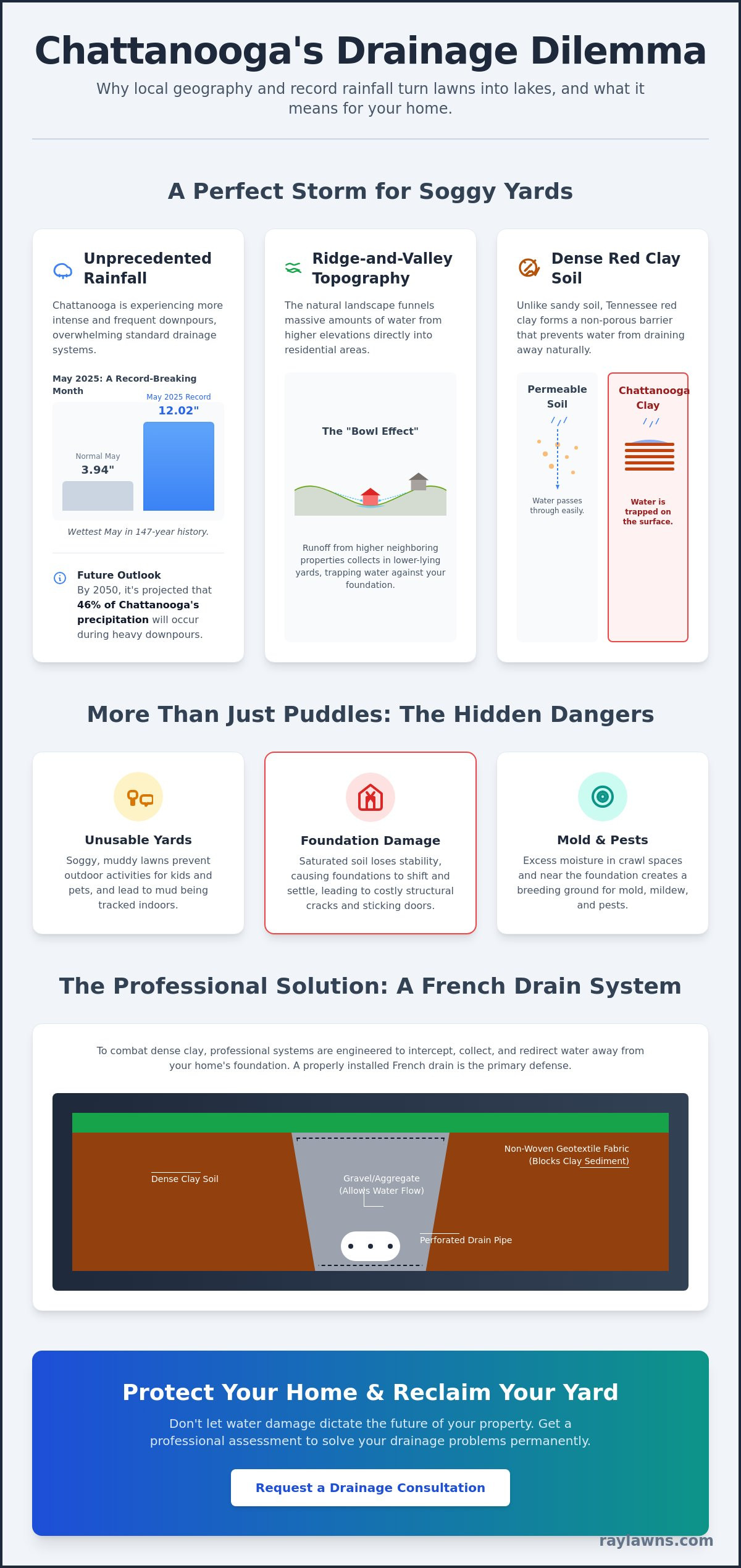
In May 2025, the Chattanooga airport recorded 12.02 inches of rainfall, marking the wettest May in the city’s 147-year history. If your backyard felt more like a lake than a lawn during those storms, you aren’t alone. Dealing with standing water is a constant headache for residents in Ooltewah and East Brainerd, where the heavy red clay makes natural absorption nearly impossible. Successfully fixing yard drainage Chattanooga homeowners can depend on means addressing these regional challenges head-on before the moisture reaches your foundation or creates mold in your crawl space.
You want a dry, usable yard where kids and pets can play without bringing a trail of mud into the house. This guide explains how to identify the root cause of your soggy lawn and provides the professional steps needed to solve it permanently. You will learn about the specific techniques used to manage our local slopes and soil conditions, including French drain installation and strategic grading. We’ll preview the professional methods that ensure your drainage system blends into your landscape while handling the 55.6 inches of rain our area receives annually.
Key Takeaways
- Learn why Chattanooga’s Ridge-and-Valley topography and dense red clay trap water, making standard lawn maintenance difficult without professional intervention.
- Differentiate between surface runoff and groundwater seepage to ensure you choose the right solution for your specific property layout.
- Master the professional approach to fixing yard drainage Chattanooga properties need, focusing on diverting water before it pools or reaches the foundation.
- Explore the technical requirements for a lasting French drain, such as precise trenching depths and the use of non-woven geotextile fabric to block clay sediment.
- Understand how a well-designed drainage plan acts as a primary defense for your home’s foundation and crawl space, preventing long-term structural damage.
The Chattanooga Drainage Dilemma: Why Local Yards Stay Soggy
Chattanooga sits in the heart of the Ridge-and-Valley province. This isn’t just a geographical fact; it is the reason your yard stays wet. Water naturally flows from high ridges down into the valleys where most residential developments in Hamilton County are built. When you combine this topography with the 55.6 inches of rain we receive on average each year, the result is often a swampy mess. In May 2025 alone, we saw a record 12.02 inches of rain at the airport, which was 8.08 inches above normal. Standard gutters and basic downspouts simply cannot keep up with that volume of water. Without a plan for fixing yard drainage Chattanooga homeowners often face expensive foundation settling. Saturated soil shifts under the weight of the home, leading to wall cracks and sticking doors. By 2050, it is projected that 46% of Chattanooga’s precipitation will occur during heavy downpours, making professional water management more critical than ever.
Understanding Tennessee Red Clay
The primary culprit for standing water is our infamous red clay. Unlike sandy soils that allow water to pass through quickly, clay is made of tiny, plate-like particles. These plates stack tightly together. They create a barrier that traps water rather than letting it drain. This is why “perk tests” in areas like Ooltewah and Apison often fail during the rainy season. To make matters worse, new home construction involves heavy machinery that compacts the soil even further. This leaves you with a yard that acts like a concrete slab. If you’re looking for French drain companies in the area, you’ll find that the best ones focus on breaking through this clay layer to reach more permeable subsoil.
Topography and the “Bowl Effect”
Even a slight slope of 1 or 2 percent can move thousands of gallons of water toward your house. Many local yards suffer from the “bowl effect.” This happens when your property sits lower than your neighbor’s. Their runoff becomes your problem. Identifying natural swales is crucial. These are the shallow channels designed to carry water away. However, many homeowners accidentally block these with flower beds, fences, or storage sheds. Understanding The Right Way to Install a French Drain involves more than just digging a hole. It requires analyzing how these slopes interact across property lines to prevent water from pooling against your foundation. Proper landscaping in Chattanooga must account for these natural water paths to be successful and keep your lawn usable year-round.
Identifying the Culprit: Surface Water vs. Groundwater Intrusion
Before you start digging, you must understand where the water is coming from. Misdiagnosing the source is the most common mistake we see. If you install a system designed for surface runoff but your problem is actually a rising water table, your yard will stay wet. Successfully fixing yard drainage Chattanooga requires a clear distinction between surface water and groundwater intrusion. Surface water is predictable; it moves across the top of the soil during rain. Groundwater is stealthier; it moves beneath the surface and can keep your lawn saturated for days after the clouds clear.
Try the “Sponge Test” to get a better idea of your soil’s condition. Walk to the wettest part of your lawn 24 hours after a rainstorm. If the ground feels firm but water pools around your shoe, you have a surface drainage issue. If the ground feels like a wet sponge and your foot sinks several inches, you’re likely dealing with a high water table or subsurface seepage. This distinction determines whether you need a simple catch basin or a deep-trench solution like a professionally installed French drain.
Signs of Surface Runoff Issues
Surface water problems are usually obvious during heavy storms, like the flash flood event on August 12, 2025, when Chattanooga saw 5 to 6 inches of rain in just a few hours. Look for these red flags:
- Erosion rills: Small “mini-canyons” or channels carved into your mulch beds or topsoil.
- Debris lines: Silt, leaves, or mud deposited on your driveway and sidewalks after a downpour.
- Immediate pooling: Large puddles that form quickly near downspouts or at the base of hillsides.
Signs of Groundwater and Seepage
Groundwater issues are more persistent and damaging to your home’s structure. Since approximately 25% of buildings in Chattanooga are at high risk of flooding, identifying subsurface water is vital. Watch for these indicators:
- Persistent “squish”: Grass that remains saturated and muddy even after three or four days of sunshine.
- Efflorescence: A white, powdery mineral deposit on your crawl space or basement walls. This is a clear sign that water is pushing through the masonry.
- Constant flow: Areas of your yard that stay wet during dry spells, often caused by underground veins or springs common in the Ridge-and-Valley area.
Professional Solutions for Tennessee Landscapes
Once you’ve identified the source of your water issues, it’s time to implement a permanent fix. In the Tennessee Valley, a single solution rarely solves everything. Fixing yard drainage Chattanooga homes requires a combined strategy that manages both surface runoff and subsurface saturation. We focus on moving water efficiently while ensuring the result looks like a natural part of your property. This often starts with the most fundamental tool in a contractor’s kit: strategic grading.
The Role of Strategic Grading
The magic number for effective yard drainage is a 2% slope. This means for every 10 feet of distance away from your foundation, the ground should drop about 2.4 inches. This “positive pitch” ensures gravity does the heavy lifting. We often use swales, which are wide, shallow channels, to guide water around the house rather than toward it. To prevent these new channels from washing away during our frequent heavy downpours, we recommend professional sod installation. The root system of fresh sod acts as an anchor, holding the graded soil in place and preventing erosion rills from forming in the new clay surface.
French Drains vs. Trench Drains
Understanding the difference between drainage systems is vital for long-term success. A French drain is designed to handle groundwater. It consists of a perforated pipe buried in a trench filled with clean gravel and wrapped in filter fabric. This setup allows water to seep into the pipe from the surrounding soil. In contrast, a trench drain or a solid-pipe system is better for redirecting roof runoff from downspouts. We always install a “pop-up emitter” at the end of these lines. This device stays closed to keep out debris and pests but pops up under water pressure to discharge runoff safely into a lower part of the yard or a designated drainage area.
For homeowners who want a solution that adds curb appeal, dry creek beds are an excellent choice. These features use varied sizes of river rock and boulders to mimic a natural stream. They provide a high-capacity path for water during storms while serving as a beautiful element of landscaping Chattanooga residents can enjoy even when it’s dry. When combined with catch basins to collect water from low spots, these systems provide a comprehensive defense against the 59.3 inches of annual rainfall projected for our region by 2050.
The Right Way to Install a French Drain in Clay Soil
Installing a drainage system in East Tennessee red clay is vastly different from working in sandy coastal soils. If you simply dig a trench and throw in a pipe, the fine silt will choke the system in less than 24 months. Successfully fixing yard drainage Chattanooga properties require involves a meticulous multi-step process designed to outlast our heavy rainfall patterns. We focus on creating a system that stays clear and functional for decades, not just a single season.
The process begins with precise trenching. We maintain a minimum slope of 1 inch for every 10 feet of pipe run. Without this consistent fall, water will stagnate in the pipe, leading to rapid sediment buildup. Before any shovel hits the dirt, you must call 811 to mark underground utilities. In established neighborhoods in East Brainerd or Ooltewah, hitting a buried line is a dangerous and expensive mistake that stops a project in its tracks.
Once the trench is prepared, we line it with non-woven geotextile fabric. Choosing the right fabric is where many DIY projects fail. Woven fabric is designed for stabilization under driveways and does not allow water to pass quickly enough for drainage. Non-woven geotextile acts as a high-performance filter. The fabric acts as a permanent barrier that preserves the void space between the gravel pieces, ensuring water always has a path to the pipe. This prevents the microscopic silt from our local clay from migrating into your drainage aggregate.
For the drainage medium, #57 washed stone is the industry standard. This aggregate is superior because it has been cleaned of “fines” or stone dust that could settle and block water flow. We lay a two-inch base of stone, place the perforated pipe with the holes facing downward, and then backfill with more stone until the pipe is fully encased. This “burrito wrap” method involves folding the excess fabric over the top of the gravel before adding the final layer of topsoil or decorative river rock. This creates a protected, clean environment for water to move. If you want a system that stands up to intense Tennessee storms, seek professional French drain installation to ensure these technical standards are met.
Avoid the common shortcut of using “socked” pipe without a gravel envelope. In our heavy clay, those thin fabric socks clog almost immediately because they lack the surface area of a full gravel trench. Finally, ensure your system has a natural “daylight” exit point. If the water has nowhere to go once it reaches the end of the pipe, the entire system will back up and fail during the next heavy downpour.
Protecting Your Foundation: Long-Term Maintenance and Planning
Your yard drainage system is the primary shield for your home’s structural integrity. While a lush lawn is a great outcome, the real goal of fixing yard drainage Chattanooga properties require is preventing foundation decay. When water pools against your home, it creates hydrostatic pressure. This physical force is strong enough to push moisture through solid concrete blocks, leading to damp crawl spaces and mold growth. Many homeowners try to solve this with interior sump pumps, but those are often just “band-aids.” A sump pump manages water once it’s already inside; a professional exterior drainage system stops it from ever entering.
On the sloped lots common in Ooltewah and Apison, managing water often involves more than just pipes. There is a deep relationship between retaining walls and water management. A poorly designed wall can act like a dam, trapping water and increasing the risk of a wall failure. Every wall we install includes integrated drainage to ensure that water pressure doesn’t build up behind the structure. This protects both the wall and the level ground it creates.
The Crawl Space Connection
Gutter extensions are a critical part of this defense. A standard roof can shed approximately 600 gallons of water for every inch of rain that falls. If your downspouts dump that water right at the foundation, your crawl space will eventually suffer. We integrate these lines into solid-wall pipes that carry the runoff at least 10 to 20 feet away from the house. This prevents the soil around your footings from becoming a saturated slurry, which is the leading cause of foundation settling in the Tennessee Valley.
Seeking a Professional Evaluation
A drainage system is only as good as its maintenance. You should check your catch basin grates and “daylight” exit points at least twice a year. We recommend doing this in late fall and early spring. Clear out any leaves, silt, or debris that could cause a backup during the next heavy storm. If you notice new wet spots or if your yard stays muddy for more than 48 hours after a rain, your current system may be overwhelmed or failing.
DIY attempts often fail because they don’t account for the complex Ridge-and-Valley topography. A site analysis from a French drain company provides a comprehensive look at your property’s elevations and soil density. Investing in a permanent, engineered solution doesn’t just save your grass; it protects your home’s resale value. Home inspectors in Hamilton County look for drainage red flags, and a certified system provides the peace of mind that your foundation is secure for the long term.
Take Control of Your Property’s Water Management
A wet yard is more than just an eyesore; it’s a direct threat to your home’s structural health. By accurately identifying whether you’re battling surface runoff or rising groundwater, you can choose the technical solution that actually works. Whether you need a functional dry creek bed or a meticulously installed French drain, the goal remains a dry and usable landscape. Successfully fixing yard drainage Chattanooga properties require means outsmarting the local red clay with high-performance filter fabric and precise grading. Don’t let another heavy season of Tennessee rain wash away your peace of mind or damage your foundation.
Ray Lawns has been family-owned since 2002. We’re specialists in the unique Ridge-and-Valley topography and the specific challenges of Hamilton County soil. Our team brings decades of hands-on expertise in both professional grading and hardscape construction to every project we handle. We don’t just move water; we transform your outdoor space into a source of pride that stands up to the elements. Request a Professional Drainage Evaluation from Ray Lawns to start your project. We’re ready to build a permanent solution that protects your home and restores your lawn.
Frequently Asked Questions
How do I know if I need a French drain or just better grading?
If water pools only during heavy rain and disappears quickly, strategic grading is usually the answer. We create a 2% slope to guide surface runoff away from your foundation. However, if your lawn stays squishy for several days after the rain stops, you likely have a groundwater issue. This requires a French drain to capture subsurface moisture before it reaches your crawl space.
Will a French drain get clogged by Chattanooga red clay over time?
A French drain will only clog if it’s installed without the proper filtration layers. Chattanooga red clay is made of fine particles that easily infiltrate standard pipes. We prevent this by wrapping the entire gravel envelope in non-woven geotextile fabric. This setup filters out the silt while allowing water to flow freely into the #57 washed stone, ensuring the system lasts for decades.
Can I discharge my yard drainage into the city storm sewer?
You must follow the City of Chattanooga Stormwater Management Ordinance regarding runoff. Direct connections to the municipal storm sewer often require a plumbing permit with a $40.00 issuance fee and specific city approval. Most residential systems are designed to discharge into a natural swale or through a pop-up emitter on your own property to stay compliant with local regulations.
How much slope does a drainage pipe need to work effectively?
A drainage pipe needs a minimum slope of 1 inch for every 10 feet of run. This 1% grade ensures that gravity moves the water fast enough to prevent sediment from settling inside the pipe. Maintaining this consistent fall is the most critical part of fixing yard drainage Chattanooga homeowners can rely on. Without it, the system will eventually back up and fail.
What is the best way to hide a drainage system in my landscaping?
Dry creek beds are the most effective way to turn a functional drain into an aesthetic feature. We use varied sizes of river rock and boulders to mimic a natural stream bed over the drainage trench. This approach hides the pipe and fabric while providing a high-capacity path for water. It adds significant curb appeal to your property even during the dry summer months.
Does fixing yard drainage increase my home’s property value?
Professional drainage work significantly increases property value by protecting the home’s structural integrity. Since approximately 25% of buildings in Chattanooga are at high risk of flooding, a certified system is a major selling point. It provides documented proof that the property is managed against the 55.6 inches of annual rainfall our region receives, giving potential buyers peace of mind.
How long does it typically take to install a professional drainage system?
Most residential drainage projects in areas like Ooltewah or East Brainerd take between 2 and 5 business days to complete. The timeline depends on the length of the pipe run and the depth of the trenching required. We always call 811 to mark utility lines before we start. This ensures the work proceeds safely and without unnecessary delays caused by damaged underground lines.
What happens if I ignore standing water near my foundation?
Ignoring standing water leads to expensive structural repairs and mold issues. Saturated clay creates hydrostatic pressure that can crack or bow concrete foundation walls. Over time, this moisture seeps into the crawl space, rotting floor joists and ruined insulation. It’s much more cost-effective to manage the water outside than to repair a sinking foundation or perform mold remediation inside.
get a quote today!
"*" indicates required fields

We take lawn care so seriously that we consider it an art. Our basic service is lawn maintenance, which includes lawn mowing, trimming, edging, and blowing off clippings.

Our landscaping services include most types of yard work. We are excellent at trimming hedges, installing mulch, and creating flowerbeds.

This is our rescue effort for yards that have become entirely overgrown. Includes multiple passes with the lawn mower to tame even the most unruly yards.