
Most homeowners in Apison treat grading as an optional step, but skipping it is the fastest way to turn your expensive new sod into a muddy disaster. When you’re grading a yard for new sod Apison conditions like heavy clay and steep slopes make precision work essential. You want a lawn that looks like a golf course, not a swamp that holds water every time a heavy Chattanooga rainstorm rolls through. It’s frustrating to invest in high-quality grass only to watch it struggle because the ground beneath it wasn’t ready.
We’ll show you the exact professional steps required to ensure your investment thrives in our local terrain. You’ll learn how to manage Hamilton County’s unique drainage challenges and the precise leveling techniques that create a healthy environment for your new lawn. This guide walks through soil preparation and final smoothing so your yard drains perfectly and stays green for years to come.
Key Takeaways
- Understand why shaping your land is the only way to prevent root rot and protect your new grass from standing water.
- Learn how to manage the heavy red clay and sloped terrain common in the Apison area to ensure long-term lawn health.
- Master the professional steps for grading a yard for new sod Apison homeowners use to create a perfectly level and smooth surface.
- Discover when surface grading isn’t enough and how integrating drainage solutions like French drains can save your property from erosion.
- Avoid common DIY mistakes, such as damaging underground utilities or using the wrong heavy equipment for soil compaction.
Why Proper Grading is the Foundation for Your New Apison Lawn
Grading is more than just moving dirt around. It is the technical process of Grading (earthworks), which involves reshaping the land to ensure water flows away from your home and doesn’t pool in your yard. In a place like Apison, where the terrain can be tricky and the soil is unforgiving, this step is non-negotiable. If you don’t get the slope right before the grass goes down, you’re just setting yourself up for failure. We consider this a one-time investment that protects your property for decades.
Apison sees significant annual rainfall, often exceeding 50 inches a year. Without proper grading a yard for new sod Apison properties often become drainage nightmares. If you lay sod directly onto uneven ground, water will find the low spots and stay there. This leads to root rot, a condition where grass roots essentially drown because they can’t breathe. Once rot sets in, your expensive sod installation will fail, regardless of how much you water or fertilize it later.
The Consequences of Poor Surface Preparation
Standing water is the primary killer of new landscapes. When water sits for more than 24 hours, it creates a “dead zone” where oxygen can’t reach the roots. These wet patches also become prime breeding grounds for mosquitoes and turn into mud pits that pets and kids track into the house. Beyond surface water, soil compaction is a major hurdle. If the ground is too hard, roots can’t penetrate deep enough to survive a hot Tennessee summer. Proper prep breaks up that compaction and creates a smooth, breathable base for growth.
Visual and Functional Benefits of a Level Yard
A perfectly graded yard doesn’t just drain well; it looks and feels better. You’ll notice the difference immediately during your first mow. A level surface eliminates the “scalping” that happens when a mower deck hits a high spot and gouges the turf. It also reduces wear and tear on your equipment by providing a consistent path. From a curb appeal standpoint, a smooth lawn looks professional and increases your property value. Most importantly, it creates a safe environment. You won’t have to worry about anyone twisting an ankle in a hidden dip or tripping over an uneven patch of turf while playing in the backyard.
Managing the Unique Terrain and Clay Soil of Apison Properties
Apison isn’t built on sand. It’s built on heavy red clay. This material is notoriously difficult for drainage because it’s dense and compacts easily. When you’re grading a yard for new sod Apison soil types act like a sponge that never quite rings out. This density leads to “ponding,” where water sits on the surface because it can’t penetrate the hard-packed earth. If you ignore this, your new grass will suffocate before it even takes root.
Before laying a single piece of turf, you must understand the soil’s structure. Clay has tiny particles that pack together tightly, leaving no room for air or water movement. If you just dump topsoil over it, you create a “shelf” where water gets trapped between the two layers. We recommend testing the pH and structure first. Most Tennessee clay is acidic and lacks the nutrients needed for aggressive root growth. Adding lime or organic matter during the grading phase can fix these issues before they become permanent problems.
Dealing with Hamilton County Red Clay
You can’t just smooth over the surface and call it a day. Professional prep requires “scarifying” or tilling the sub-base. This process scratches the hard clay surface, allowing the new topsoil to bond with the existing ground. Purdue’s guide to sod installation emphasizes that proper site preparation is the only way to ensure deep root establishment. Without this bond, your sod will have shallow roots that wither during the first dry spell of a Chattanooga summer. We make sure the transition between layers is seamless so water can move freely through the soil profile.
Strategic Pitching for Sloped Yards
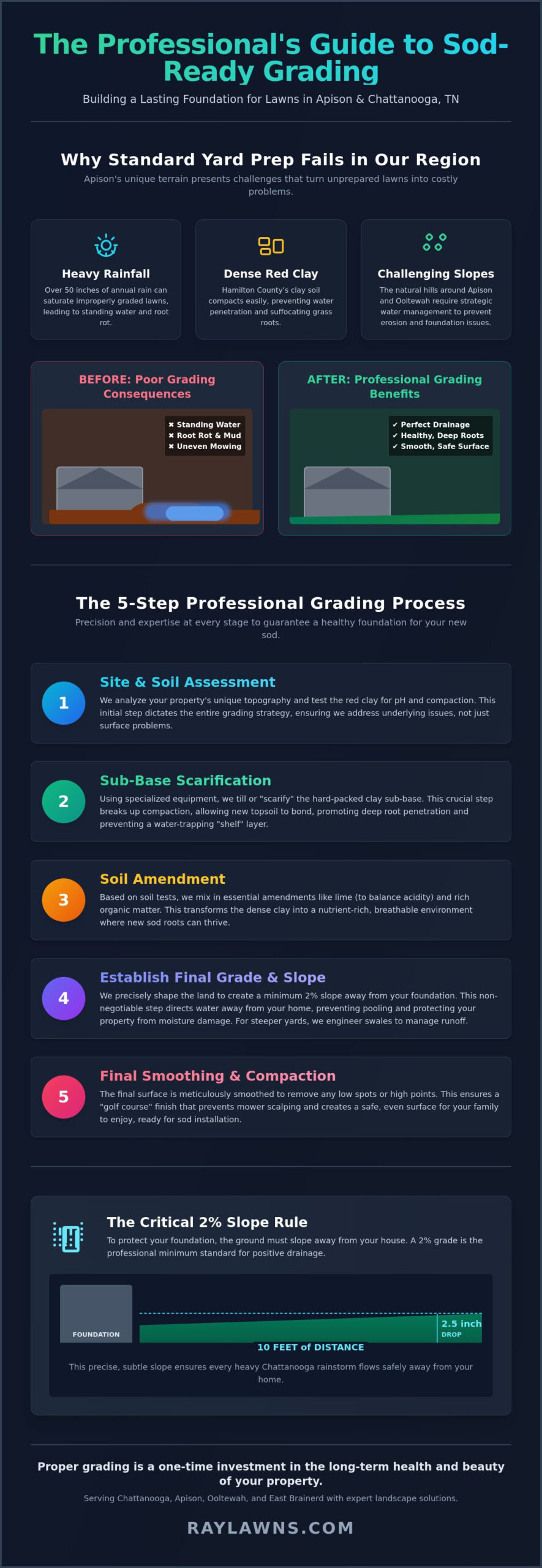
Topography in the Ooltewah and Apison area is rarely flat. The natural hills dictate where water wants to go, and your grading must work with that flow. Our goal is to maintain a minimum 2% slope away from your foundation. This means for every 10 feet of distance, the ground should drop about 2.5 inches. This is why grading a yard for new sod Apison properties requires a deep understanding of local topography. For steeper grades, we use swales. These are shallow, grass-lined channels that catch runoff and direct it safely toward the street or a wooded area.
If your slope is too steep, sod can wash away during a heavy rain before the roots take hold. In these cases, we might suggest specific landscaping Chattanooga solutions to stabilize the soil. Getting the pitch right is a delicate balance between preventing erosion and ensuring the water doesn’t move so fast it takes your topsoil with it. We focus on creating a stable, well-drained foundation that keeps your yard dry and your foundation protected.
The Professional Grading Process: Steps for a Sod-Ready Surface
Professional grading isn’t about making the dirt look pretty for a few days. It’s a systematic approach to building a foundation that lasts decades. When we handle grading a yard for new sod Apison projects, we follow a strict sequence of events to ensure the ground is perfectly prepared before the first pallet of grass arrives. This process transforms a rough, uneven lot into a smooth, stable environment where roots can thrive.
The first step is always site clearing. We strip away old vegetation, large rocks, and woody debris. It’s a mistake to leave organic matter buried under the surface. As that material decomposes, it creates air pockets and localized sinkholes that will make your new lawn look lumpy within a year. Once the site is clean, we move into rough grading. This is where we use heavy equipment to establish the primary slope and address the 2% pitch away from your home’s foundation.
If the natural grade isn’t enough to handle heavy Chattanooga rainfall, we address it now. This might involve installing subsurface pipes or French drains to manage water that surface grading can’t solve. After the heavy lifting is done, we move to finish grading. This is precision work. We use specialized tools to smooth the “seedbed” until it’s perfectly level. Finally, we lightly compact the soil. The ground should be firm enough to support a person’s weight without sinking, but loose enough for new roots to penetrate easily.
Heavy Equipment vs. Hand Work
Efficiency requires the right tools. We use a skid steer for bulk earthmoving and establishing the rough grade. However, the secret to a golf-course finish is the Harley rake. This attachment pulverizes the soil and creates a consistent texture that’s ideal for sod installation. While machines do the heavy work, hand-raking is still essential. We manually level the areas around trees, flower beds, and concrete edges to ensure a seamless transition where the equipment can’t reach.
The Importance of Quality Topsoil
You can’t grow high-end sod on “fill dirt.” Fill dirt is often packed with rocks, clay chunks, and zero nutrients. For a healthy lawn, you need a layer of screened topsoil. We typically aim for a depth of 2 to 4 inches of fresh topsoil across the entire area. This layer acts as a nutrient-rich buffer that holds moisture without becoming waterlogged. Using the right materials during the grading a yard for new sod Apison process ensures your grass has the nutrients it needs to grow deep roots. We source our soil from local suppliers to ensure it’s free of invasive weed seeds and optimized for our regional climate.
Solving Drainage Issues: Beyond Just Moving Dirt
Sometimes, simply moving dirt around isn’t enough to fix a soggy property. If you notice soft spots that never dry out or water seeping into your garage after a storm, your drainage issues run deeper than the surface. While grading a yard for new sod Apison homeowners often discover that our local clay soil acts like a natural dam. In these cases, we must look at subsurface solutions. Surface grading handles where the rain goes immediately; subsurface drainage handles the water that has already soaked into the ground.
We often see properties in Ooltewah and Apison that sit at the base of a long ridge. No amount of surface sloping will stop the “seepage” coming from uphill neighbors. This is where we integrate French drain solutions. By combining a precise grade with a gravel-filled trench and perforated pipe, we can intercept that water before it ever reaches your new grass. For extreme grade changes, we might suggest retaining walls. These structures allow us to flatten out a yard while managing the hydrostatic pressure that builds up behind the soil. In low-lying areas where a slope isn’t possible, we install catch basins. These collect surface water and pipe it away to prevent the “pond” effect that kills sod and breeds mosquitoes.
When to Integrate a French Drain
A French drain is a specialized tool for specific problems. We use them when water is “bleeding” out of a hillside or when a retaining wall needs protection from water weight. It’s also the best way to manage downspout runoff. Instead of letting your gutters dump water directly onto your new grass, we pipe that water underground and discharge it far away from the foundation. This keeps your grass from washing away during the heavy spring rains common in East Tennessee. If you’re dealing with persistent wet spots, you should request a professional drainage evaluation before investing in new turf.
Using Swales and Berms
Not every drainage fix requires pipes. Swales are shallow, wide ditches that act as natural-looking channels. They move high-volume runoff around your home without looking like a construction project. Conversely, berms are raised mounds of earth that act as diversions. We often build privacy berms that serve a double purpose: blocking the view of a neighbor’s yard and redirecting water flow. We always ensure your drainage plan doesn’t negatively impact neighbors, as keeping water on your own property or directing it to a legal discharge point is essential for local compliance.
Why Professional Prep Outperforms DIY Sod Grading
Taking the DIY route for grading might seem like a way to save money, but the reality often involves hidden expenses and high risks. Renting a skid steer or a power rake is costly. If you lack experience operating heavy machinery, you might spend more time fighting the equipment than actually leveling the ground. Beyond the rental fees, there is the danger of hitting underground lines. In Apison, utility depths vary. We always coordinate with 811, but a professional eye also knows how to read the landscape for signs of buried infrastructure that maps might miss.
When we handle grading a yard for new sod Apison projects, we aren’t just pushing dirt. We are looking for the subtle signs of future drainage failure that a homeowner might overlook. A professional knows how to compensate for the settling that occurs after the first big rain. We also adjust the final soil height based on the specific grass you’ve chosen. For example, Zoysia and Bermuda have different root structures and thickness. This means the finished soil level must be perfectly calibrated so the grass sits flush with your driveway or patio once it’s rolled out.
The Ray Lawns Approach to Site Preparation
Our team brings decades of experience with landscaping in Chattanooga to every jobsite. We focus on “one and done” solutions. We don’t want to come back to fix a puddle six months later, so we do the hard work correctly the first time. This involves a disciplined, no-nonsense approach to soil compaction and moisture control. We also respect your property. This means protecting the root zones of your established oaks and ensuring our equipment doesn’t damage your existing structures or hardscapes.
Transitioning from Grading to Sod Installation
Timing is everything in this process. Once the grade is set, the window for sod installation in Chattanooga is short. If you leave freshly graded soil exposed for too long, a single thunderstorm can wash away your hard work and create new gullies. We coordinate the delivery and installation to ensure the soil remains at peak consistency for root establishment. Grading a yard for new sod Apison requires precision that only comes from years of hands-on labor. If you’re unsure about the state of your terrain, seeking a professional evaluation for your Apison property is the best way to protect your investment and ensure a beautiful, lasting lawn.
Secure Your Lawn’s Future with Expert Grading
Getting the foundation right is the only way to protect your investment in new turf. Proper prep prevents the standing water and root rot that often plague local landscapes. When you prioritize grading a yard for new sod Apison properties gain the drainage and stability needed for deep root growth and a perfectly level finish. It’s a one-time task that pays off in curb appeal and property value for decades.
Ray Lawns has been family-owned and operated since 2002. We are specialists in the heavy clay and sloped terrain found throughout Hamilton County. Our team provides comprehensive site prep and installation services designed to handle the toughest drainage challenges. We focus on doing the job right the first time so you don’t have to worry about muddy low spots or foundation issues later.
Take the first step toward a beautiful, functional lawn. Request a Professional Site Evaluation for Your Apison Yard today. We look forward to helping you transform your property into a space you truly enjoy.
Frequently Asked Questions
Do I really need to grade my yard before laying new sod?
Yes, grading is essential to ensure the long-term health and survival of your new lawn. Skipping this step often leads to root rot and uneven surfaces that make mowing difficult or dangerous. Proper grading a yard for new sod Apison homeowners choose creates the necessary drainage pitch to move water away from your home. It is the only way to guarantee your investment doesn’t fail after the first heavy Tennessee rainstorm.
How much does it cost to grade a yard in Apison, TN?
Costs vary significantly based on the size of the area, the current condition of the terrain, and the volume of dirt that needs to be moved. Factors like site accessibility for heavy equipment and the amount of screened topsoil required also influence the final investment. You should consult a local professional who can evaluate your specific property’s drainage needs and soil composition to provide an accurate assessment for your project.
Can I lay sod on a slope without grading first?
You can, but it’s a high-risk move because the sod may wash away or fail to root properly during heavy rainfall. Slopes require specific preparation to ensure water flows at a controlled rate rather than causing erosion. Professionals use techniques like creating swales or terracing to stabilize the ground. Without grading, water will likely cut channels underneath your new turf, detaching the roots from the soil and killing the grass.
How deep should the topsoil be for new sod?
A depth of 2 to 4 inches of high-quality, screened topsoil is the professional standard for a healthy lawn. This layer provides enough loose, nutrient-rich material for the sod roots to establish themselves quickly and deeply. In the heavy clay soil found in Apison, this topsoil acts as a critical buffer. It prevents roots from hitting hard-packed clay too early, which can stunt growth and lead to poor drought resistance.
What is the best time of year to grade and install sod in Chattanooga?
The ideal timing depends on the grass variety you choose for your property. For warm-season grasses like Bermuda or Zoysia, late spring is the best window for installation. For cool-season varieties like Tall Fescue, early fall is preferred. Grading should happen when the ground isn’t overly saturated from winter rains. This ensures that heavy equipment doesn’t cause excessive soil compaction while we are shaping the terrain for your new lawn.
Will grading my yard fix my standing water problems?
Surface grading resolves most ponding issues by directing water toward proper discharge points like the street or a wooded area. However, if your water problem is caused by a high water table or underground springs, surface work alone might not be enough. In those cases, we integrate subsurface solutions. Combining proper grading a yard for new sod Apison residents need with a strategic drainage plan is the most effective fix for a soggy yard.
How long does the grading process usually take for a standard residential yard?
Most residential grading projects are completed within 1 to 3 days depending on the size of the lot. The timeline depends on the complexity of the terrain and whether we are installing additional drainage features like French drains. Site clearing and rough grading usually occupy the first day. Finish grading and soil preparation follow immediately. We aim for maximum efficiency so your property is ready for sod installation as quickly as possible.
Should I install a French drain at the same time as my grading project?
Installing drainage pipes while the ground is already being moved is the most efficient and cost-effective approach. It prevents you from having to dig up your new sod later to fix a persistent wet spot. If a site evaluation identifies areas where water naturally collects despite the surface slope, a French drain is recommended. This proactive step ensures your lawn stays healthy and your foundation remains protected from hydrostatic pressure.
get a quote today!
"*" indicates required fields

We take lawn care so seriously that we consider it an art. Our basic service is lawn maintenance, which includes lawn mowing, trimming, edging, and blowing off clippings.

Our landscaping services include most types of yard work. We are excellent at trimming hedges, installing mulch, and creating flowerbeds.

This is our rescue effort for yards that have become entirely overgrown. Includes multiple passes with the lawn mower to tame even the most unruly yards.