
Last April, a family in East Brainerd invested $3,850 in pallets of Bermuda grass only to see 65% of the lawn rot during a typical Chattanooga spring downpour. It is a frustrating reality for many local homeowners who realize too late that our dense red clay requires more than just laying down green strips. You want a thick, resilient carpet of grass where your kids can play without tracking mud into the house. We agree that your outdoor space should increase your property value, not drain your bank account through repeated failed attempts at sod installation Chattanooga.
This guide provides the professional framework for selecting, installing, and protecting your new lawn against our region’s specific climate challenges. You will learn the exact soil preparation steps required to break through compaction and the grading techniques used to manage our 51 inches of annual rainfall. We are going to show you how a meticulous approach to site preparation turns a struggling yard into a lush, dependable landscape that your neighbors will envy. From Ooltewah to Apison, we have refined these methods to ensure your grass takes root and thrives for the long haul.
Key Takeaways
- Discover why sod outperforms traditional seeding in the Tennessee Valley by solving common issues like soil compaction and erosion.
- Compare premium Zoysia and high-traffic Bermuda to find the best match for your specific Ooltewah or Hamilton County landscape.
- Learn why professional soil preparation and mechanical tilling are the most critical steps for a successful sod installation Chattanooga project.
- Understand the “checkerboard” laying technique used by professionals to eliminate air pockets and ensure your new lawn establishes deep roots quickly.
- Follow a critical 30-day aftercare roadmap designed to protect your investment during Chattanooga’s high-heat summer months.
Why Your Chattanooga Lawn is Struggling (and How Sod Fixes It)
Many homeowners in Hamilton County spend hundreds of dollars on grass seed every spring only to see it wash away by the first heavy June thunderstorm. Chattanooga’s unique topography and weather patterns make traditional seeding a high-risk gamble. Professional sod installation Chattanooga provides an immediate solution to these recurring frustrations. It isn’t just about aesthetics; it’s about establishing a functional ecosystem on your property today rather than two years from now.
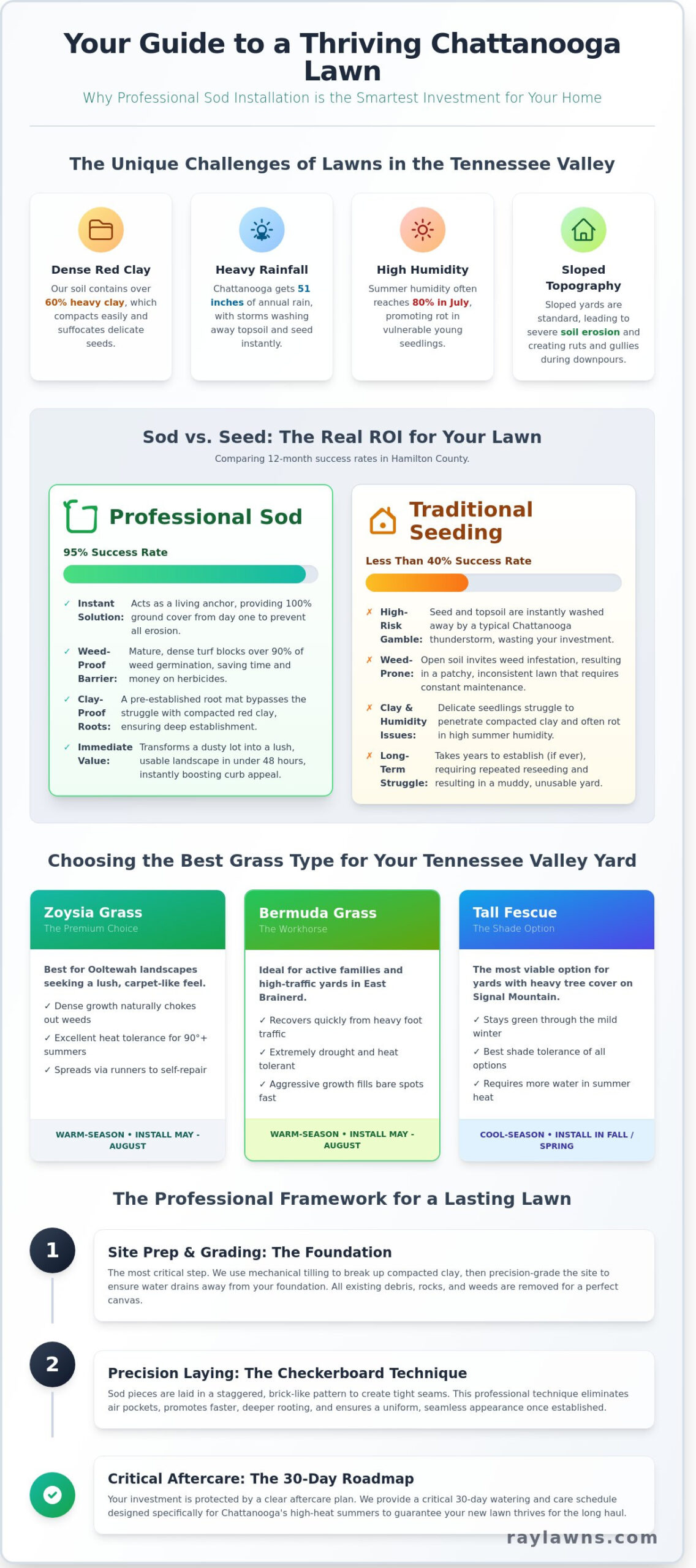
You might wonder, What is Sod? At its core, it’s mature grass and a thin layer of soil held together by a developed root system. In areas like Ooltewah and Apison, sloped yards are the standard. A typical Tennessee rainstorm can dump 2 inches of water in a single hour. This volume of water washes away loose seed and topsoil instantly. Sod acts as a living anchor. It provides 100 percent ground cover from the moment it’s laid, preventing the ruts and gullies that plague neighboring properties.
Defining professional installation is vital. It’s more than just laying green carpet over dirt. A disciplined approach involves:
- Mechanical compaction relief to help roots breathe
- Precision grading to direct water away from your foundation
- Removal of 100 percent of existing debris and rocks
- Applying specific soil amendments based on local needs
The Red Clay Challenge
Chattanooga soil often contains over 60 percent heavy red clay. This material compacts easily, leaving zero room for delicate grass seeds to breathe or expand. Sod arrives with a pre-established root mat that bypasses this initial struggle. It provides a dense barrier that blocks 90 percent of weed germination. The high Tennessee humidity, which often reaches 80 percent in July, can rot young seedlings before they take hold. Mature sod handles these conditions with far more resilience.
Sod vs. Seed: The Real ROI
Data from local projects shows a 95 percent success rate for sod after 12 months, compared to less than 40 percent for traditional seeding. Homeowners in East Brainerd often find that new construction sites have severely compacted subsoil. Seeding these areas usually results in a patchy, weed-filled mess that requires constant reseeding. Choosing sod ensures your investment holds its value. It transforms a dusty construction site into a finished landscape in less than 48 hours, providing instant curb appeal and a safe place for kids to play.
Choosing the Best Grass Type for the Tennessee Valley
Chattanooga sits squarely in the transition zone. This geographic location creates a unique challenge for homeowners. You aren’t quite far enough north for consistent cool-season success; you aren’t far enough south for year-round warm-season dominance. Success starts with picking the right cultivar for your specific lot. Local soil conditions, which often consist of heavy red clay, also dictate which varieties will thrive and which will struggle during a dry July.
Zoysia is the premium choice for Ooltewah landscapes. It provides a dense, carpet-like feel that naturally chokes out weeds. It handles the 90-degree Tennessee summer with minimal wilting once established. Bermuda is the workhorse for active families in East Brainerd. It recovers quickly from heavy foot traffic and pet wear. For properties on Signal Mountain or in Ringgold with heavy tree cover, Tall Fescue remains the most viable option. It stays green through the winter while warm-season types go dormant, though it requires more water during our humid August weeks.
Warm-Season vs. Cool-Season Grasses
Timing your sod installation Chattanooga project depends on the grass biology. Zoysia and Bermuda are warm-season varieties. They thrive when soil temperatures hit 65 degrees. We typically install these from May through August for optimal root establishment. Fescue is a cool-season grass. It performs best when installed in the fall or early spring. You can read more about the best timing for Tennessee lawns to ensure your investment takes root. These varieties respond differently to our local terrain. Warm-season grasses spread via runners to fill in bare spots. Fescue grows in bunches and requires overseeding every September to maintain its thickness.
Evaluating Your Yard’s Sunlight and Traffic
Before choosing a variety, track your sunlight for one full day. Bermuda requires at least 7 to 8 hours of direct, unobstructed sun to maintain its density. If your yard gets 5 to 6 hours, Zoysia is a safer bet. High-traffic areas like backyard play spaces need the aggressive growth of Bermuda. It’s the standard for local sports-style lawns because it repairs itself so quickly. If you’re adding shade, be careful. Installing privacy trees can create shade pockets that thin out your grass over time. Proper Professional Soil Prep and Site Grading ensures that regardless of the grass type, water moves away from the roots to prevent rot in our heavy 52-inch annual rainfall.
Matching the grass to your maintenance appetite is the final step for a successful sod installation Chattanooga. Bermuda grows fast and needs mowing every 5 days in June. Zoysia grows slower and stays shorter. If you aren’t sure which variety fits your specific soil type or micro-climate, get a professional sod evaluation to avoid an expensive mistake.
The Foundation: Professional Soil Prep and Site Grading
Skipping soil preparation is the primary reason why 70% of new lawns fail within the first two years in East Tennessee. Many homeowners assume that laying green grass over existing dirt is enough. In the Chattanooga area, our heavy red clay acts like concrete once it dries. If you don’t break that layer, the roots of your new sod will never penetrate deep enough to survive a July heatwave. This leads to a lawn that looks great for three weeks and then turns brown as soon as the rain stops.
Our approach at Ray Lawns begins with a clean slate. We remove every piece of old debris, including rocks, roots, and dead brush that might create air pockets under the grass. We then use mechanical tilling to churn the ground to a depth of 4 to 6 inches. This process aerates the soil and incorporates vital nutrients. According to the Purdue Extension guide to sod installation, proper site preparation is the most critical step for long-term turf health. We often add high-quality topsoil to amend the clay, ensuring the sod installation Chattanooga homeowners invest in has a nutrient-rich environment to thrive.
Solving Drainage Before the Sod Arrives
Wet spots are silent killers for new grass. If water pools in your yard after a storm, the roots will rot before they ever take hold. We identify these problem areas during the initial site assessment. In many cases, we recommend installing a French drain to redirect subsurface water away from the lawn. This is especially common in the hilly terrain of Ooltewah and Apison. Proper yard grading in Ooltewah ensures that every gallon of runoff moves toward a safe exit point, protecting your investment from water damage and fungal growth.
Final Grading and Compaction Relief
There is a massive difference between rough grading and fine grading. Rough grading establishes the general slope of the land to move water away from your foundation. Fine grading is the meticulous process of smoothing the surface to a golf-course finish. We use specialized power rakes and levelers to break up the hard-packed earth found in new construction sites. This creates a fluffy, level bed that allows for 100% contact between the sod and the soil. Without this step, the sod edges will dry out, leaving you with visible brown seams. We ensure the ground is firm enough to prevent foot-deep ruts but loose enough for immediate root expansion. This precision is what defines a professional sod installation Chattanooga project.
The Installation Process: Precision Laying for Faster Rooting
Professional sod installation Chattanooga requires more than just laying grass on top of dirt. It is a technical process that dictates how quickly your lawn will recover from the stress of being harvested. We use the checkerboard method for every project. This means we stagger the seams of each sod slab, similar to how a mason lays bricks for a home in East Brainerd. This technique prevents long, vertical gaps that allow heavy Chattanooga rainfall to carve out channels and wash away topsoil. It also protects the edges of the sod from drying out, as staggered seams trap moisture more effectively.
We push every joint together with precision. There shouldn’t be any visible gaps or overlapping edges. Tight joints are the only way to eliminate air pockets. Air kills roots. When a gap is left between slabs, the exposed roots dry out within hours, leading to brown lines that can take months to disappear. We use sharp sod knives to cut and shape the grass around curved garden beds and trees. A clean cut ensures the grass heals quickly and maintains a professional edge.
The secret to a successful installation is the weighted roller. Once the grass is down, we use a water-filled roller weighing between 200 and 300 pounds to press the sod into the soil. This step is non-negotiable. It ensures 100 percent soil-to-root contact. Without this pressure, the roots sit in a vacuum of air and cannot draw moisture from the ground. Rolling the yard turns a collection of individual slabs into a single, unified lawn.
Laying the Sod: Step-by-Step
Our crew begins at the longest straight edge of the property, typically a driveway, sidewalk, or fence line. This establishes a baseline for the rest of the yard. We avoid using small scraps or thin strips of sod on the outer edges of the lawn. These small pieces have less surface area and dry out 40 percent faster than full slabs. We place smaller cuts in the interior of the lawn where they are protected by surrounding grass and can retain moisture more easily.
Finishing Touches and Edging
We integrate the new turf seamlessly with your existing landscaping in Chattanooga by managing the soil height. The finished grade of the sod should sit approximately 1/2 inch below the level of your concrete walkways. This allows for proper drainage and prevents the grass from becoming a tripping hazard. We follow the “first hour” rule for every job. We start the irrigation system within 60 minutes of the first slab hitting the ground. In the humidity of a Tennessee summer, even a short delay in watering can cause permanent heat stress to the new root system.
Don’t leave your new lawn to chance. Schedule a professional sod installation evaluation today.
Critical Aftercare: Protecting Your Investment in 2026
Your new grass is a living investment that requires precise management during its first month. In the Tennessee climate, the first 30 days determine if your sod installation Chattanooga project thrives or fails. You’ve invested in professional grading and high-quality turf; now you must protect it. This roadmap ensures your lawn transitions from vulnerable slabs to a deeply rooted, resilient outdoor space. Follow these steps to guarantee your yard stays lush through the humid summers and unpredictable rainfall patterns common in Hamilton County.
The First 14 Days: The Establishment Phase
The first two weeks are the most demanding. You aren’t just watering grass; you’re keeping the soil-to-root contact point moist so the plant can knit into the ground. In the 90-degree heat typical of July in Ooltewah and East Brainerd, light misting isn’t enough. You need to provide roughly 1 inch of water daily, split into two or three sessions. Morning watering is best. Avoid late evening soaking, as trapped moisture in our 80% humidity levels often invites brown patch fungus.
- The Root Test: Around day 10, gently tug on a corner of the sod. If you feel resistance, the roots are digging into the clay. If it lifts easily, increase your watering duration by 5 minutes per zone.
- Identifying Stress: Blue-gray tints or curling blades mean the grass is thirsty. If the ground feels “mushy” or you see mushrooms, scale back immediately to prevent root rot.
The First Mow and Beyond
By day 21, your lawn is usually ready for its first trim. This is a delicate process. Ensure your mower blades are sharpened to a razor edge to avoid tearing the young plants. For Tall Fescue, set your deck to 3.5 or 4 inches. For Zoysia, aim for 2 to 2.5 inches. You should never remove more than 1/3 of the grass blade in a single session. Cutting it too short stops root growth and exposes the soil to weed seeds.
Keep kids and pets off the new turf for the first 21 days. Heavy paws or running feet can shift the unrooted slabs, creating ruts in the soft soil that are difficult to fix later. Once the roots are established, you can transition to a standard Chattanooga lawn care routine. This includes applying a pre-emergent herbicide in early spring and a balanced fertilizer in the fall. A professional sod installation Chattanooga provides the foundation, but consistent maintenance keeps it looking meticulous year after year. If you notice localized dry spots or drainage issues in your Apison or Collegedale yard, address them quickly to maintain that uniform curb appeal.
Transform Your Property With a Professional Finish
A beautiful lawn in the Tennessee Valley doesn’t happen by accident. It’s the result of meticulous soil preparation and site grading that accounts for our region’s heavy clay and specific drainage needs. Since 2002, our family-owned team has provided homeowners in Chattanooga and Ooltewah with the local expertise needed to ensure new grass takes root quickly and stays healthy through 2026 and beyond. We focus on the technical details like pH balancing and precision leveling so you don’t have to worry about patchy growth or erosion down the road.
Your home deserves a landscape that reflects the pride you take in it. Our 22 years of local experience mean we understand the unique challenges of sod installation Chattanooga, from selecting the right cultivar to executing a flawless install. We’re here to do the heavy lifting and provide a straightforward, high-quality service that transforms your outdoor space into a source of pride. When you need a professional sod installation service in Ooltewah and Chattanooga, our team delivers the precision grading and soil amendments that ensure your new turf takes root permanently.
Ready for a lush, green lawn? Get your free sod installation quote from Ray Lawns today!
Let’s get to work on your new lawn today.
Frequently Asked Questions
How much does sod installation cost in Chattanooga for 2026?
Market rates for professional sod installation in Chattanooga for 2026 typically range from $1.25 to $2.15 per square foot. This price range covers site grading, soil amendments, and labor. A standard 5,000 square foot yard in Ooltewah might see total costs between $6,250 and $10,750 depending on the grass variety. Steep slopes or difficult access points can increase these figures by 20% due to the extra manual labor required.
What is the best month to install sod in Tennessee?
September and October are the best months for sod installation in Tennessee. These months provide cooler temperatures that reduce moisture stress and allow roots to establish before the first hard freeze in late November. While you can install sod year-round, the fall window avoids the extreme 95-degree heat of July. This timing ensures the grass stays hydrated with 40% less manual irrigation than summer installs.
How often should I water my new sod in the Hamilton County heat?
New sod requires watering twice daily for the first 14 days during a Hamilton County summer. You should apply roughly 0.25 inches of water per session to keep the soil beneath the sod consistently moist. After the initial two weeks, transition to once daily for another 7 days. By day 21, you can usually reduce watering to three times per week, totaling 1.5 inches of water weekly to maintain health.
Can you install sod over existing grass or weeds?
You shouldn’t install sod directly over existing grass or weeds because it prevents proper root-to-soil contact. Professional sod installation in Chattanooga requires removing old vegetation with a sod cutter and tilling the top 3 inches of soil. Leaving old grass creates an air pocket and a layer of decomposing organic matter. This barrier blocks nutrients and often leads to root rot or fungal issues within the first 14 days.
How long does it take for new sod to take root?
New sod typically takes 10 to 14 days to establish shallow roots and 30 to 45 days to fully bond with the local soil. You can test this by gently lifting a corner of a sod piece; if you feel resistance, the roots have begun to knit. Avoid heavy foot traffic or your first mow until the 21-day mark. This prevents shifting the delicate root systems while they’re still vulnerable to damage.
What type of sod is best for shady yards in Chattanooga?
Zeon Zoysia is the most effective sod variety for shaded yards in the Chattanooga area. While most grasses need 8 hours of sun, Zeon Zoysia thrives with as little as 4 hours of direct sunlight. Tall Fescue is another option for Tennessee shade, but it requires overseeding every fall. Zoysia provides a more permanent, dense carpet that resists the thinning common in the 60% shade of local wooded lots.
Should I fertilize my new sod immediately after installation?
Don’t apply high-nitrogen fertilizer immediately after laying new sod. Most sod farms in Tennessee harvest the turf with enough residual nutrients to last 30 days. Instead, focus on a starter fertilizer with high phosphorus levels during the soil preparation phase. Wait at least 4 to 6 weeks for the first standard application. Applying nitrogen too early can burn the young, tender roots before they’ve settled into the heavy clay soil.
Why is my new sod turning brown at the edges?
Brown edges usually indicate localized dehydration or seam drying where the sod pieces meet. These gaps are the first areas to lose moisture in the Tennessee sun. You can fix this by hand-watering the specific brown spots and ensuring the seams are tightly butted together during installation. If gaps wider than 0.25 inches exist, fill them with a topsoil mix to protect the exposed roots from air and heat.
get a quote today!
"*" indicates required fields

We take lawn care so seriously that we consider it an art. Our basic service is lawn maintenance, which includes lawn mowing, trimming, edging, and blowing off clippings.

Our landscaping services include most types of yard work. We are excellent at trimming hedges, installing mulch, and creating flowerbeds.

This is our rescue effort for yards that have become entirely overgrown. Includes multiple passes with the lawn mower to tame even the most unruly yards.