After a three inch downpour hits the Tennessee Valley, many homeowners find their backyards transformed into a swamp of slick red clay. It’s a common sight in neighborhoods across the region. You’ve likely spent your Saturday morning staring at standing water, wondering if that moisture is currently pressing against your foundation. It’s frustrating to deal with a yard that stays soft for days, making it impossible to mow or let the kids play outside. This is why proper yard grading Ooltewah TN is so critical for local properties.
We understand that a level, dry property is the foundation of a great home. You want a yard that’s usable, not a muddy mess that ruins your shoes and your weekend plans. This guide will show you how professional site preparation protects your home from erosion and directs heavy rainfall exactly where it needs to go. You’ll learn the specific steps we take to tame the local terrain, manage runoff, and create the ideal base for a lush, green lawn that actually lasts. We’ll break down the technical side of dirt work so you can make an informed decision for your landscape.
Key Takeaways
- Understand the vital difference between rough and finish grading to ensure your property is prepared for both drainage and aesthetics.
- Learn how professional yard grading Ooltewah TN addresses the unique challenges of Tennessee red clay and steep ridge slopes.
- Discover the essential steps experts take to clear debris and mark utilities before reshaping your land for optimal water flow.
- Explore how combining strategic grading with subsurface drainage solutions like French drains prevents erosion during heavy Valley rainfall.
- Find out why a precision finish grade is the secret to a successful sod installation and a perfectly level lawn.
What is Yard Grading and Why is it Critical in Ooltewah?
Yard grading is the strategic process of sculpting and leveling the land to ensure water flows exactly where it should. It isn’t just about smoothing out a few bumps in the lawn. It is a precise engineering task known as Grading (earthworks), which involves adjusting the slope of your property to protect your home. In Ooltewah, where the terrain transitions from flat valley floors to steep ridges, proper grading is the difference between a dry basement and a costly flood repair.
We categorize this work into two main phases. Rough grading happens during initial construction to set the general shape of the lot. Finish grading is the meticulous final step where we prepare the soil for sod installation or landscaping. While rough grading moves the heavy earth, finish grading focuses on the top 2 to 4 inches of soil to ensure perfect drainage and a smooth surface. This process acts as your home’s “invisible foundation,” supporting the structural integrity of your property by keeping water at a safe distance.
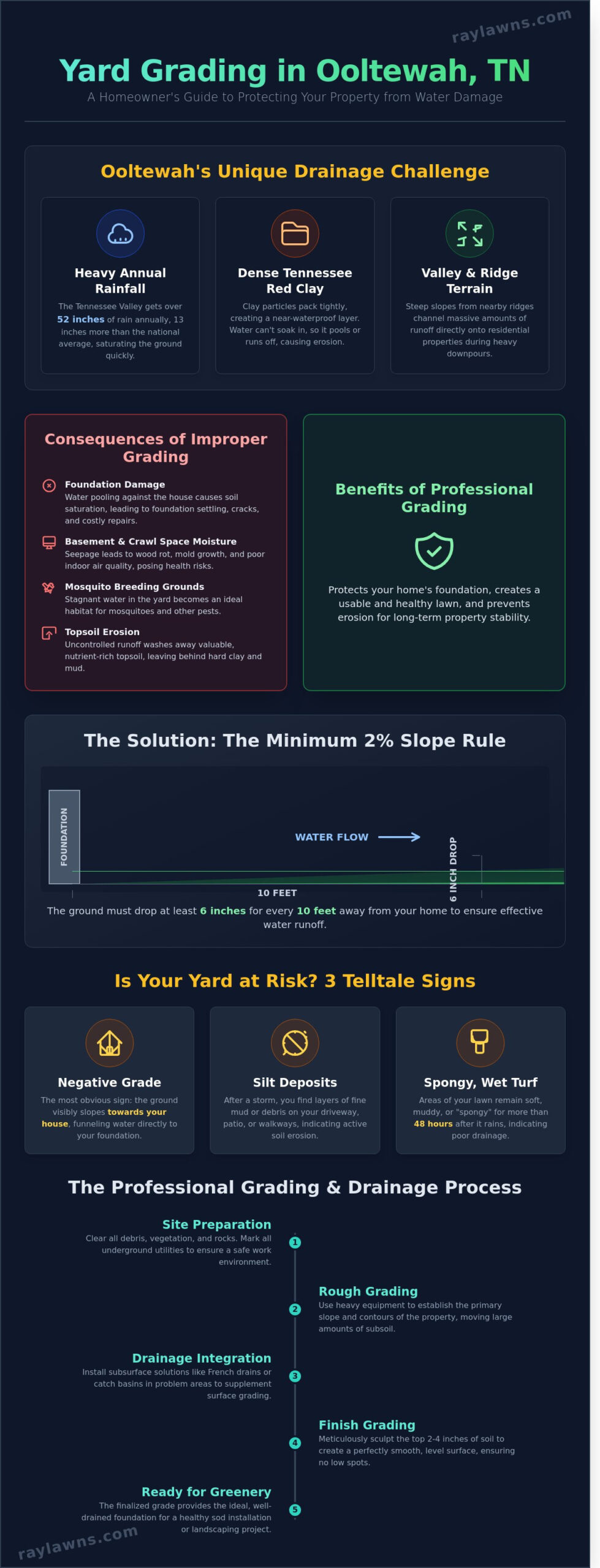
Ooltewah’s unique topography makes this more complex than in other regions. Local properties often deal with heavy runoff from nearby hills and ridges. When you combine these slopes with the dense red clay common in Hamilton County, water doesn’t soak in; it moves across the surface. Professional yard grading Ooltewah TN requires a deep understanding of these local soil types and the 52 inches of average annual rainfall our area receives.
The Consequences of Improper Grading
When water isn’t directed away from the home, the results are often expensive. In nearby East Brainerd and Ooltewah, we frequently see foundation settling caused by saturated soil. A single inch of rain on a 2,000-square-foot roof produces roughly 1,200 gallons of water. If your grade is flat or “negative,” that water pools against your foundation or seeps into crawl spaces. This moisture leads to wood rot and mold. Beyond the house, poor grading causes significant soil erosion, washing away nutrient-rich topsoil during spring storms and creating stagnant pockets that serve as mosquito breeding grounds.
Signs Your Ooltewah Property Needs Re-grading
You can often spot drainage issues before they become emergencies. Look for these specific indicators on your property:
- Negative Grade: If the ground slopes toward your house rather than away from it, water is being funneled directly into your foundation.
- Silt Deposits: Finding layers of fine mud or debris on your driveway or patio after a storm indicates that water is carrying soil across your hardscapes.
- Spongy Turf: If sections of your lawn remain soft and muddy for more than 48 hours after a rain, the soil is likely compacted and improperly sloped.
When performing yard grading Ooltewah TN, we aim for a minimum 2 percent slope. This means the ground should drop at least 6 inches within the first 10 feet away from your home’s exterior walls to ensure effective runoff.
The Challenges of Grading in the Tennessee Valley
Ooltewah homeowners face a unique battle with the landscape. The Tennessee Valley receives over 51 inches of rain every year, which is 13 inches higher than the national average. When this volume of water hits the ground, it doesn’t just disappear. It follows the path of least resistance. If your lot isn’t shaped correctly, that path leads straight toward your foundation or creates a swamp in your backyard. Effective yard grading Ooltewah TN requires more than a tractor and a pile of dirt; it requires an understanding of how our local geology reacts to saturation.
A common mistake is assuming that “just adding more dirt” will solve a low spot. If you dump loose topsoil over a drainage problem without proper compaction, the first heavy storm will wash that investment into your neighbor’s driveway. Professional grading involves stripping back the top layer, shaping the subsoil, and using vibratory rollers to ensure the ground stays where it’s put. Without this mechanical compaction, new soil remains porous and will settle unevenly within the first 6 months.
Dealing with Tennessee Red Clay
Red clay is the primary obstacle for yard grading Ooltewah TN projects. Clay particles are flat and pack together tightly, creating a waterproof seal that traps puddles on the surface for days. This soil expands when wet and shrinks during our hot August droughts, which can shift retaining walls and crack concrete pads. When we prep for sod installation, we often have to incorporate soil amendments to break up this density.
Working with clay requires specialized equipment. Using a heavy skid steer on wet clay can cause “slicking,” a process where the bucket glazes the soil surface and makes it nearly impenetrable to water and roots. The Tennessee Smart Yards program highlights how managing runoff starts with understanding your soil’s absorption rate. We use tined attachments to scarify the clay before adding topsoil, ensuring the two layers bond rather than sliding apart during a downpour.
Managing Steep Slopes and Erosion
White Oak Mountain and the surrounding ridges create elevation changes of 15 to 30 degrees on many residential lots. Managing this water velocity is critical. If water gains too much speed as it travels down a hill, it gains the power to move rocks and carve deep gullies in your lawn. We use “benches,” which are flat breaks built into a long slope, to act as speed bumps for rainwater.
- Terracing: Breaking one steep hill into two or three smaller levels using stone or timber.
- Velocity Control: Using rip-rap or vegetation to slow water before it reaches the bottom of the grade.
- Immediate Stabilization: Never leave graded clay exposed for more than 24 hours. We use erosion control blankets or temporary seeding to lock the soil in place.
If your backyard feels like a mountain trek every time you mow, it might be time for a professional evaluation. You can request a site visit to see how strategic contouring can make your hills more manageable and your lawn more functional.
The Professional Grading Process: How Experts Do It
Professional yard grading Ooltewah TN requires a disciplined sequence of events to ensure water moves exactly where it belongs. We don’t just push dirt around and hope for the best. The process starts with a site survey and utility marking. Calling 811 is a mandatory safety step. In Ooltewah, utility lines for gas, water, and fiber optics are often buried just a few inches below the surface. Striking one is a safety risk and an expensive mistake we avoid by verifying every line before the machines arrive.
Once the site is marked, we clear the work area. This involves removing old stumps, thick brush, and invasive vegetation. Leaving organic matter in the ground is a shortcut that leads to future failure. After clearing, we begin rough grading. This phase establishes the primary pitch of the land. Because Ooltewah sits on heavy clay soil, water doesn’t soak in quickly. It needs a clear, unobstructed path to travel. We refine the surface through final grading and soil conditioning to create a smooth finish layer. Finally, we stabilize the area with quality sod or seed. Hamilton County averages 52 inches of rain per year, so immediate stabilization is the only way to prevent erosion from ruining the new grade.
Equipment and Precision
We choose tools based on the specific needs of your property. A skid steer is our workhorse for moving large volumes of dirt in open spaces. For tight areas near the foundation or between houses, we use a mini-excavator for its surgical precision. We use laser levels to verify a minimum 2% slope away from your home. That is a 2 foot drop for every 100 feet of distance. Our operators focus on feathering the edges. This technique blends the new grade into your existing landscape so the transition looks natural rather than like a construction site.
Avoiding Common Grading Mistakes
Many DIY attempts fail because they bury organic debris like logs or stumps. As this material rots over three to five years, it creates underground voids that turn into dangerous sinkholes. We also account for the neighbor’s property. Professional yard grading Ooltewah TN ensures you don’t solve your drainage issue by flooding the house next door. That only leads to neighbor disputes and potential legal liability. Finally, we respect the settling period. Freshly moved dirt will compact by 10 to 15 percent over time. We plan for this shift before any permanent hardscapes or French drains are finalized.
Integrating Drainage Solutions with Your New Grade
Proper yard grading Ooltewah TN homeowners invest in often requires more than just moving soil. While a 2% slope away from your foundation is the standard, Tennessee’s heavy rainfall often exceeds what soil alone can absorb. We see an average of 52 inches of rain annually in Hamilton County. This volume creates high hydraulic pressure against basement walls and crawl spaces. To manage this, we integrate mechanical solutions into the land’s new shape.
A French drain serves as the primary tool for capturing subsurface water that grading cannot reach. We also utilize catch basins at low points to collect surface runoff before it turns into a muddy mess. For areas prone to aggressive washouts, a dry creek bed offers a rugged, aesthetic way to slow down fast-moving water. These features work together to ensure your new grade remains stable during a summer downpour.
When a French Drain is Necessary
In areas like Apison and Collegedale, underground springs and high water tables are common. If your yard stays soft three days after the rain stops, grading alone won’t fix it. We install French drains in tandem with a 1-degree surface slope to pull water from the root zone. We use 4-inch or 6-inch perforated pipe depending on the square footage of the collection area. This ensures the system handles Chattanooga’s peak rainfall intensity of 3 inches per hour without backing up.
Downspout and Surface Water Management
Standard plastic downspout extensions are a leading cause of foundation failure. They crack, clog, and trip mowers. We replace these with solid Schedule 40 PVC piped directly into the grade. This moves roof water to safe zones like street gutters or wooded perimeters. This protection is vital for your landscaping in Chattanooga. It prevents soil erosion and keeps your mulch beds from washing into the driveway.
Preparing for Success: From Grade to Greenery
Finish grading is the most critical step for achieving a level, functional lawn. While rough grading moves the heavy clay to solve major drainage issues, finish grading smooths the surface for aesthetics and health. This meticulous process removes small rocks, breaks up clods, and fills minor depressions. For any yard grading Ooltewah TN project, this step ensures the water doesn’t just leave your foundation; it flows exactly where it should without pooling in the middle of your grass.
A smooth grade is the only way to guarantee a successful sod installation in Ooltewah. Air pockets under new sod are the primary cause of root failure. If the ground isn’t perfectly smooth, the grass cannot establish a deep root system in our tough Tennessee clay. If your plan includes tree planting or privacy screens on a newly graded slope, we ensure the soil is stabilized first. Ray Lawns brings 20 years of local experience in Hamilton County to every job. We understand the specific soil density and runoff patterns unique to Ooltewah and the surrounding areas.
Choosing Your Ground Cover
Choosing between sod and seed is a matter of timing and erosion control. Sod provides 100 percent soil coverage immediately. This is vital on a new grade where a single storm can wash away weeks of work. Zoysia and Bermuda sod are the best choices for Ooltewah because they thrive in heat and handle the local clay soil better than fescue. After laying the turf, we use a heavy roller to press the roots into the soil. This contact is the secret to a lawn that stays green and stays put. For homeowners seeking the most durable results, our comprehensive approach to sod installation Chattanooga ensures your new grass survives the region’s challenging climate conditions.
Long-Term Maintenance of Your Grade
Once the work is done, you must monitor the land. Watch for “rills” or small channels that might form after the first heavy rain in early 2026. These small paths can turn into deep gullies if ignored. Catching them early with a little extra soil and seed saves the whole grade. Consistent lawn care in Ooltewah helps maintain the soil structure by encouraging thick root growth. A properly graded yard is a long-term investment. It protects your foundation and increases your property value by up to 15 percent. It’s the foundation of a yard you can actually use.
Protect Your Property with Expert Site Preparation
Your home represents a major investment. Proper yard grading Ooltewah TN ensures that the 52 inches of annual rainfall our region receives flows safely away from your foundation instead of pooling in your crawl space. Since 2002, our family-owned team has specialized in managing the unique challenges of Tennessee red clay. This dense soil requires specific machinery and a precise touch to prevent compaction while ensuring effective runoff. We focus on the physical results of our labor because we know that a professional grade is the only way to avoid costly drainage repairs down the road.
We’ve spent over two decades perfecting a process that combines meticulous grading with final sod installation. This dual expertise means your property won’t just drain correctly; it’ll also have the perfect foundation for a lush, green lawn. Don’t let standing water or erosion devalue your outdoor space. Take the first step toward a more functional and beautiful property today. Request a Free Grading Evaluation from Ray Lawns and let our experienced crew provide the precision your landscape deserves. We look forward to helping you transform your yard into a space you’re proud to own.
Frequently Asked Questions
How much does yard grading cost in Ooltewah, TN?
Professional yard grading in the Chattanooga area typically costs between $2,500 and $7,500 for most residential lots. This price range covers the cost of equipment transport, labor, and the delivery of 10 to 20 cubic yards of fill dirt. Large-scale projects involving heavy excavation or the construction of retaining walls will see costs increase beyond these figures based on the volume of earth moved.
How long does it take to regrade a standard 1/4 acre backyard?
A standard 1/4 acre backyard regrading project typically takes 2 to 3 business days to complete from start to finish. The first day involves clearing existing vegetation and stripping the top layer of sod. The second day focuses on moving dirt to establish the 2 percent minimum slope needed for proper drainage. Final smoothing and soil stabilization happen on the third day to prepare the site for landscaping.
Can I regrade my yard myself with a rented bobcat?
You can rent a skid steer for about $350 per day, but DIY grading often leads to foundation damage or legal disputes with neighbors. Most homeowners lack the laser leveling equipment required to ensure a precise 1/4 inch drop per foot of distance. If you miscalculate the pitch, you might accidentally send 500 gallons of runoff directly into your crawl space during a heavy Tennessee rainstorm.
Will grading my yard kill my existing trees?
Adding more than 2 inches of soil over the root zone of a mature oak or maple can suffocate the tree by blocking oxygen. Roots need to breathe to survive. If the grading plan requires raising the elevation near a tree, we install a dry well or a small retaining wall at the drip line. This keeps the root flare exposed and protects the tree’s 40 year lifespan while still fixing the surrounding drainage.
What is the best time of year for grading in Chattanooga?
The best time for yard grading Ooltewah TN is during the late summer or early fall when the heavy clay soil is driest. Between August and October, the ground is stable enough to support heavy machinery without creating deep ruts or compaction issues. Working in the wet spring months often results in pumping soil, where the ground turns into a spongy, unworkable mess that won’t hold a grade.
Do I need a permit for yard grading in Hamilton County?
You generally don’t need a permit for minor residential grading in Hamilton County if you disturb less than 1 acre of land. However, if your project involves more than 10,000 square feet of land disturbance, you must submit a Land Disturbance Permit application to the county. Always check with the local building department if your project impacts a designated wetland or a protected stream buffer.
What happens if my neighbor’s yard is draining into mine?
Tennessee follows the civil law rule, which means a neighbor can’t legally increase the natural flow of water onto your property through artificial means. If a neighbor installs a pipe that dumps water directly onto your lawn, they’re often responsible for the resulting damages. Solving this usually requires a combination of professional yard grading Ooltewah TN and a French drain to redirect the flow safely toward the street.
How soon can I lay sod after my yard has been graded?
You should lay sod within 24 to 48 hours after the final grade is established to prevent erosion. If a heavy rain hits an unprotected dirt slope, it can wash away $1,200 worth of topsoil in a single afternoon. Once the soil is raked and firmed, the sod provides immediate stabilization for the new contours of your yard. Don’t wait longer than 3 days or weeds will begin to germinate in the fresh soil.
get a quote today!
"*" indicates required fields

We take lawn care so seriously that we consider it an art. Our basic service is lawn maintenance, which includes lawn mowing, trimming, edging, and blowing off clippings.

Our landscaping services include most types of yard work. We are excellent at trimming hedges, installing mulch, and creating flowerbeds.

This is our rescue effort for yards that have become entirely overgrown. Includes multiple passes with the lawn mower to tame even the most unruly yards.