
The “permanent” look of a solid concrete slab is actually its biggest weakness in the Tennessee Valley. You know the frustration of watching a brand-new surface develop a hairline fracture within the first 12 months, especially after our heavy spring rains. Whether you’re in Ooltewah or East Brainerd, you’ve likely seen how the 40% expansion rate of our local red clay can snap a rigid 4-inch slab like a cracker. It’s a common headache for homeowners who just want a reliable place to grill without worrying about trip hazards or pooling water.
In this guide, I’ll provide an expert comparison of a paver patio vs concrete Chattanooga residents can rely on to withstand our unique geological challenges. You’ll learn exactly how these materials respond to the 52 inches of rain we receive annually and how steep slopes affect long-term stability. We’ll break down the structural differences so you can choose a solution that won’t require a total replacement in 5 years, ensuring your outdoor space remains a source of pride and property value.
Key Takeaways
- Understand how Chattanooga’s heavy clay soil and high rainfall impact the stability and lifespan of different patio foundations.
- Learn the critical differences between a paver patio vs concrete Chattanooga residents need to know to avoid common cracking and shifting issues.
- Discover why flexible interlocking systems often outperform rigid concrete on the steep slopes and uneven terrain of the Tennessee Valley.
- Identify the essential professional excavation and drainage techniques that ensure your hardscape remains level for decades.
- Evaluate the long-term ROI and maintenance requirements for various materials to choose a style that best fits your home in Ooltewah or Ringgold.
Choosing Your Foundation: Paver Patio vs. Concrete in Chattanooga’s Climate
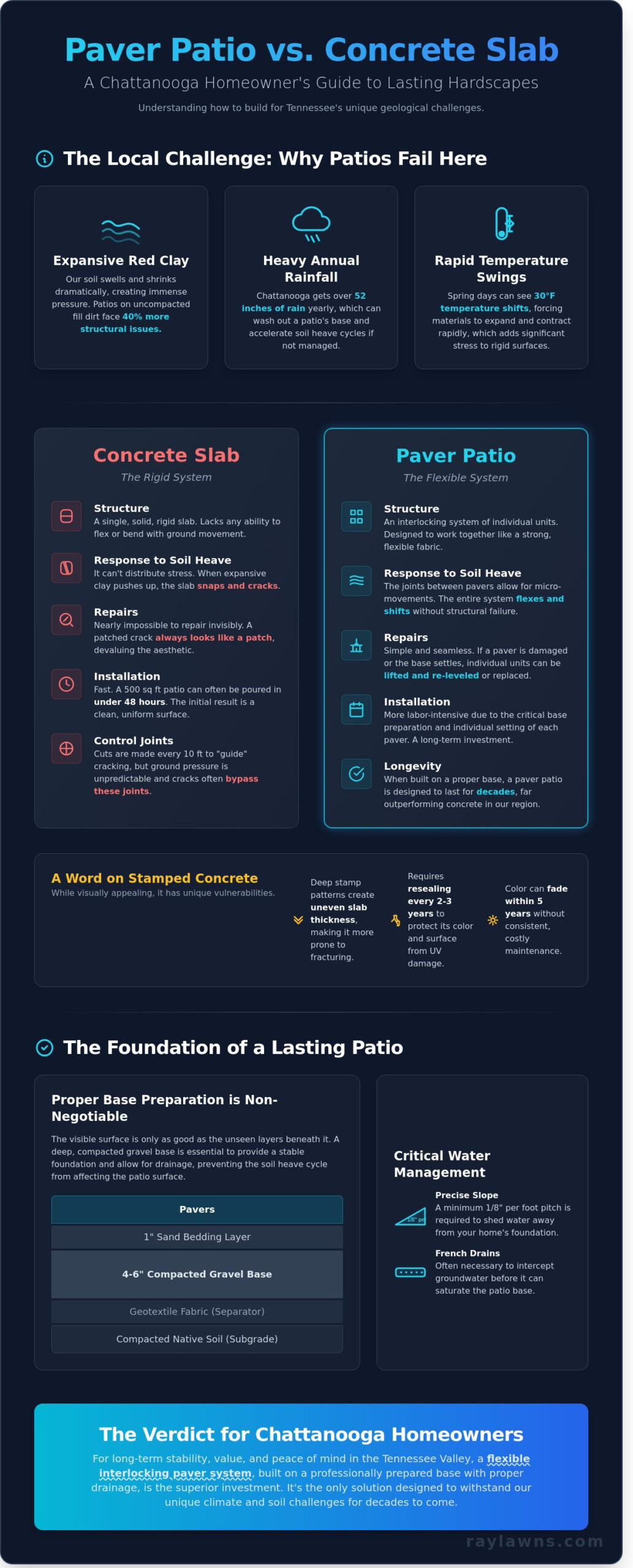
Homeowners in East Brainerd and Ooltewah often debate the merits of a paver patio vs concrete Chattanooga installations. The choice usually comes down to how a material handles the local environment. Concrete represents a rigid system; it’s a single, solid mass that resists movement until the pressure becomes too great. Pavers function as a flexible system. They consist of individual units that shift slightly without structural failure. In the Tennessee Valley, this distinction determines whether your investment stays level or develops unsightly cracks within the first five years.
The Impact of Chattanooga Red Clay
Chattanooga red clay is a heavy, expansive soil that acts like a dense sponge. When it rains, the clay particles swell, creating immense upward pressure known as soil heave. During a dry July, that same soil shrinks, leaving voids under your patio surface. Rigid concrete slabs often fail under these conditions because they lack the ability to bend. If your home was built on “fill dirt” rather than stable “virgin soil,” this movement is even more aggressive. We’ve observed that patios installed on uncompacted fill dirt experience 40% more structural issues compared to those on native, undisturbed ground.
Rainfall and Runoff Challenges
Chattanooga averages 51 inches of rain per year. This volume of water can quickly wash away the sub-base of a poorly planned patio if drainage isn’t the top priority. Every professional installation requires a precise pitch of at least 1/8 inch per foot to move water away from the home’s foundation. Without this slope, water saturates the underlying clay, accelerating the heave cycle and destabilizing the ground.
Many homeowners find that French drains are a necessary addition to their hardscape project. These systems intercept groundwater before it reaches the patio base. This protects your paver patio vs concrete Chattanooga investment from the destructive force of hydrostatic pressure. Managing water flow is the only way to ensure your outdoor living space remains a source of pride rather than a maintenance headache.
Poured Concrete Patios: The Pros, Cons, and the Reality of Cracking
Concrete is the default choice for many homeowners in Ooltewah and East Brainerd because it is fast. A professional crew can often prep and pour a 500-square-foot patio in under 48 hours. The result is a clean, uniform surface that provides a level spot for grills and furniture. Whether you choose a standard broom finish or a decorative stamped pattern, the initial appeal is undeniable. It’s a straightforward solution that gets the job done quickly.
Local contractors live by a simple rule: there are only two types of concrete. You have concrete that has cracked and concrete that hasn’t cracked yet. In Hamilton County, the 52 inches of average annual rainfall saturates the heavy red clay beneath your home. This clay expands with moisture and shrinks during our humid July dry spells. Because a concrete slab is rigid, it cannot bend with these shifts. Instead, it snaps. The 30-degree temperature swings we see in a single spring day only accelerate this stress, forcing the material to expand and contract until it fails.
Stamped Concrete vs. Standard Pours
Stamped concrete offers a high-end look by mimicking natural stone or slate textures. While beautiful, the stamping process can actually compromise the slab’s integrity. The deep grooves used to create the pattern often result in varying thicknesses across the pour. This makes the slab more prone to fracturing under pressure. To keep these surfaces looking sharp, you must commit to a maintenance cycle of cleaning and resealing every 24 to 36 months. Without this protection, Tennessee UV rays will bleach the color out of the surface within 5 years.
Why Concrete Cracks in Tennessee
The primary issue when weighing a paver patio vs concrete Chattanooga project is flexibility. Our local soil is dominated by expansive clay. When this soil shifts, a rigid concrete slab has no way to distribute the stress. We install control joints every 10 feet to encourage the concrete to crack in a straight, hidden line. Unfortunately, the ground doesn’t always follow our plans. Cracks often bypass these joints, resulting in jagged fractures across the middle of your living space. Repairing these is nearly impossible to do invisibly. A patched crack will always look like a patch, often devaluing the aesthetic of your backyard. If you’re dealing with shifting soil or poor runoff, a professional landscaping Chattanooga evaluation can help identify if your site is even suitable for a traditional pour.
Choosing a paver patio vs concrete Chattanooga often comes down to how much you’re willing to tolerate surface imperfections over time. While concrete is cheaper upfront, the cost of a full replacement after a major fracture can be double the original investment. Professionals know that in the long run, the ground always wins against a rigid slab.
Paver Patio Systems: Why Flexibility Wins on Tennessee Slopes
In the rolling hills of East Brainerd and Ooltewah, the ground is rarely static. We view an interlocking paver system as a living hardscape. Unlike a rigid slab, a paver patio consists of hundreds of individual units that work together to manage environmental stress. When the heavy Tennessee clay expands after a 3-inch rainfall, these units distribute the pressure across the entire surface. You don’t get the localized stress points that cause concrete to snap. This flexibility is the primary reason why the paver patio vs concrete Chattanooga debate often ends in favor of pavers for sloped properties. Homeowners can choose from modern, clean-lined Belgard products or go with a classic tumbled stone look to match a traditional home. The aesthetic versatility is unmatched.
The Strength of Interlocking Units
The secret to long-term durability lies in the sand-filled joints. These small gaps allow for micro-movements without structural failure. In areas like Apison, where winter temperatures can swing 40 degrees in 24 hours, the freeze-thaw cycle is brutal on hardscapes. Pavers handle this by shifting slightly and then settling back into place. If a single stone gets stained by grill grease or cracked by a dropped heavy tool, we replace that one unit in about 20 minutes. You aren’t stuck looking at a permanent scar on a massive concrete slab. This modularity creates an effectively infinite lifespan for the patio when the base is installed to professional standards.
Integration with Retaining Walls
Chattanooga properties often deal with 15 to 25 percent grades that make flat outdoor space a luxury. Pavers are the superior choice here because they tie into structural retaining walls seamlessly. We use them to create tiered outdoor living spaces that follow the natural contour of your yard. This modular approach makes it easier to leave room for softscape features. You can integrate privacy trees and garden beds directly into the design. It creates a cohesive look that feels like a natural part of the landscape rather than a flat, disconnected island of gray stone. This system allows for better drainage management, directing water away from your foundation and into designated runoff areas. For properties with significant slope challenges, working with a qualified retaining wall contractor in Ooltewah ensures your patio integration meets proper engineering standards for long-term soil stability.
- Weight Distribution: Independent units prevent large-scale cracking.
- Repairability: Individual stones are easily swapped if damaged.
- Climate Resilience: Sand joints absorb the shock of rapid temperature changes.
- Design Flexibility: Works with the slope, not against it.
Choosing a paver patio vs concrete Chattanooga means investing in a system that adapts to the environment. While concrete relies on its own internal strength to resist the earth, pavers move with it. This distinction is what keeps your outdoor space level and beautiful for 20 or 30 years instead of five or ten.
The Critical Difference: Base Preparation and Drainage in the Tennessee Valley
The surface of your patio is only 30% of the project. The remaining 70% stays hidden beneath the surface, yet it dictates whether your investment lasts 5 years or 25 years. In the Tennessee Valley, the high concentration of heavy red clay creates a volatile foundation. This soil expands when wet and shrinks during our humid summers. If the base isn’t engineered to handle these shifts, the paver patio vs concrete Chattanooga debate becomes irrelevant because both will fail prematurely.
Professional installation requires a minimum excavation depth of 10 to 12 inches for a standard pedestrian patio. We remove the unstable topsoil and organic matter to reach the firm clay subgrade. From there, we build the foundation using a specific layering technique. This involves 6 inches of densely graded crushed stone, compacted in 2-inch lifts using a 2,500-pound plate compactor. This ensures the base reaches a 95% Proctor density, which is the standard required to prevent the settling that creates dangerous tripping hazards.
Grading and Site Preparation
Stability in Apison or Ooltewah starts with a high-quality geotextile fabric. We place this heavy-duty woven material between the raw clay and your gravel base. It prevents the stone from sinking into the soft mud over time. Precision grading is the next step. Every patio must have a minimum 1% to 2% slope, which equates to a 1/4-inch drop for every foot of distance. This keeps water moving away from your foundation, protecting your home’s structural integrity.
Managing Water Flow
Chattanooga receives an average of 51 inches of rain per year. A standard concrete slab acts as a giant umbrella, shedding all that water onto your lawn at once. This often leads to erosion or standing water. A permeable paver system allows smaller amounts of water to filter through the joints, reducing runoff. However, for properties with significant elevation changes, we often integrate a French drain system to intercept subsurface water before it reaches the patio area. This proactive approach protects your new sod installation from being washed away during heavy spring downpours.
Don’t let poor drainage ruin your outdoor living space. Get a professional site evaluation to ensure your patio base is built for Tennessee clay.
Designing for Longevity: Making the Final Decision for Your Backyard
Choosing between a paver patio vs concrete Chattanooga depends on your long-term goals and your tolerance for maintenance. Standard concrete offers a lower initial price point, but its rigid nature makes it a liability in East Tennessee. Local clay soils expand and contract with every heavy rain cycle. Pavers provide a flexible system that handles this ground movement without structural failure. Homeowners in Ooltewah and Ringgold often see a 15% higher return on investment with stone pavers compared to standard broom-finish concrete. You’re paying for a surface that won’t require a total tear-out in ten years.
Aesthetic and Property Value
Pavers offer immediate curb appeal that concrete cannot match. In neighborhoods across Collegedale and East Brainerd, the architectural style often leans toward traditional or craftsman designs. Multi-tonal pavers complement these homes perfectly. We recommend selecting pavers with integral UV-resistant pigments. These colors won’t fade under the intense Tennessee sun like topical concrete stains do. To create a finished look, integrate your new hardscape with professional landscaping and tree planting. This softens the edges of the stone and makes the patio feel like a natural extension of your lawn.
The “Professional Shortcut” Warning
Be careful when reviewing low-ball quotes. Some contractors save time by skimping on the base layers. If a quote doesn’t specify at least 6 inches of compacted 57 stone and a layer of geotextile fabric, walk away. Without this foundation, your pavers will sink and your concrete will snap. A cheap installation usually fails within the first 24 months. Look for a line item for site grading; if they aren’t planning to move water away from the house, they’re setting you up for a flooded patio.
The Ray Lawns Approach to Hardscaping
We build patios to survive the local environment. Our process starts with a meticulous site evaluation to identify drainage issues before the first shovel hits the ground. We prioritize durability over speed. Our crew follows a strict multi-layer preparation protocol:
- Subgrade Compaction: We stabilize the native clay before adding any stone.
- Geotextile Separation: We use heavy-duty fabric to prevent the stone base from sinking into the mud.
- Precision Grading: Every project includes a 2% slope to ensure water runs off the surface.
The debate between a paver patio vs concrete Chattanooga usually ends with the same conclusion. Concrete is a rigid slab in a moving world. Pavers are a flexible system designed to last a lifetime. If you want a backyard that stays level and looks professional for decades, the choice is clear. Contact us today for a professional evaluation of your property layout and get a straightforward quote for your next project.
Building a Backyard That Stands Its Ground
Choosing between a paver patio vs concrete Chattanooga homeowners often face comes down to how you manage the heavy red clay beneath your feet. Since 2002, we’ve seen poured concrete slabs fail under the pressure of 52 inches of annual rainfall and the natural expansion of Tennessee soil. A flexible paver system avoids these structural cracks by moving with the ground rather than fighting it. Success always starts with a 6-inch compacted stone base and precision drainage planning to keep water away from your foundation. Our family-owned team has spent 22 years mastering the steep slopes and unique challenges of Ooltewah and the Tennessee Valley. We prioritize meticulous preparation so your outdoor living space stays level for decades. Don’t leave your backyard investment to chance with contractors who skip the critical base work. Take the first step toward a durable, beautiful outdoor transformation today.
Request a Professional Hardscape Evaluation from Ray Lawns
Your property deserves a foundation that lasts as long as your home.
Frequently Asked Questions
Is a paver patio much more expensive than concrete in Chattanooga?
Paver installations typically cost 30% to 50% more upfront than standard poured concrete slabs. While concrete is the cheaper initial investment, pavers offer a higher return on value because they don’t require full replacement when the ground shifts. In our local Tennessee clay, a concrete slab often develops visible cracks within 5 to 7 years, whereas a paver system remains flexible and easier to maintain over decades.
How do I prevent weeds from growing in my paver patio joints?
Install high-quality polymeric sand in the joints to create a durable, weather-resistant barrier. This specialized sand hardens after it’s activated with water, blocking 95% of weed seeds from taking root in the gaps. For homeowners in East Brainerd and Ooltewah, we recommend refreshing this sand every 3 to 5 years to ensure the seal remains tight against the heavy 50-inch annual rainfall we see in Hamilton County.
Will my concrete patio definitely crack if I live on a hill in Ooltewah?
Concrete patios on Ooltewah slopes have a 90% chance of developing hairline fractures due to the high shrink-swell capacity of local clay. This soil expands rapidly when wet and shrinks during summer dry spells, putting immense pressure on rigid surfaces. While we use control joints every 8 to 10 feet to manage where the concrete breaks, these joints only guide the cracks rather than preventing them entirely.
How long does a typical paver patio installation take compared to concrete?
A standard 400-square-foot paver patio takes 4 to 6 days to complete from excavation to final sealing. In contrast, a concrete crew can pour a slab in 1 day, but the surface requires a 28-day curing period to reach its full structural strength. You can’t place heavy furniture or grills on new concrete for at least 7 days, while pavers are ready for use the moment we finish the job.
Can I install a fire pit on both concrete and paver patios safely?
You can install a fire pit on both surfaces, but you must use a heat shield or fire brick liner to protect the material. Direct heat exceeding 400 degrees Fahrenheit causes concrete to spall or pop, which can permanently ruin a slab’s finish. When comparing a paver patio vs concrete Chattanooga homeowners often choose pavers because individual stones damaged by heat are easily replaced without tearing up the entire outdoor space.
What is the best way to clean and maintain a patio in the Tennessee humidity?
Use a pressure washer set to 1,500 PSI along with a biodegradable surfactant to remove organic growth twice per year. Chattanooga’s high humidity and frequent shade create a breeding ground for green algae and mold on porous surfaces. Applying a professional-grade breathable sealer every 24 to 36 months prevents moisture from soaking into the material and makes your seasonal cleanup much faster and more effective.
Do I need a permit for a new patio in Hamilton County?
Most detached patios under 200 square feet don’t require a building permit in Hamilton County. However, any project that changes the footprint of your property or impacts drainage patterns may require a site plan review to ensure compliance. We always verify specific zoning rules for homes in Apison and Collegedale to make sure your new hardscape meets all local setback requirements and doesn’t interfere with existing utility easements.
Can pavers be installed over an existing concrete patio?
You can install thin pavers over an existing slab using an “overlay” method if the concrete is structurally sound and has less than 1/4 inch of settling. This process involves a 1-inch sand bed or specialized adhesive to secure the new units in place. When weighing a paver patio vs concrete Chattanooga residents often use this approach to upgrade an old, stained driveway or patio without the 2,000-pound mess of a full demolition.
get a quote today!
"*" indicates required fields

We take lawn care so seriously that we consider it an art. Our basic service is lawn maintenance, which includes lawn mowing, trimming, edging, and blowing off clippings.

Our landscaping services include most types of yard work. We are excellent at trimming hedges, installing mulch, and creating flowerbeds.

This is our rescue effort for yards that have become entirely overgrown. Includes multiple passes with the lawn mower to tame even the most unruly yards.