
In Ooltewah, retaining walls rarely fail because of the blocks themselves; they fail because of the heavy red clay and the intense Tennessee rain. You have likely stood in your yard after a summer downpour, wondering if that new hairline fracture is just cosmetic or if the entire structure is about to slide into your neighbor’s property. It is a common worry, especially when you see soil eroding or water pooling where it should not. Identifying the specific signs of a failing retaining wall Ooltewah homeowners encounter is the first step toward protecting your investment.
We understand the stress of maintaining a property on the Chattanooga area’s steep slopes. This guide will help you distinguish between minor settling and dangerous structural shifts. You will learn how the 2018 International Residential Code impacts your repair options and why walls over four feet require an engineer’s stamped drawing in Hamilton County. We provide a clear assessment checklist to help you decide when it is time to call for a professional evaluation before a small crack turns into a total collapse.
Key Takeaways
- Understand how Ooltewah’s expansive red clay exerts massive pressure on your hardscape during heavy Tennessee rain.
- Identify the specific signs of a failing retaining wall Ooltewah homeowners often encounter, such as a “belly” bulge or a loss of vertical batter.
- Discover why white powdery efflorescence and clogged weep holes are early indicators of dangerous water buildup behind the blocks.
- Follow a professional checklist to measure wall movement and determine if your structure meets Hamilton County safety codes.
Why Retaining Walls Fail in Ooltewah’s Red Clay
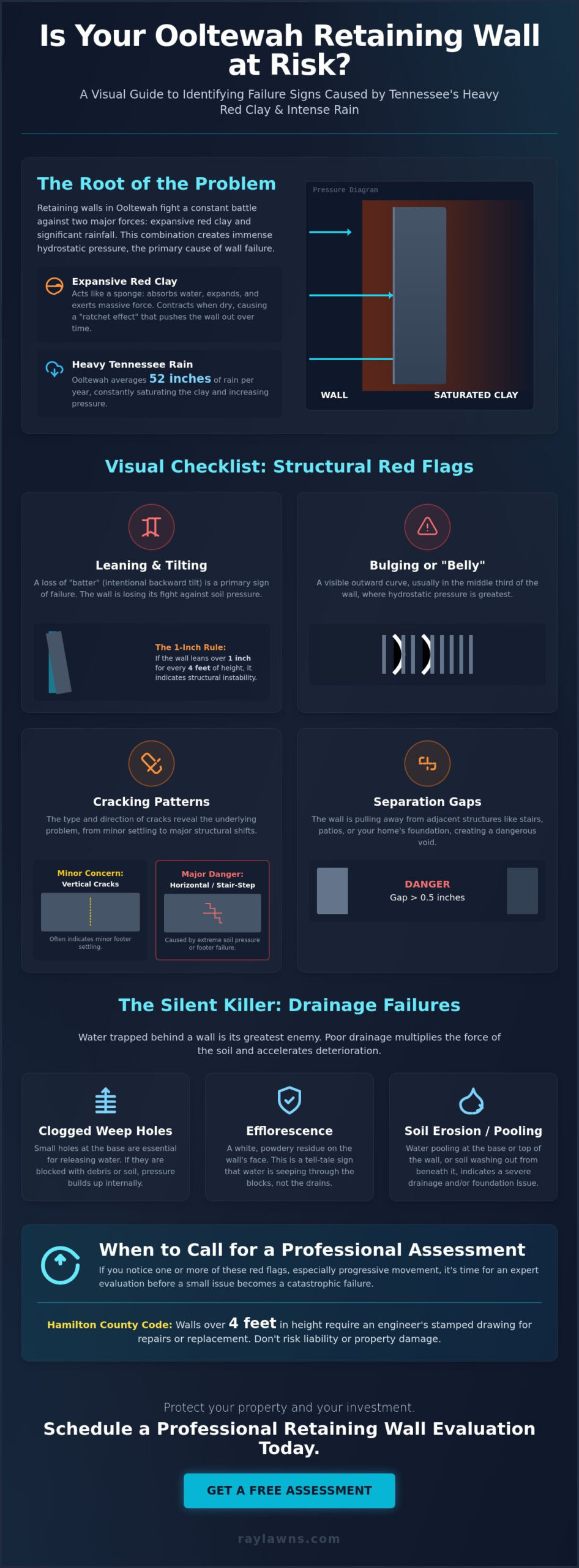
In East Tennessee, your retaining wall is constantly fighting the ground behind it. Ooltewah sits on a thick layer of heavy red clay that behaves differently than the sandy soils found in other regions. This clay is expansive. When it rains, it absorbs water and increases in volume, exerting massive force against the back of your hardscape. If you notice the signs of a failing retaining wall Ooltewah weather often triggers, you are likely witnessing the result of this relentless pressure. Most residential structures here are gravity walls, which rely purely on their own weight to hold back the earth. Without proper reinforcement or drainage, the weight of saturated clay eventually exceeds the weight of the wall itself.
Ooltewah receives an average of 52 inches of rainfall per year. This high volume of water saturates the soil frequently, leading to a phenomenon known as hydrostatic pressure. Hydrostatic pressure is the force of fluid at rest against a structural surface. This pressure is the primary reason walls start to lean or crack. Understanding retaining wall basics helps homeowners see that the wall isn’t just a stack of blocks; it is an engineered system designed to manage these environmental stresses.
The Impact of Saturated Soil
Clay soil acts like a sponge. It expands when wet and contracts during our hot, dry Tennessee summers. This movement creates a “ratchet” effect. The soil pushes the wall out during a storm, then shrinks back, leaving a tiny gap that fills with loose debris. The next rain pushes it even further. Hamilton County also experiences frequent freeze-thaw cycles. When water trapped in the clay freezes, it expands by about 9 percent, delivering a hammer-like blow to the back of your wall. If your contractor used native red clay as backfill instead of clean gravel, the wall cannot drain, and failure is almost guaranteed.
Understanding Wall Engineering Basics
A stable wall relies on its “toe” (the front bottom edge) and its “heel” (the back bottom edge) to stay upright. If the soil under the toe erodes or the heel lifts due to pressure, the wall tips. Many older homes in Ooltewah and Collegedale still have timber walls installed in the late 1990s. These wood structures have a natural lifespan of about 15 to 20 years before the internal “deadmen” anchors rot away. When the drainage fails, we often recommend installing French drains to divert water away from the structure. This is a critical step in professional landscaping Chattanooga homeowners use to save their existing walls.
Visual Checklist: Identifying Structural Movement
Walk to the side of your wall and look down the line of the blocks. A healthy wall should have a consistent “batter,” which is the intentional backward tilt designed to resist soil pressure. When you lose this batter, you are seeing one of the primary signs of a failing retaining wall Ooltewah residents should never ignore. Structural movement often starts slowly but accelerates as the heavy red clay pushes the wall past its center of gravity. Most failures we see in East Tennessee aren’t sudden; they are the result of years of incremental shifting that finally reaches a breaking point.
Leaning and Tilting Red Flags
Use a four-foot level to check for progressive tilting. A good rule of thumb is the “one-inch rule.” If a wall leans more than one inch for every four feet of vertical height, it has likely reached a point of structural instability. This degree of deflection suggests that the footing or foundation has failed. According to U.S. Army Corps of Engineers standards, overconsolidated swelling clay soils can cause significant lateral movement that traditional gravity walls cannot always withstand. If the top of your wall is visibly hanging over the base, the internal structure is compromised.
Cracking and Separation Patterns
Not all cracks mean the wall is falling, but their direction tells a story. Vertical cracks often indicate minor settling in the footer. However, horizontal cracks are a major red flag. These cracks usually appear in the middle third of the wall where the pressure is highest. In masonry walls, look for stair-step cracking. This occurs when the joints between blocks separate because the soil underneath is shifting or eroding unevenly. These gaps allow water to penetrate the core of the wall, leading to rapid deterioration during our winter freeze-thaw cycles.
Check the connection points where the wall meets your house, stairs, or a patio. If you see a gap wider than 0.5 inches forming, the wall is pulling away from the property. This separation creates a path for even more water to enter the backfill, which speeds up the failure. If your wall shows a “belly” or bulge in the center, the internal reinforcement or geogrid has likely snapped. At this stage, the wall is no longer acting as a solid unit. It is simply a series of loose blocks held up by friction. Don’t wait for a total collapse to seek a professional landscaping Chattanooga assessment to determine if the wall can be braced or if it requires a full replacement.
Drainage Failures: The Silent Killer of Ooltewah Walls
Water is the single biggest threat to any hardscape structure in East Tennessee. In our decades of field experience, nine out of ten failures start with poor water management. When drainage systems fail, they provide clear signs of a failing retaining wall Ooltewah homeowners can spot if they know where to look. Weep holes, those small openings at the base of your wall, should be dry most of the time but active during and after a storm. If they remain bone dry during a heavy downpour, the drainage aggregate behind the wall is likely clogged with fine red clay particles. This blockage prevents water from escaping, turning your backfill into a heavy, pressurized mud.
Don’t ignore the ground at the base of the wall. If the lawn feels “spongy” or you see water pooling long after the rain stops, your internal drainage pipe may be crushed or disconnected. In Ooltewah, our heavy 52-inch annual rainfall means that even a small clog can lead to a massive buildup of hydrostatic pressure in a matter of hours. Your gutter system also plays a major role. If a downspout dumps water within 10 feet of the wall’s backfill zone, you’re effectively pumping hundreds of gallons of water into the clay, which no standard gravity wall is designed to withstand.
Surface Water vs. Subsurface Water
Surface water should never flow over the top of your wall. This “overtopping” erodes the soil at the cap and creates “piping,” where water carves hidden tunnels through the backfill. Subsurface water is even more dangerous because it’s invisible until the wall starts to bulge. Many homeowners in East Brainerd and Ooltewah find that installing French drains uphill from the wall is the best way to intercept this water before it reaches the structure. Research in the Forensic Evaluation of Retaining Walls shows that soil-structure interaction in clay environments requires meticulous water diversion to avoid total slope failure.
The Role of Efflorescence and Rust
Efflorescence is a sign of moisture migrating through the wall, carrying dissolved minerals to the surface. It looks like a white, powdery substance or “fuzz” on the face of the concrete or stone. While it might look like a cosmetic issue, it proves that water is trapped inside or behind the wall with nowhere to go. If you see reddish-brown stains near cracks, the situation is more urgent. This often indicates that internal steel reinforcement is rusting. Rusting steel expands, which cracks the concrete from the inside out and compromises the wall’s structural integrity.
Secondary Symptoms: Landscaping and Soil Erosion
Sometimes the most telling signs of a failing retaining wall Ooltewah properties exhibit aren’t found on the face of the wall itself. They appear in the surrounding landscape. If you notice small sinkholes or bowl-shaped depressions forming in the grass behind the wall, soil is likely migrating through gaps in the structure. This is called “fines migration.” It happens when water washes away the smaller particles of Ooltewah’s red clay, leaving hollow pockets underground. Eventually, the sod collapses into these voids. This process often compromises the health of your landscaping Chattanooga designs by starving plants of the stable soil they need to thrive.
Look at the trees near your wall. If you see exposed roots that were previously covered, or if a mature tree has developed a sudden lean, the entire slope may be shifting. Tree roots provide some stabilization, but they can’t stop a massive clay slide. When a wall moves, it stretches the root systems, which can lead to tree death or property damage if the tree eventually falls. In our experience on local jobsites, trees within 10 feet of a leaning wall are at the highest risk of structural instability.
Soil Loss and Grading Issues
Check the “toe,” or the base of the wall, for erosion. If you see a trench forming where the wall meets the ground, water is likely “scouring” the base. This removes the soil that provides the necessary passive resistance to keep the wall from sliding forward. This erosion also ruins the success of a fresh sod installation. We often see homeowners replace sod three or four times before realizing the underlying wall failure is the root cause of their dead grass. Without a stable grade, no amount of watering or fertilizer will keep your lawn healthy.
Impact on Nearby Hardscapes
A shifting wall is a threat to every other structure on your property. Paver patios and concrete pool decks are particularly vulnerable. Because these surfaces are rigid, even a 0.25-inch shift in the retaining wall can cause significant cracking or “lippage,” where one paver becomes higher than the next. This creates tripping hazards and allows more water to infiltrate the base. If your privacy fence is leaning or the gate no longer latches correctly, don’t assume it’s just a loose post. The entire grade might be moving toward the wall. If you spot these issues, it is time for a professional landscaping Chattanooga assessment to prevent further property damage.
Professional Assessment: Repair or Replace?
When we arrive at a jobsite to evaluate the signs of a failing retaining wall Ooltewah residents have reported, we follow a systematic four-step process. First, we measure the deflection. If the wall’s lean exceeds the one-inch per four-foot rule, the structural center of gravity has likely shifted beyond the point of a simple fix. Second, we evaluate the condition of the existing footer. We often dig a small test pit to see if the wall was built on a compacted gravel base or directly on raw red clay. Third, we determine if the original drainage was sufficient. We look for evidence of “blowouts” where water pressure has physically pushed blocks out of alignment. Finally, we decide between structural reinforcement and a total replacement based on the safety of the slope.
Our assessment focuses on long-term stability rather than a quick cosmetic patch. In Hamilton County, the 2018 International Residential Code dictates many of our repair standards. If a wall is structurally sound but simply overwhelmed by water, we can often implement a drainage-first solution. However, if the base has shifted more than 2 inches from its original position, the integrity of the entire system is compromised. This structured approach helps you understand the technical reality of your property before any digging begins.
When Repair is Possible
Repair is a viable option if the movement is caught in the early stages. We can frequently save a wall by relieving the hydrostatic pressure that was discussed in previous sections. This often involves installing French drains behind the wall or re-grading the area above the structure to redirect surface runoff. Replacing individual damaged blocks or re-securing loose capstones can restore the wall’s appearance and prevent water from entering the core, provided the footer remains level and intact.
When Total Replacement is Necessary
Total replacement becomes necessary when the footer has completely failed or was never installed. If the base of the wall is “kicking out” at the bottom, the structure is no longer safe. Timber walls are rarely worth repairing once rot sets in. Because the internal “deadmen” anchors rot at the same rate as the face of the wall, there is usually no solid material left to secure. If you are facing a total rebuild, consult this retaining wall contractor Ooltewah guide to ensure your new wall is engineered specifically for Ooltewah’s expansive clay and heavy rainfall patterns.
Secure Your Landscape and Your Investment
Ignoring the early signs of a failing retaining wall Ooltewah weather creates can lead to a total structural collapse. You now know that Ooltewah’s 52 inches of annual rain and heavy red clay turn poorly drained walls into safety hazards. Whether you have noticed a slight bulge in the blocks or white efflorescence on the face, these symptoms require a professional look before the next heavy Tennessee storm hits. Early intervention with a French drain or minor grading can often save a wall that would otherwise need a full, costly replacement.
Ray Lawns has been family-owned and serving the Ooltewah area since 2002. We are specialists in Hamilton County’s unique clay soil conditions and bring decades of expertise in both structural grading and hardscape aesthetics to every jobsite. We focus on the physical results that keep your property safe and beautiful. Protect your property—request a professional retaining wall evaluation from Ray Lawns today. We are ready to help you transform a failing structure back into a source of pride for your home.
Frequently Asked Questions
Is it normal for a retaining wall to have some small cracks?
Minor hairline cracks under 0.06 inches in mortar joints can be a sign of normal settling. However, horizontal cracks or gaps wider than 0.25 inches are clear signs of a failing retaining wall Ooltewah homeowners should address immediately. These wider openings allow water to infiltrate the structure, which accelerates the freeze-thaw damage common during Hamilton County winters. If the crack is wide enough to fit a house key, it is likely structural.
How long do retaining walls typically last in Ooltewah, TN?
A well-built concrete block wall can last 50 to 100 years, while timber walls typically fail within 15 to 20 years. In our local red clay, life expectancy depends entirely on drainage. Without a proper gravel backfill and pipe system, even a stone wall can show structural distress in under 10 years. The relentless hydrostatic pressure from our 52-inch annual rainfall will eventually compromise any wall that lacks a professional drainage plan.
Can heavy rain in Chattanooga cause a wall to fail overnight?
Yes, a “blowout” failure can happen during a single intense storm if the drainage is blocked. When East Tennessee red clay becomes fully saturated, its weight increases by approximately 30 percent. If the weep holes are clogged, this sudden surge in pressure can physically push a wall over or cause a catastrophic slide in a matter of hours. This is especially common on the steep slopes found throughout Ooltewah and Apison.
What is the most common cause of retaining wall failure in our area?
Poor drainage is the leading cause of failure in 90 percent of local cases. Many builders mistakenly use native clay as backfill instead of clean #57 stone. This clay traps water against the wall rather than letting it flow to the footer. Over time, the trapped moisture causes the soil to expand, leading to the leaning and bulging often seen in failing structures. Proper water diversion is the only way to ensure long-term stability.
Will insurance cover a failing retaining wall on my property?
Most standard homeowners’ insurance policies do not cover retaining wall failure caused by wear and tear, poor maintenance, or earth movement. Coverage is usually only available if the wall is damaged by a specific “covered peril,” such as a vehicle impact. It is best to check your specific policy details. Many carriers in the Chattanooga area explicitly exclude damage caused by hydrostatic pressure or the natural expansion of clay soil.
Can I fix a leaning retaining wall myself?
DIY repairs are rarely successful for walls leaning more than one inch. While you can replace a few loose capstones, a leaning wall indicates a failure of the footer or the internal reinforcement. Attempting to “push” a wall back without excavating the saturated clay behind it is dangerous and ineffective. Professional equipment is necessary to safely remove the pressure and rebuild the foundation to modern Hamilton County engineering standards.
How much does a professional wall inspection cost in Ooltewah?
Most local hardscape contractors provide a free initial visual assessment and quote for the project. If the wall is over four feet tall and requires a structural engineer’s report for Hamilton County permitting, you may pay a separate fee to a licensed professional. This detailed engineering evaluation ensures the repair plan meets the 2018 International Residential Code requirements for safety and long-term stability on your specific property.
What happens if I ignore a failing retaining wall?
Ignoring a failing structure leads to progressive property damage and potential legal liability. A collapsed wall can destroy expensive landscaping, take out a neighbor’s fence, or even undermine your home’s foundation. In Ooltewah, a collapse often triggers a landslide that requires emergency excavation. Addressing the signs of a failing retaining wall Ooltewah experts identify now is significantly less disruptive than managing a total slope failure during a storm.
get a quote today!
"*" indicates required fields

We take lawn care so seriously that we consider it an art. Our basic service is lawn maintenance, which includes lawn mowing, trimming, edging, and blowing off clippings.

Our landscaping services include most types of yard work. We are excellent at trimming hedges, installing mulch, and creating flowerbeds.

This is our rescue effort for yards that have become entirely overgrown. Includes multiple passes with the lawn mower to tame even the most unruly yards.