
Last July, a homeowner in Ooltewah watched $4,500 worth of fresh fescue turn into dry straw because the soil underneath was nothing but packed Chattanooga red clay. It’s a frustrating reality for many in East Brainerd and Apison who expect a green lawn but end up with a mud pit after the first heavy rain. Calculating the sod installation cost Chattanooga homeowners face in 2026 requires looking past the price per pallet. You’re likely tired of seeing your neighbors’ yards wash away on Tennessee slopes or watching new grass struggle in the heat.
We agree that a lawn should be a source of pride, not a constant source of stress or repair bills. This guide explains the specific factors that determine the real cost of a successful installation, from professional grading to essential drainage work. We will walk through the 2026 pricing landscape, the technical prep work required for our local soil, and how to ensure your new turf survives the transition from the farm to your backyard.
Key Takeaways
- Learn why Chattanooga’s heavy red clay requires specific soil preparation to ensure your new sod roots successfully and avoids rot.
- Discover how square footage, grass variety, and accessibility issues like narrow gates directly impact the total sod installation cost Chattanooga homeowners can expect.
- Understand the breakdown between material costs and the professional labor required to grade and level your yard for a precision finish.
- Find out why a “cheap” quote often skips critical site preparation steps that are essential for surviving the local micro-climates of Ooltewah and Apison.
- Master the correct way to calculate your yard’s square footage while accounting for the necessary “waste” margin needed for curves and edges.
Factors Influencing Sod Installation Cost in the Chattanooga Area
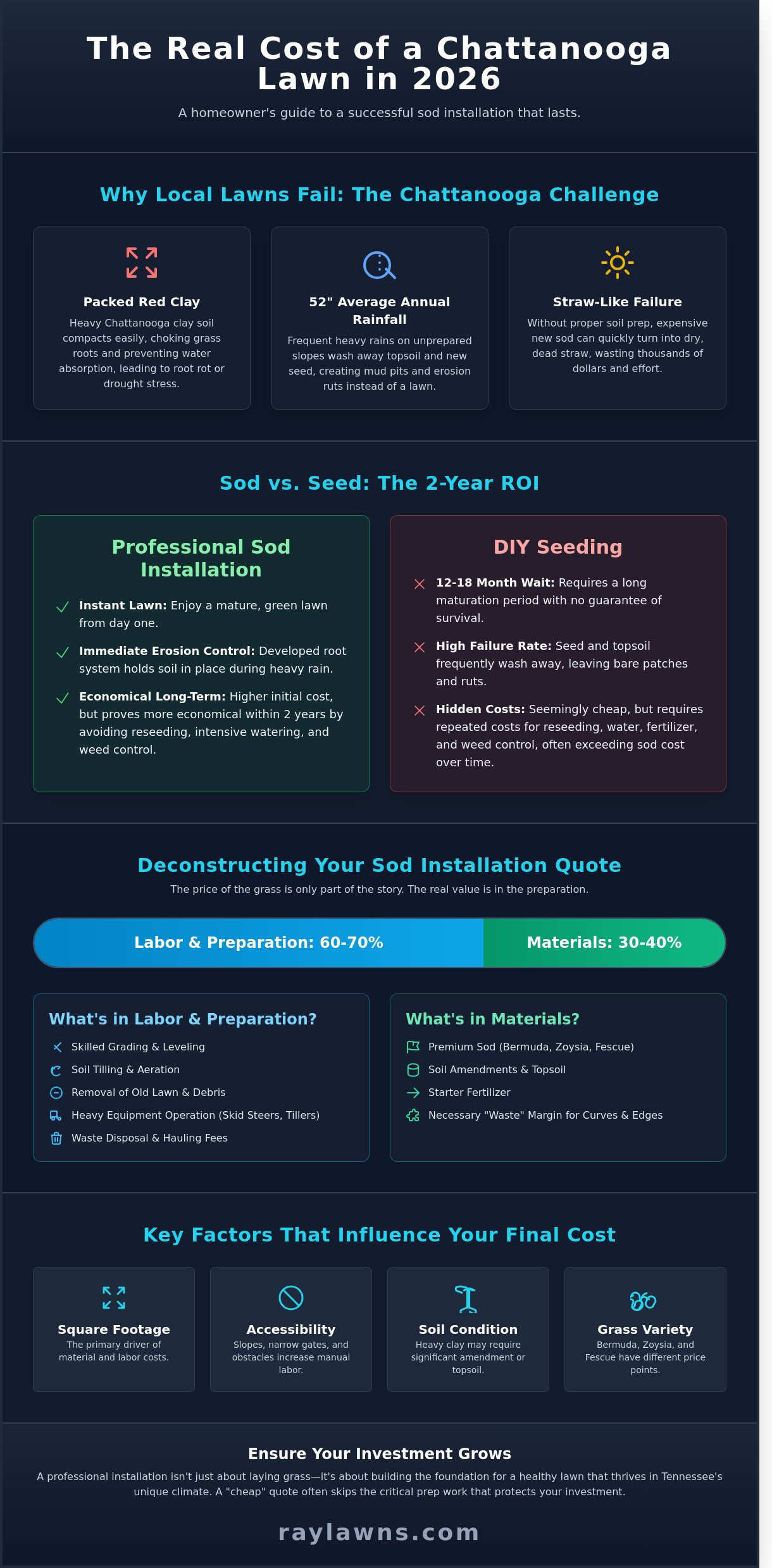
Installing a new lawn in the Tennessee Valley is more than just a cosmetic upgrade; it’s a long-term investment in your property’s foundation. Many homeowners consider DIY seeding to save money, but the high failure rate in our region often leads to wasted resources. Professional sod installation provides an “instant lawn” that bypasses the 12 to 18 months required for traditional seed to mature and survive. When calculating the sod installation cost Chattanooga homeowners should expect, several variables come into play. Total square footage is the primary driver, but the current state of your soil and the specific grass variety also dictate the final estimate. Local clay soil often requires significant grading or topsoil amendments before the first pallet ever arrives on site.
A professional installation ensures that the root system establishes itself quickly. This is vital in Tennessee, where we often transition from a wet spring directly into a punishing summer drought. A contractor with local experience understands that the work starts underground. We look at three main factors during an initial site visit:
- Soil Composition: Heavy clay requires aeration or tilling to prevent compaction.
- Accessibility: Slopes in areas like East Brainerd or Signal Mountain require more manual labor than flat lots.
- Grass Type: Bermuda, Zoysia, and Fescue each carry different price points and maintenance requirements.
Sod vs. Seed: The Real ROI for Tennessee Homeowners
Chattanooga receives an average of 52 inches of rainfall per year. This heavy precipitation creates a major hurdle for traditional seeding, especially on the rolling hills of Ooltewah or Apison. Heavy rains frequently wash away seed and topsoil before roots can take hold, leading to unsightly ruts and bare patches. If you are researching What is Sod?, it’s essentially pre-grown grass with a developed root system and soil layer. This structure provides immediate erosion control. It protects your property value and enhances your landscaping in Chattanooga from day one. While the initial price point of sod is higher than a bag of seed, it eliminates the need for repeated reseeding and intensive weed management over a 24-month period. When you factor in the cost of water, fertilizer, and labor to fix failed seed patches, sod often proves to be the more economical choice within two years.
Seasonal Timing and Market Demand in Hamilton County
Timing is everything in Hamilton County. Peak demand for installers hits in April and September when temperatures are mild. During these windows, local sod farms in the region face high volume, which can influence the sod installation cost Chattanooga contractors quote based on supply availability. Installing during the peak heat of July or the deep freezes of January increases the risk of plant shock and failure. Professionals schedule projects to ensure roots establish before the 90-degree summer humidity arrives. In growing communities like Collegedale, securing your place on the schedule early is vital to avoid seasonal price fluctuations. A well-timed installation ensures the grass is hardy enough to survive the winter dormancy period or the summer sun, protecting your initial investment from the start.
Breaking Down the Price: Material Costs vs. Labor
Understanding the sod installation cost Chattanooga homeowners face requires looking past the price per square foot of the grass itself. Most professional quotes are split into two distinct categories. Materials, including the turf, starter fertilizers, and soil amendments, typically account for 30% to 40% of the total bill. The remaining 60% to 70% covers the skilled labor, specialized equipment, and logistics required to make the project a success. It’s a common mistake to assume the grass is the most expensive part. In reality, the intensive work required to ensure that grass survives the transition is where the primary value lies.
Professional equipment is a major part of that labor cost. We use heavy-duty skid steers, sod cutters, and industrial tillers to transform a yard. These tools allow us to achieve a level finish that’s impossible to replicate with a hand rake and a shovel. Using the right machinery prevents the bumpy, uneven surfaces that often plague DIY projects. We also account for disposal fees. Removing a 2,500-square-foot lawn generates several tons of organic waste and old debris. This material must be hauled away and processed at a local facility, a cost that many homeowners overlook when planning their own budget.
Sod Variety Pricing: Fescue, Bermuda, and Zoysia
Tall Fescue is a popular choice for yards with partial shade. It stays green year-round and is generally the most cost-effective option per pallet. Bermuda grass is the durable, sun-loving standard for high-traffic yards in East Brainerd. It handles the heat well and recovers quickly from pet or foot traffic. Zoysia is the premium luxury grass. It has a higher upfront cost but offers a dense, carpet-like feel. It’s also more drought-tolerant and requires less frequent mowing, which can lower your long-term maintenance expenses.
Labor Intensity: Why “Just Laying It Down” Isn’t Enough
The physical toll of a sod project is significant. A single pallet of wet sod can weigh over 2,000 pounds. Our crews move dozens of these pallets across a residential lot, often navigating tight spaces and slopes. We don’t just drop the pieces in place. We meticulously cut and fit the turf around existing tree plantings, flower beds, and hardscapes to ensure a seamless look. This precision prevents air pockets and drying at the edges of the rolls.
Before the first piece of grass touches the ground, we follow university-backed soil preparation steps to give the roots the best chance at survival. This involves tilling the heavy Chattanooga clay and grading the surface for proper drainage. Once the sod is laid, we use a weighted roller to press the turf into the soil. This step is non-negotiable for establishing root contact and eliminating air pockets that can kill new grass within days.
Delivery logistics also play a role in the final estimate. Transporting heavy pallets requires flatbed trucks and specialized forklifts. For properties in Ooltewah or remote areas of Apison and Collegedale, fuel surcharges and travel time are factored into the quote. Every property has unique challenges, from steep hillsides to limited access points. If you want to see exactly how these variables affect your property, you can request a detailed site evaluation to get an accurate breakdown for your lawn.
Why Soil Preparation and Grading are Non-Negotiable
Laying sod on unprepared ground is the fastest way to lose your investment. In the Tennessee Valley, 85% of sod failures stem from poor site preparation rather than the grass quality itself. When homeowners calculate the sod installation cost Chattanooga contractors provide, they often focus on the price per pallet. However, the labor spent under the surface determines if that grass lives through its first summer. Chattanooga’s infamous red clay is the primary obstacle. This soil type is nutrient-deficient and compacts so tightly that it effectively suffocates new roots, preventing them from establishing deep into the earth.
Proper grading prevents “sod rot,” a condition where standing water sits beneath the rolls and drowns the root system. Without a 2% minimum slope away from the home, water pools in low spots. This moisture trapped against the clay creates a shelf that prevents drainage. Professional prep involves more than just raking away rocks; it requires a systematic approach to soil chemistry and physical structure. This Purdue Extension guide to establishing a lawn from sod highlights how critical these initial steps are for long-term health and cost-efficiency.
Taming the Red Clay: Tilling and Amending
You can’t just put good dirt over hard clay and expect results. We till the existing subgrade to a depth of 4 inches to break up compaction before adding any amendments. In areas like Ooltewah where the clay is particularly dense, we introduce a layer of premium screened topsoil. Most Chattanooga soils register an acidic pH between 4.5 and 5.5. Since most turfgrass thrives at 6.5, we apply pelletized lime to neutralize the acidity. Adding a starter fertilizer high in phosphorus at this stage ensures the sod installation cost Chattanooga residents pay results in a lawn that greens up within 14 days.
Addressing Drainage and Slopes Before the Grass Goes Down
Chattanooga’s topography isn’t flat. Properties in East Brainerd or Apison often feature steep grades that complicate the installation process. If the slope exceeds a 3:1 ratio, we use biodegradable sod staples every 12 inches to prevent the rolls from sliding during heavy Tennessee thunderstorms. When the land naturally directs water toward the foundation, we integrate French drains to intercept runoff. This ensures that the 52 inches of annual rainfall our region receives doesn’t wash away your new lawn or cause erosion gullies. Taking these steps during the grading phase is much cheaper than trying to fix a drainage disaster after the grass is already down.
Calculating the Total Cost: Square Footage and Accessibility
Measuring your lot accurately is the first step toward a realistic budget. Most homeowners calculate the flat area but forget that sod isn’t a liquid; it comes in rectangular pieces. To account for curves along flower beds or the angles of a driveway, we add a waste factor of 5% to 10%. This ensures every edge is clean without leaving gaps. If you’re calculating your sod installation cost Chattanooga, remember that ordering exactly to the square foot often leads to delays when you run short on the final corner. We’ve seen projects stall because a homeowner was three rolls short, which results in a second delivery fee that can exceed $200.
The total price isn’t just about the grass. Accessibility plays a massive role in labor costs. We prefer using heavy equipment like skid steers to move pallets quickly. If your backyard is only accessible through a 36-inch pedestrian gate, our crew must move every piece of sod by hand or wheelbarrow. This transition from machine to manual labor can increase the man-hours on a project by 30% or more. Steep driveways common in areas like Signal Mountain or Elder Mountain also present challenges, as heavy delivery trucks often can’t safely navigate the incline, requiring us to stage materials at the street and shuttle them up.
Small yards often carry a higher cost per square foot due to the “Minimum Project” fee. Every job requires a baseline of expenses: mobilization of equipment, fuel, and the flat delivery rate charged by the turf farm. Whether we install 500 square feet or 2,000 square feet, those fixed costs remain the same. For this reason, many professional contractors in Ooltewah and Apison set a minimum job size or a base fee to ensure the project is viable for a full crew.
Don’t overlook the cost of the initial 14-day watering commitment. New sod requires roughly 1 inch of water per day, usually split into two 20-minute sessions. This is a non-negotiable step for the homeowner. In a typical July in Chattanooga, this can add $40 to $80 to your local utility bill, depending on the size of the lawn. It’s a small price to pay to protect a multi-thousand dollar investment during the critical rooting phase.
Accessibility and Lot Complexity
Backyard projects with limited access, such as those behind privacy fences or narrow alleys in East Brainerd, significantly drive up labor hours. We also have to account for existing obstacles. If your yard has 12 irrigation heads or shallow utility lines, our excavation team must work slowly with hand tools rather than power equipment. Creating that “curb appeal” finish also takes time; meticulous edging against sidewalks and driveways requires precision cuts that manual labor provides.
Hidden Costs: From Old Grass Removal to Site Clearing
There is a major cost difference between laying sod on a new construction site versus a full lawn renovation. A renovation requires the removal of old, established Bermuda or invasive weeds. This involves either a chemical kill-off phase, which takes 7 to 10 days, or mechanical sod cutting. Our regional soil is often packed with chert and large roots. Clearing these obstructions is vital for a level finish. Skipping this step leads to a lumpy lawn that is difficult to mow and maintain. Understanding these variables helps you better estimate the sod installation cost Chattanooga for your specific property.
The Professional Difference: Ensuring Your Investment Grows
Choosing a contractor based solely on the lowest bid often leads to long-term frustration. A “cheap” quote usually omits the 70% of labor required before a single piece of grass touches the ground. In Hamilton County, our dense red clay doesn’t forgive shortcuts. Professional site preparation involves stripping old vegetation, tilling the soil to a depth of 4 inches, and correcting grade issues that cause standing water. Without these steps, your new lawn will likely struggle with root rot or dehydration within the first 180 days.
Local expertise matters because the micro-climates in our region vary significantly. A yard in the low-lying areas of Ringgold faces different humidity and drainage challenges than a sloped lot in Ooltewah or the wind-exposed ridges of Apison. We understand how the 51 inches of average annual rainfall in Chattanooga affects different grass varieties. By hiring a local specialist, you ensure the soil chemistry is adjusted specifically for these conditions before the installation begins. This precision is what separates a temporary green patch from a permanent landscape feature.
High-quality sod installations in Chattanooga provide more than just a place for the kids to play. Real estate data shows that a professionally installed, lush lawn can increase home equity by 10% to 12% immediately. It’s a functional upgrade that prevents erosion and keeps your home cooler during our 90-degree July afternoons. When calculating the total sod installation cost Chattanooga homeowners should view the project as a capital improvement rather than a simple maintenance task.
Questions to Ask Your Sod Contractor Before Hiring
Don’t sign a contract without clarifying the scope of work. Ask if the quote includes finish grading and soil amendments like lime or organic compost. Verify the source of the grass; we prefer local farms like Sims to ensure the sod hasn’t spent 48 hours on a hot truck. Finally, ask how they handle drainage. If a contractor doesn’t mention pitch or runoff during the walkthrough, they might be leaving you with a swampy mess after the first heavy rain.
Long-Term Maintenance to Protect Your New Lawn
The first 30 days are the most critical period for your investment. You’ll need to provide roughly 1 inch of water daily for the first two weeks to keep the root zone saturated. Once the roots knit into the soil, you can transition to a regular lawn care schedule that focuses on deep, infrequent watering. This encourages the roots to push deeper into the clay, making the grass more drought-tolerant during August dry spells.
Mowing habits must change based on your specific variety. Keep Tall Fescue at 3.5 inches to shade the soil, while Bermuda thrives when kept shorter, around 1.5 to 2 inches. Wait at least 6 weeks before applying your first round of nitrogen-rich fertilizer. Applying chemicals too early can burn tender new roots. Stick to a disciplined schedule of pre-emergent weed control in the fall and spring to prevent invasive species from “checking in” to your clean, new turf.
Secure Your Landscape Investment
A successful lawn starts long before the first piece of turf touches the ground. To get the most out of your sod installation cost Chattanooga homeowners must prioritize meticulous soil preparation and precise grading. Chattanooga’s dense red clay doesn’t drain easily; skipping these steps often results in root rot or patchy growth within the first 12 months. Since 2002, our family-owned team has focused on these exact technical details to ensure your yard thrives. We’ve spent 22 years mastering the drainage patterns and soil conditions unique to Ooltewah, Apison, and the greater Tennessee Valley. Professional sod installation in Chattanooga isn’t just about speed. It’s about protecting your investment with the right equipment and local expertise. Don’t leave your curb appeal to chance when you can have a lawn that stays green and healthy for years. For properties dealing with persistent water pooling or uneven terrain, proper yard grading Ooltewah TN is essential before any sod installation begins.
Request a Professional Sod Evaluation & Quote from Ray Lawns
We’re ready to help you build a lawn you can be proud of.
Frequently Asked Questions
How much does sod installation cost per square foot in Chattanooga?
Your sod installation cost Chattanooga typically ranges from $1.15 to $2.10 per square foot for most residential properties. This price includes the sod itself, delivery, site preparation, and professional laying. If your yard requires extensive grading or 4 inches of new topsoil to cover heavy clay, the price may lean toward the higher end of that scale.
Is it cheaper to seed or sod a lawn in Tennessee?
Seeding is cheaper initially, costing about 75% less than sod upfront, but sod is more cost-effective over a 12 month period. Establishing a seeded lawn in Tennessee requires 4 months of intensive watering and multiple herbicide treatments to fight local weeds. Sod provides an instant 100% ground cover that prevents erosion and blocks weed growth immediately.
What is the best time of year to install sod in Ooltewah?
The best time to install sod in Ooltewah is during the spring months of March and April or the fall months of September and October. These windows offer temperatures between 60 and 75 degrees, which allow roots to establish without the stress of 90 degree summer heat. For warm season grasses like Bermuda, installation is most successful between May and July when the grass is actively growing.
Do I need to install a French drain before laying new sod?
You need a French drain if water stands for more than 24 hours after a heavy Chattanooga rainstorm. Laying sod over saturated, swampy soil will cause the roots to rot within 10 days. We recommend installing drainage 2 weeks before the sod arrives to ensure the subgrade is stable and dry enough for proper grading.
How long does it take for new sod to take root in clay soil?
New sod takes 10 to 14 days to develop shallow roots in our local clay soil. You can check this by gently tugging on a corner of a sod piece; if it resists, the roots have started to knit. It takes 6 weeks for the root system to penetrate deep enough to withstand regular foot traffic or mower blades.
Will new sod survive the Chattanooga summer if installed in late spring?
New sod will survive a Chattanooga summer if you provide 1 inch of water daily during the first 21 days. High humidity in June and July increases the risk of fungus, so you must water early in the morning, specifically between 4:00 AM and 8:00 AM. If temperatures exceed 95 degrees, you might need a 5 minute afternoon misting to cool the leaf blades.
Should I remove my old grass before installing new sod?
You must remove 100% of your old grass and weeds before laying new sod. Leaving old vegetation creates an air pocket that prevents the new roots from touching the soil, which kills the sod within 7 days. We use a sod cutter to remove the top 2 inches of old growth, ensuring the new rolls have direct contact with nutrient rich dirt.
How much watering is required for new sod in the first two weeks?
You must water new sod 2 times per day for the first 14 days. Each session should last 20 to 30 minutes to ensure the water soaks through the sod and 3 inches into the soil beneath. In the Hamilton County area, this schedule prevents the edges of the sod rolls from shrinking and turning brown during the establishment phase.
get a quote today!
"*" indicates required fields

We take lawn care so seriously that we consider it an art. Our basic service is lawn maintenance, which includes lawn mowing, trimming, edging, and blowing off clippings.

Our landscaping services include most types of yard work. We are excellent at trimming hedges, installing mulch, and creating flowerbeds.

This is our rescue effort for yards that have become entirely overgrown. Includes multiple passes with the lawn mower to tame even the most unruly yards.