
That $150 bag of premium fescue seed might actually be the most expensive mistake you make for your Ooltewah landscape this year. We’ve seen it happen dozens of times across Hamilton County where a weekend of hard work disappears during a single two-inch rainfall. It’s frustrating to watch your investment wash down the storm drain while red clay mud continues to track into your living room. You want a yard that’s ready for kids and pets to enjoy by next month, not next year.
When weighing the pros and cons of sod vs seed Tennessee homeowners often focus on the initial price tag rather than the long-term success rate in our local climate. We understand the struggle of battling stubborn weeds and persistent erosion in our heavy red clay. This guide reveals the professional truth about establishing a lawn in the Tennessee Valley. You’ll learn which method actually withstands our 52 inches of annual rain and exactly what it takes to build a yard that stays green and stable for years to come.
Key Takeaways
- Learn how the heavy red clay of the Chattanooga Valley dictates your lawn strategy and why proper soil preparation is non-negotiable for long-term success.
- Compare the long-term value and immediate impact of sod vs seed Tennessee to choose the best installation method for your property’s specific slope and soil.
- Discover why grass varieties like Tall Fescue and Bermuda perform differently in Ooltewah and which one best suits your maintenance goals.
- Understand the “hidden” costs of seeding, including intensive labor and water requirements, versus the instant erosion control provided by professional sod.
- Find out why professional site grading is the most critical step in ensuring your new lawn survives Hamilton County’s heavy seasonal storms.
The Tennessee Valley Turf Challenge: Soil, Slopes, and Storms
Establishing a lush lawn in the Chattanooga Valley is a different game than in other parts of the country. Homeowners often weigh the pros and cons of sod vs seed Tennessee style, but the local environment usually makes the choice for you. In our region, a successful lawn depends on how well you handle the transition from bare dirt to established turf. Seed requires 21 to 30 days of consistent moisture and stable temperatures to even begin showing results. In East Tennessee, we rarely see a 14-day window without a weather extreme. Whether it is a sudden 90-degree spike in Ooltewah or a torrential downpour in Apison, new grass faces immediate threats.
Sod offers an instant solution that bypasses the most vulnerable stages of grass growth. While seed is a gamble on the weather, sod is a finished product. It provides a dense, mature root system from day one. This difference is critical because our local climate does not offer much room for error. We see an average of 52.48 inches of rainfall annually in Chattanooga. Most of that volume arrives in heavy, concentrated bursts. For a seeded lawn, these storms are a disaster. For a sodded lawn, they are just a watering session. Choosing the right method requires looking closely at your specific lot and the challenges of the Tennessee landscape.
Understanding Our Regional Clay Soil
Hamilton County is famous for its heavy red clay, often classified as Ultisols. This soil type is dense, acidic, and lacks natural pore space. Local soil tests frequently show pH levels between 5.1 and 5.8, which is too acidic for most premium grass varieties. When this clay dries out, it creates a hard crust that new seeds cannot penetrate. If the roots cannot get deep, the grass dies during the first dry spell. Professionals spend hours tilling and amending this clay before any work begins. understanding sod is vital here because it acts as a protective barrier for the soil. It keeps the underlying clay cool and moist, preventing the ground from baking into a brick-like consistency. Sod comes with its own layer of nutrient-rich soil that bridges the gap between the grass blades and our tough local clay.
The Erosion Factor in East Tennessee
Topography is the biggest hurdle for property owners in East Brainerd and Collegedale. Many residential lots feature slopes with 15% to 25% grades. On these inclines, traditional seeding is almost impossible to manage. A single afternoon thunderstorm can wash away $600 worth of seed and straw in less than 20 minutes. This leads to a frustrating cycle of re-seeding and patching that eventually costs more than a professional sod installation. Sod provides immediate structural integrity to these “Chattanooga slopes.” It functions like a living carpet that locks the soil in place. When we install sod on a hillside, it stops erosion the moment the last piece is laid. It turns a potential mudslide into a stable, green space. For homeowners with any degree of incline, the sod vs seed Tennessee debate ends with the first heavy rain. Sod is an engineering tool as much as it is a cosmetic choice.
Growing Grass from Seed in Tennessee: The Reality of Patience
Starting a lawn from scratch involves more than throwing out a few bags of contractor mix. Many homeowners choose seeding because the upfront material cost is often 70% lower than purchasing sod. However, the labor and water requirements quickly bridge that financial gap. In the Tennessee Valley, you’ll spend 20 to 30 minutes every morning and evening for three weeks just managing the irrigation. If you miss a single day during a 90-degree stretch, you can lose 40% of your new sprouts to desiccation. The sod vs seed Tennessee debate often comes down to whether you want to pay with your wallet now or with your weekends for the next two years.
In Ooltewah and Collegedale, we primarily see two choices for local lawns. Tall Fescue offers a deep green look through the winter, but it struggles when Chattanooga temperatures hit 95 degrees in July. Bermuda is a tank in the heat but stays dormant and brown for five months of the year. Seeding Fescue requires a meticulous approach to soil preparation that most DIYers skip. Without core aeration to break up our heavy red clay, the seeds simply sit on the surface and wash away during the first heavy thunderstorm.
The Critical Planting Windows
In Chattanooga, fall is the only reliable window for Fescue seeding. You should target the period between September 15 and October 20. This allows the roots 6 months to establish before the punishing summer heat arrives. If you are planning for the 2026 season, identify a weather window where nighttime temperatures consistently stay below 65 degrees. Spring seeding has a 75% failure rate in East Brainerd because young roots aren’t deep enough to survive the humidity and soil fungus that arrive by mid-June.
Weed Competition and Germination
Bare Tennessee red clay is a magnet for crabgrass and nutsedge. Without the instant barrier provided by sod, these aggressive weeds will compete for every drop of water you provide. You must use straw or peat moss to cover the seed, which adds another 4 to 6 hours of labor per 1,000 square feet. Even with perfect conditions, a seeded lawn takes 12 to 18 months to reach the density of a 1-day sod installation. To understand the full scope of this process, consult a complete guide to lawn establishment for technical soil requirements.
Long-term maintenance for a seeded lawn includes aggressive aeration and overseeding every single fall for the first 3 years to fill in bare spots. It’s a marathon, not a sprint. If you’d rather skip the 18-month wait and avoid the constant battle with local weeds, you can request a professional evaluation to see if a sod installation is a better fit for your property’s specific drainage and sun exposure.
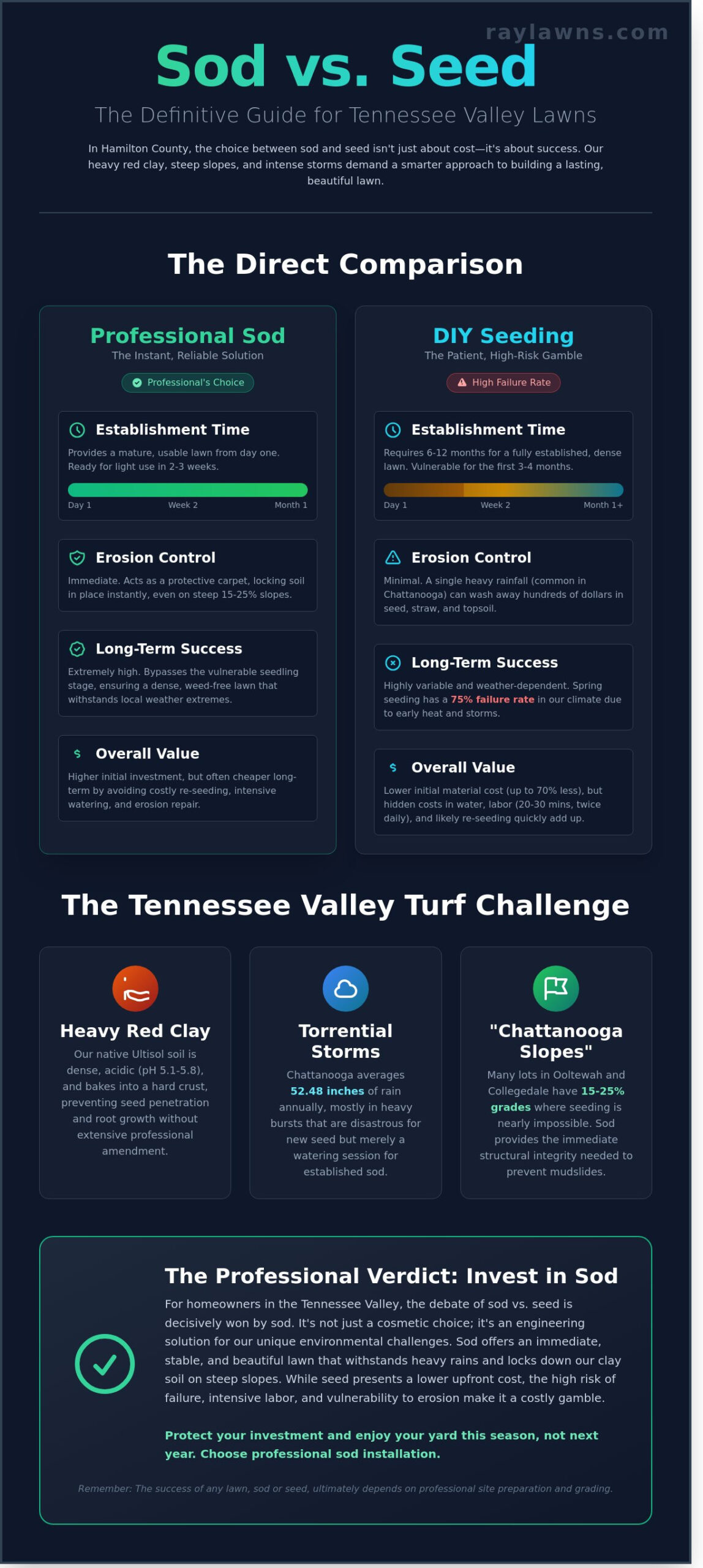
Professional Sod Installation: Immediate Results for Chattanooga Homes
Homeowners in East Brainerd or Apison often face a frustrating problem. After a construction project or a major renovation, the yard is a mess of red dirt and tire ruts. Sod is the professional solution for instant gratification. It transforms a dusty lot into a lush, green space in roughly 24 hours. When weighing sod vs seed Tennessee residents usually choose sod for this immediate impact. It isn’t just about looks. It’s about stabilizing the site and protecting your investment from the elements.
Tennessee red clay is notoriously difficult for DIY projects. It’s dense, acidic, and prone to heavy compaction. Seed often washes away during a typical 2-inch Chattanooga rainstorm before it ever germinates. Sod solves this. It acts as a heavy, living blanket that stays in place. The mechanics are simple. The pre-grown root system begins searching for moisture in the clay immediately. Within 10 to 14 days, those roots “knit” into the native soil, creating a bond that prevents erosion even on the steep slopes found in our region.
This immediate density is a core component of high-quality landscaping Chattanooga projects. While a seeded lawn looks like a collection of thin green whiskers for the first 60 days, sod provides a thick, uniform carpet. There’s no room for crabgrass or broadleaf weeds to find a foothold. You get a finished product that looks like it has been there for years, not hours. This professional finish adds immediate curb appeal that seed simply can’t match in the first year of growth.
The Benefits of a Mature Root System
Pre-grown turf is significantly more resilient than a fragile seedling. It has already developed the strength to withstand local environmental stressors at the sod farm. This mature root system makes the lawn 40% more likely to survive a sudden July heat wave or a localized pest outbreak. The density of the sod also serves a practical purpose for families. In Ooltewah neighborhoods with active kids and pets, sod reduces mud tracking by 85% compared to a patchy, seeded yard. It creates a clean, durable surface that keeps the inside of your home as tidy as the outside.
Usability Timeline
The most significant difference when considering sod vs seed Tennessee is how quickly you can actually use your property. A seeded lawn requires a 120-day “keep off” period to ensure the grass survives its infancy. If you walk on it too soon, you’ll leave permanent dead spots. Sod drastically shortens this wait. We recommend staying off the new turf for the first 14 days while the roots begin to take hold. By day 21, the lawn is usually rooted, meaning you can’t pull the corners up with a firm tug. An established lawn, ready for pets and heavy foot traffic, is typically achieved in 45 days. This 3-week sod window is a small fraction of the 4-month seed cycle.
The Decision Framework: Evaluating Your Property’s Needs
Choosing between sod vs seed Tennessee involves more than just looking at a price tag. In Hamilton County, our heavy clay soil and unpredictable spring rains often dictate the winner. Seed is an attractive option for large, flat acreage where you have time to wait. However, sod provides an immediate 100% barrier against the crabgrass and nutsedge that thrive in our local climate. If you’re looking at a 5,000 square foot yard, seed might cost $500 in materials, while sod could be $5,000. You have to weigh that $4,500 difference against the 18 months of intensive labor required to get seed to a finished state. Most homeowners find that the “cheaper” seed option requires three rounds of overseeding and $400 in specialized fertilizers before it looks comparable to a one-day sod job.
- Sod: Provides instant results and 100% weed suppression. It requires a high initial investment but needs only 14 days of heavy watering to establish.
- Seed: Takes 12 to 24 months to reach full maturity. It offers a low initial cost but carries a high risk of weed infestation and requires 12 months of intensive monitoring.
- Soil Prep: Both options require professional grading. However, seed is much more sensitive to the 5.5 to 6.5 pH levels common in our local red clay.
Deciding on sod vs seed Tennessee for your specific neighborhood also depends on the local terrain. In established areas like East Brainerd, property lines are often tight and curb appeal is a priority. Sod is the standard here because it prevents mud from tracking into the house or onto the sidewalk. In more rural parts of Ringgold or Apison, homeowners with two-acre lots often choose a hybrid approach. They might use sod near the house for immediate use and seed the back pastures to save on costs. If your lot has heavy canopy cover, professional tree planting and maintenance can change your grass needs. Removing a dying oak or thinning a limb line can be the difference between a lush lawn and a dirt patch that never takes seed. We see many homeowners spend $1,000 on seed over three years before realizing that shade management was the actual priority.
The Slope and Drainage Test
If your yard has a grade steeper than 15%, seed is a gamble you’ll likely lose. A single afternoon thunderstorm in Chattanooga can wash away $300 worth of seed in twenty minutes. This is where sod installation becomes a functional necessity. The root mat acts as a biological erosion blanket that stays put during a downpour. We often integrate French drains before laying turf to ensure the subsoil doesn’t rot your new grass from the bottom up.
Maintenance Capability Assessment
Tennessee humidity often sits above 80% during July, creating a breeding ground for fungus. New seed requires a strict watering schedule, often three times daily for the first 21 days to ensure germination. If you don’t have an automated irrigation system, sod is the safer bet. Your choice should reflect your actual lawn care commitment level. Sod is significantly more resilient to the occasional missed watering during our hot, humid summers.
Ready to see which option fits your landscape? Get a professional evaluation of your property today.
Beyond the Grass: Why Site Prep and Grading Dictate Success
A lush lawn starts long before the first roll of sod or handful of seed touches the dirt. In the Tennessee Valley, the soil is the foundation. Many homeowners focus on the sod vs seed Tennessee debate while ignoring the 2 to 4 inches of earth below the surface. If the site prep is wrong, even the most expensive turf will fail within 12 months. We’ve seen $5,000 sod jobs die off because the ground was too hard for roots to penetrate. You can’t just throw grass on top of hard-packed clay and expect it to survive a Chattanooga summer.
Professional grading is mandatory for properties in East Brainerd and Ooltewah. We start by removing 100% of existing weeds and debris. We use commercial-grade equipment to till the dense red clay. This clay often has a compaction rate exceeding 90% in local developments. Breaking it up allows oxygen and water to reach the root zone. Our team focuses on the structural integrity of the yard. We don’t just clear the land; we prepare it for a lifetime of growth. It’s a labor-intensive process, but it’s the only way to guarantee the grass takes hold.
The Grading Process
Grading isn’t just about making the yard look flat. It’s about moving water away from your foundation. We set a 2% minimum slope for every property we service. This prevents standing water. In Chattanooga, 50 inches of annual rainfall can quickly turn a low spot into a breeding ground for fungal growth like brown patch. A smooth sub-grade also ensures a level mowing experience. It prevents your mower from scalping the high spots and leaving the lawn looking patchy. We use laser levels to ensure every square foot drains exactly where it should. For homeowners dealing with persistent drainage issues, professional yard grading Ooltewah TN services address the root cause of standing water and foundation concerns.
Soil Conditioning and Amendments
Tennessee red clay lacks the organic matter needed for rapid root growth. We typically spread 1 to 2 inches of screened topsoil or a 70/30 compost blend over the tilled base. This lowers the soil density. When deciding between sod vs seed Tennessee options, remember that both require this nutrient-rich layer to thrive. We use a 200-pound water-filled roller after installation. This eliminates air pockets. Air is the enemy of new roots. Without tight soil-to-root contact, the grass dries out in 48 hours. We finish with a deep saturation of the first 6 inches of soil. This kicks off the 21-day establishment phase where consistent moisture is critical for long-term success.
A professional approach saves you money in the long run. It prevents the need for costly reseeding or sod replacement later. If you want a lawn that stays green through the August heat, you have to get the dirt right first. Every yard in Apison and Collegedale has different drainage needs. Don’t skip the prep work. Contact a local expert to evaluate your property’s specific needs before you begin your next project.
Secure Your Ooltewah Landscape Investment
Deciding on sod vs seed Tennessee depends on how quickly you need to combat our regional elements. Chattanooga averages over 50 inches of rainfall per year. This heavy precipitation often triggers erosion on Ooltewah’s sloped lots before grass seed can establish a root system in the local clay. Since 2002, our family-owned crew has specialized in drainage solutions and precision grading to ensure new lawns thrive immediately. Sod provides an instant barrier against runoff that seed simply can’t match during the first critical weeks of growth.
We’ve spent 22 years refining our process to handle the specific soil conditions of the Tennessee Valley. Our team prioritizes the technical site prep that prevents future sinkholes and drainage failures. You don’t have to wait years for a full, green yard when professional sod installation Chattanooga offers a finished look in a single afternoon. Let’s get your project started with the right foundation for long-term health and curb appeal.
Get a Professional Sod Evaluation for Your Ooltewah Property
Your beautiful new lawn is just a professional evaluation away.
Frequently Asked Questions
Is it better to sod or seed in Chattanooga during the spring?
Sod is the superior choice for spring projects in Chattanooga. Spring rain in the Tennessee Valley averages 4.9 inches in March alone, which often washes away loose seed. Sod provides an instant root mat that prevents erosion on sloped lots. It also blocks 95 percent of weed seeds from germinating in your new lawn during the peak growing season.
How much does sod installation cost compared to seeding in Ooltewah?
Sod installation costs roughly 10 to 15 times more than seeding in Ooltewah. Professional sod installation typically ranges from $1.50 to $2.50 per square foot. Seeding costs between $0.15 and $0.25 per square foot. While seed saves money today, sod prevents the need for 3 rounds of weed control and 2 years of waiting for a full lawn. It’s a faster path to curb appeal.
Can I lay sod over my existing Tennessee weeds and grass?
You cannot lay sod directly over existing Tennessee weeds and grass. The new roots must have direct contact with prepared soil to survive. Leaving old vegetation creates an air pocket that dries out the new sod within 48 hours. You must remove the existing 2 inches of turf and till the soil to a depth of 4 inches for a successful installation.
What is the best type of grass for a shady yard in East Brainerd?
Tall Fescue is the most successful grass for shady yards in East Brainerd. It requires 4 to 5 hours of sunlight to maintain its density. Most warm-season grasses like Bermuda or Zoysia need at least 6 to 8 hours of direct sun. If your yard gets less than 4 hours of light, we recommend using shade-tolerant groundcovers instead of traditional turf or sod.
How often do I need to water new sod in the Tennessee summer?
You need to water new sod twice daily for the first 14 days during a Tennessee summer. Set your sprinklers for 20 minutes at 6:00 AM and again at 4:00 PM to keep the soil moist. This schedule prevents the 90-degree heat from shrinking the sod rolls. After 2 weeks, you can transition to 1 inch of water once per week to encourage deep rooting.
Why did my grass seed wash away after the last thunderstorm?
Your seed washed away because Chattanooga’s heavy clay soil has a low infiltration rate. When a thunderstorm drops 1.5 inches of rain in an hour, the water moves across the surface instead of soaking in. This surface flow carries 80 percent of your seed into the street or storm drains. This is a primary reason homeowners compare sod vs seed Tennessee for hilly properties.
When is the best time to plant Fescue in the Tennessee Valley?
The best time to plant Fescue in the Tennessee Valley is between September 15 and October 15. Soil temperatures during this 30-day window typically range from 55 to 65 degrees, which is the sweet spot for germination. Fall planting gives the grass 6 months to build a deep root system before the July heat arrives. Spring seeding often fails when temperatures hit 85 degrees.
How long does it take for sod to root in clay soil?
It takes 14 to 21 days for sod to establish initial roots in our local clay soil. You can test this by gently pulling on a corner of the turf; if it resists, the roots have taken hold. Full establishment and heat resistance require 6 to 9 months of consistent growth. We recommend avoiding heavy foot traffic and pets for the first 30 days of growth.
get a quote today!
"*" indicates required fields

We take lawn care so seriously that we consider it an art. Our basic service is lawn maintenance, which includes lawn mowing, trimming, edging, and blowing off clippings.

Our landscaping services include most types of yard work. We are excellent at trimming hedges, installing mulch, and creating flowerbeds.

This is our rescue effort for yards that have become entirely overgrown. Includes multiple passes with the lawn mower to tame even the most unruly yards.